SKU: 76825214814
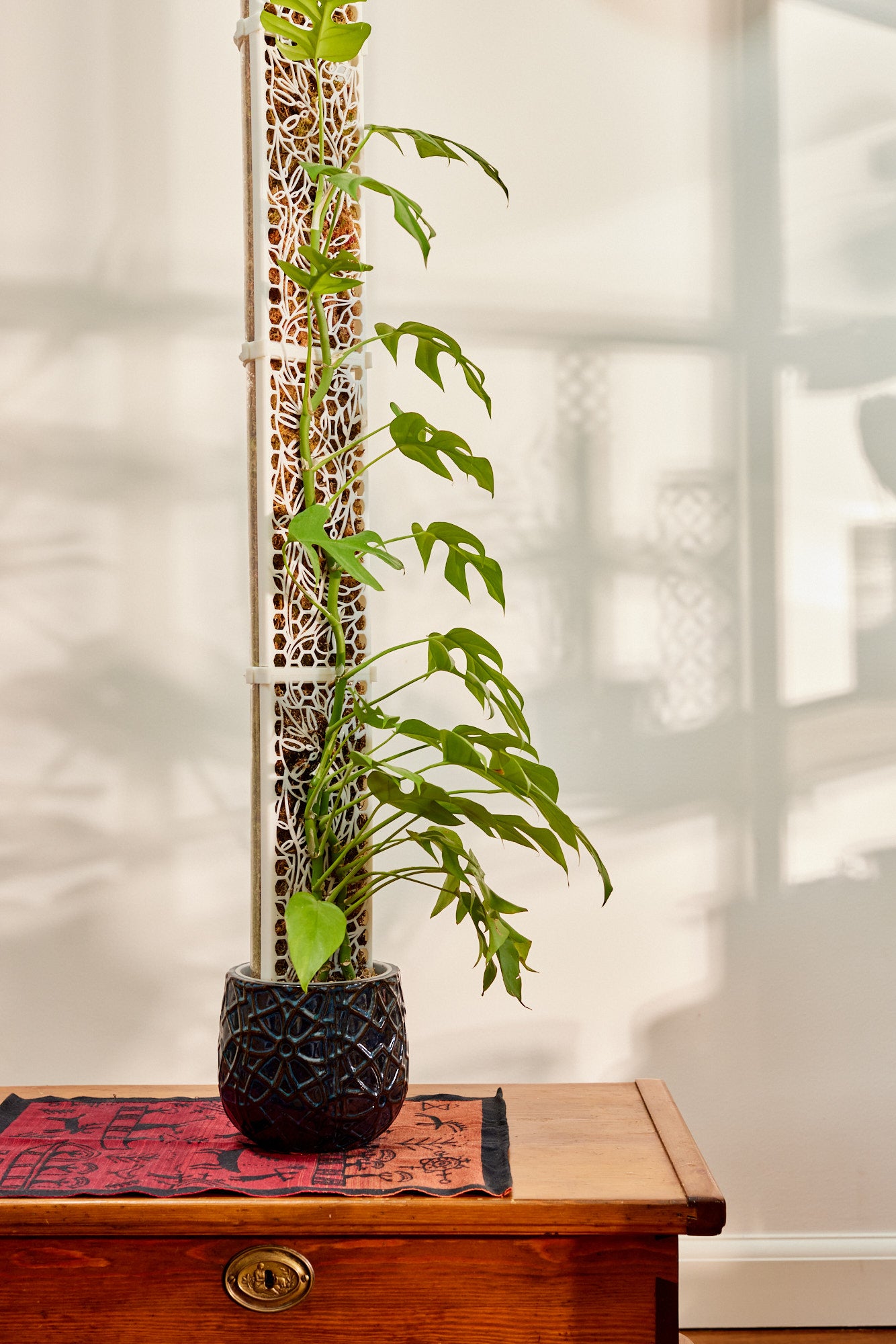
moss pole for a monstera plant

moss pole for a monstera plant Moss Pole: Monstera Pattern: D-Shaped Open Moss Trellis

Sale price$18.66 Regular price$20.73
Save 10%

Pay in installments of $5.18 with ShopPay, AfterPay and Klarna

Shipping Estimate
USA
  • USA
  • CAN

Ships within 48 hours · Estimated delivery Oct 14 - Oct 19

Promo Codes Available:

For Your Every Summer RSVP, with Code: SUMMER15

Description

moss pole for a monstera plant Moss Pole: Monstera Pattern: D-Shaped Open Moss TrellisWe think your plants can do better than three lengths of chicken wire held together by zip ties, so here's a moss pole that isnt ugly. Ready to graduate and get serious about moss poles? This moss pole is a pretty picture on a gorgeous frame. We designed the Barbara because we were sick and tired of putting beautiful plants on ugly, scraggly moss poles. Stand out with a moss pole that puts your plants in the top spot. Unique artist designed open

We think your plants can do better than three lengths of chicken wire held together by zip ties, so here's a moss pole that isn’t ugly.

Ready to graduate and get serious about moss poles? This moss pole is a pretty picture on a gorgeous frame. We designed the Barbara because we were sick and tired of putting beautiful plants on ugly, scraggly moss poles. Stand out with a moss pole that puts your plants in the top spot.

  • Unique artist-designed open trellis
  • Snap together for easy assembly (made by an engineer so you don't have to be one)
  • Works for heavy-duty plants

Why put a gorgeous plant on a coco coir pole that looks like it’s been on the garden centre floor since 1985? We love the Barbara moss pole in refined and elegant tones, but she's also pretty in pink and other fun colours.

Top moss pole features

  • Longer moisture retention: less watering, less maintenance*
  • Biggest moss volume for chunky roots
  • Extendable, self-watering moss pole**
  • Exclusive design you can’t get anywhere else

Top moss pole benefits

  • One-of-a-kind hefty moss pole
  • Buildable and extendable
  • Get to those 2m+ heights with easy stackable system

*when compared with our XL or XXL line watering frequency data. 

**self-watering, when bought with our drip cap.

Product specification

Artist-designed open face trellis, with clear semi-circular back (half-moon).

A spin-off of our popular D-Shaped Moss Pole (the front is interchangeable), the open face measures 12.5 (5") cm wide and each section is 30 cm (12") tall. This pole can be extended as your plant grows, simply add another 30 cm section every time you run out of space!

Material

The front and joints are made of PLA, and the backing is PETG. PLA is a 100% bio-sourced plastic: it’s made of renewable resources such as corn or sugar cane. PLA is also biodegradable and it can be composted. PETG is a 100% reusable material.

Sizing

The smallest kit is a single module that measures 12.5 cm wide (5") and 30 cm in height (12"), and the larger kits measure 60 cm (24", 2 modules), 90 cm (36", 3 modules), and 120 cm (48", 4 modules), all of which are sent with a base. Each section you wish to add can be assembled onto an already built moss pole, simply attaching the new parts and filling with more moss.

Assembly

You can find an assembly guide with pictures and a video, valid for all our D- shaped poles, at the following: D-Pole Instructions.

This pole includes a stake that is designed to be either fastened to the plant pot with zip ties for maximum stability, or simply pushed into the soil of an established plant and pot. Keep growing your pole with your plant by purchasing extension kits.

Additional modules can be attached without the use of any tools, with snap fit joints. In the same fashion, the poles may be disassembled for cleaning and reuse if your plant doesn't take to its home. The transparent curved back will allow you to supervise root growth, while retaining moisture for longer.

As hydrated moss can be very heavy, our recommendation is that you use an additional brace if your plant is very heavy, or if you extend your moss pole past 120 cm (4 units). Ideally you are able to prop the pole against a wall, or even use one of our D-Pole Brackets to keep it from accidentally tipping over.

Add-ons & extensions

Keep growing your pole with your plant by purchasing extension kits.

Get the incredibly practical Slow-Drip watering cap that drops into the top of your D-pole to make keeping the moss moist a breeze! You can find it here:

SlowDrip Watering Cap

Complementary products/also consider

This moss pole is designed for medium to heavy plants. Browse our other moss pole sizes to find one that suits your plant:

L-Line moss pole: perfect for thin-stemmed climbers and nursery plants.

XL-Line moss pole: the workhorse of moss poles, suitable for most plants.

XXL-Line moss pole: large diameter pole, best for when you really need support and moss volume.

D-Shaped Line moss pole: striking a balance between aesthetics and moisture retention, this is currently our top product.

Small print

Everything we make is printed to order and lovingly squeezed out by our 3D printers at our little workshop, so there may be slight variations and minor visual defects to your products. This is just a standard feature of the production method.

Shipping Notes
  • Free Standard Shipping on $100+ Orders to the USA.
  • Except Preorder products are shipped in 48 hours.
  • Delivery to the USA:
  1. Standard Shipping : 3-10 business days
  • If time is of the essence, please consider selecting expedited delivery for faster service.
Exchange/Return Notes
  • We offer a 30-day return/exchange service after receiving.
  • Final sale items are not eligible for returns or exchanges.
  • To process your return/exchange, please contact us at [email protected]
  • Please click here for more details>>> Return & Exchange Policy
SKU: 76825214814

Discover Niche Categories That Outsell moss pole for a monstera plant

Top-Converting Item to Boost Your Average Order

4.0 ★★★★★
Based on 17 reviews
Sort
Highest Rating
Newest First
Oldest First
Product Reviews
C
Verified Purchase
Connor
Waukegan, US
★★★★★ 5
Great Purchase
Format: Paperback
Content is excellent. Very pleased with the purchase.
WAS THIS REVIEW HELPFUL?YesReportShare
Reviewed in the United States on March 1, 2026
R
Verified Purchase
Received as seen on the app. Thanks
Cuba, US
★★★★★ 5
Product received
Format: Paperback, Format: Paperback
Product received in good condition. I like the book
WAS THIS REVIEW HELPFUL?YesReportShare
Reviewed in the United States on February 19, 2026
D
Dulcimoo
Charlottesville, US
★★★★★ 3
I think this book will give many beginners a good quick start into Python programming
A review of "Python: QuickStart Guide by Robert Oliver" Published by ClydeBank Media Copyright (c) 2023 ISBN-13: 978-1-63610-038-8 First Edition: Last Updated: April 24, 2023 In summary - I feel this book has missed some opportunities, is trying to be “cute" and is somewhat lacking in detail in some of the beginning explanations. However … this book starts at the bottom and builds you up. When you are done … while not quite a Python Expert you will be well on the way. It really is a good overview of Python and covers a lot of ground; while it does leave out some things I would have liked to see, [cough cough turtle graphics — turtles make a great introduction to objects … even if they may have taken a detour to the application you end up with at the end] you can’t put every everything including the kitchen sink in a book like this. Most of the things I would have liked to see differently are just nit-picky: they have these little icons (Note, quckclip, detour, etc.) … things like that should be DEFINED before they show up — the introduction is the perfect place to do that; that that isn’t done bugs me. That he brings up “X” as in Algebra isn’t really needed, programming variables are known quantities for the most part, and are more like the names for things, or the name of a box that contains something … the “variables” in Python has little to do with the variables in Algebra which are unknowns you are trying to solve for. As example of missing “essential” detail: In the discussion of data types such as integers, and floating point numbers, and strings but don’t discuss magnitude and precision for the numerical datatypes. Not everyone needs to know that in integers basically have as much precision as you have allowed it memory to run. This isn’t “normal” in most other languages and is a nifty feature of Python. I have used it to compute really large numbers such as the 1 millionth Fibonacci number, or the 33rd perfect number (it has over half a million digits, and is very simple in Python[see the short code at the end of this review for another example]). It doesn’t discuss comparison operators for objects you create (I feel that is an important topic, but may be more advanced that this introductory book is designed for - and actually isn't NEEDED but would have been a nice thing to mention). On the other hand the discussion of Python data structures really was very clear. While it does discuss and use objects, the discussion really isn’t in-depth. But that is OK as this is a quick start guide, not an in-depth reference book. You could (and will later if you go on) find enough to fill a book half this size talking about the details of Python Object Oriented programming ([P]OOP). This one may not be a nit if they are older: The format is somewhat difficult to read when it comes to the code examples. Code examples are highlighted in gray, this lowers the contrast and unless well lighted makes it harder to read, so make sure you read it in a well lit room or use a book light. Bolding the highlighted text would probably solve this issue. The binding is great (it is spiral bound) and even being somewhat thick, every page lies flat — this makes it easy to use for when you are copying the code examples to your computer. The code can be downloaded, but I would recommend that you type everything in. Errors made by having your typed code not be what you intended to type in are a common source of errors and learning how to find and correct those sorts of errors now will save you a lot of problems. The book isn’t just introductory material, but gets into some fairly advanced topics such as databases, test driven development, and using GIT. The book does do a good job about more “advanced” topics. It talks about some features of Python while just a few years old may not have been know to some older Python Developers (like dataclass, or Lamda expressions). It provides you an introduction to developing websites, and interacting with the web, multiprocessing, optimization, and error handling to name a few. I really think topics that may stump some people the author has explained clearly and concisely the make the topics easy to grasp. One thing that surprised me is that it didn’t talk about the philosophy of Python in the introduction… No braces {} or semicolons, but you do need the occasional colon Whitespace, indentation, and blank lines MATTER in Python. That needs to be hammered in (really). One simple way of doing things (not a lot of different ways to do the same thing). And the name Python comes from the Monty Flying Circus kind and not the Reptile kind (even though a lot of Python “stuff” has the snake kind on it). It doesn’t talk about Python 2. Python 2 and 3 are different Code bases, They eventually stopped “improving” Python 2 and Python 3 is the one true version of Python, it should at least have a mention. The phylosophy is important because in Python white space in really important, and that is part of the philosophy of Python that should be covered. This is probably one of the things that messes people up most in the beginning (and that case matters — cow and COW are not the same, as they are in a lot of cases in Windows machines). Here is an example of case mattering: (not from the book). >>> cow=3 >>> cow==COW Traceback (most recent call last): File "", line 1, in NameError: name 'COW' is not defined. Did you mean: 'cow'? Here are some things to try once you get your Python installed that show a bit of Python Humor…(also not from the book)… >>> import this The Zen of Python, by Tim Peters Beautiful is better than ugly. Explicit is better than implicit. Simple is better than complex. Complex is better than complicated. Flat is better than nested. Sparse is better than dense. Readability counts. Special cases aren't special enough to break the rules. Although practicality beats purity. Errors should never pass silently. Unless explicitly silenced. In the face of ambiguity, refuse the temptation to guess. There should be one-- and preferably only one --obvious way to do it. Although that way may not be obvious at first unless you're Dutch. Now is better than never. Although never is often better than *right* now. If the implementation is hard to explain, it's a bad idea. If the implementation is easy to explain, it may be a good idea. Namespaces are one honking great idea -- let's do more of those! >>> Or try import antigravity Python is a fun programming language to learn and it probably the best language for a beginner. Python is a fairly easy to learn programming language, and Mr. Oliver’s brief look back at BASIC is fitting. I do think that Python, in may ways, really is the new BASIC. In conclusion: This book does provide you a step by step learning path, if followed will get you a lot more knowledgeable about Python, while fairly wide it isn’t always as deep as I would like. The Python QuickStart Guide(r) is like one of those tour packages, it covers all the things you need to see but sometimes you wish you could linger a bit more on a topic. The Coffee Shop game that you work in throughout most of the book is interesting and leads to some good topics and gets you in to some really good practices so you start out right. The author has provided a video the help you get going which will help you over the rough beginning spots. If you take the time, and follow the book step by step, I think you will be pleased with your progress, and will be able to do some fun stuff quickly. Just remember to do a little bit every day, because learning to program is like learning any language — practice makes perfect. PS: You might want to try this to see just how easy it is in Python to work with large integers: f=1 for x in range (1, 101): f=f * x print (f" {x:>3d}! = {f:>210,d}") print If you had the book, you would know what to do with that! Also - It may not show up but the following lines need to be indented two spaces in the above example f=f * x print (f" {x:>3d}! = {f:>210,d}") print
WAS THIS REVIEW HELPFUL?YesReportShare
Reviewed in the United States on May 26, 2023
M
Verified Purchase
Michael S.
Port Orchard, US
★★★★★ 5
Great intro to (Monty) Python...
Format: Hardcover
Quick start books are really really good. Get right to the topic but in a way that does not leave your head swimming. Great intro text to the language that will prepare the reader for deeper tomes with the added bonus of a pretty well structured intro project. Recommend this publisher and will be looking for more of their titles.
WAS THIS REVIEW HELPFUL?YesReportShare
Reviewed in the United States on June 20, 2025
D
Verified Purchase
Dishem
Boise, US
★★★★★ 5
Great for reluctant readers
Format: Paperback
This book is great for reluctant readers. I got this for my niece and her mother asked if I knew of any other graphic novels like this one because of how much my niece loved reading it. I ended up reading it and the story is very enjoyable and inspiring. The art is exceptional. I was very happy to find that there are more in the series. I bought both the first and second ones for my step daughter and other nieces this Christmas. Highly recommend!
WAS THIS REVIEW HELPFUL?YesReportShare
Reviewed in the United States on January 10, 2026

recommand products