SKU: 77643366142
celery garden seeds

celery garden seeds Chinese Pink Celery – UJAMAA SEEDS

Sale price$21.01 Regular price$23.34
Save 10%

Pay in installments of $5.83 with ShopPay, AfterPay and Klarna

Shipping Estimate
USA
  • USA
  • CAN

Ships within 48 hours · Estimated delivery Oct 10 - Oct 15

Promo Codes Available:

For Your Every Summer RSVP, with Code: SUMMER15

Description

celery garden seeds Chinese Pink Celery – UJAMAA SEEDSApium graveolens Seeds per pack ~200 Germination: 76% Nov 2025 (Packed for 2026). Origins Celery (Apium graveolens) traces its roots to the Mediterranean and Near Eastern regions, where its wild ancestoroften called smallagegrew in salty coastal soils and marshy ground. Early cultivation focused less on the crisp stalks we prize today and more on aromatic leaves and strongly flavored seeds used in medicine and cookery. Over centuries, growers selected

Apium graveolens  

Seeds per pack ~200  

Germination: 76% Nov 2025 (Packed for 2026).

Origins

Celery (Apium graveolens) traces its roots to the Mediterranean and Near Eastern regions, where its wild ancestor—often called “smallage”—grew in salty coastal soils and marshy ground. Early cultivation focused less on the crisp stalks we prize today and more on aromatic leaves and strongly flavored seeds used in medicine and cookery. Over centuries, growers selected plants with thicker, milder, less-stringy petioles (the “stalks”), transforming a bitter, fibrous marsh herb into a refined kitchen vegetable. In an heirloom context, celery reflects older selection goals—deep aroma, strong “celery-ness,” and sturdy growth—often associated with traditional “Pascal-type” stalk celery and other old-fashioned strains that were developed before modern uniformity and shipping traits became the main priority.

Chinese Pink Celery (Apium graveolens) is a traditional heirloom variety of celery widely cultivated in East Asia, particularly in China. Unlike Western celery, which has been bred for thick, mild stalks, Chinese celery is prized for its aromatic leaves and slender stems. This pink variety likely originated through regional selection for its vibrant coloring and strong flavor. It remains a beloved ingredient in Chinese home gardens and markets, especially valued during cooler growing seasons.

Appearance and Characteristics
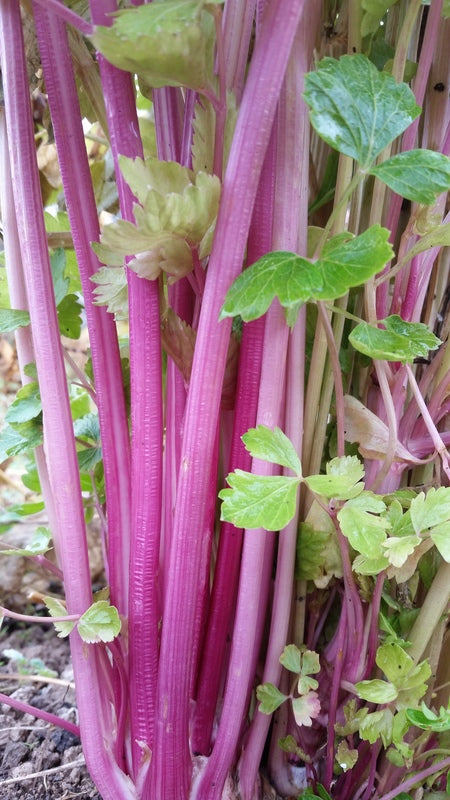
Chinese Pink Celery stands out for its striking blush to pale magenta stems and fine, feathery green leaves. The stalks are thinner and more fibrous than standard Western celery, but far more fragrant and flavorful. Plants typically grow 12–18 inches tall and form loose clusters of stems rather than a tightly compact head. The color intensifies with cooler temperatures, making it a beautiful and unique crop for fall or early spring gardens.

Culinary Uses
This variety is widely used in Chinese and Southeast Asian cooking for its intense celery flavor and attractive color. It is typically stir-fried, braised with tofu or meats, or added at the end of soups and broths to enhance aroma. Unlike the crunchier Western types, Chinese Pink Celery is more often cooked than eaten raw, allowing its full flavor to mellow and blend with other ingredients. The leaves are also edible and can be used as an herb or garnish.

Growing Tips
Chinese Pink Celery thrives in cool weather, growing best in spring and fall. Start seeds indoors 8–10 weeks before the last frost, as germination is slow—often taking 2 to 3 weeks. Transplant seedlings to rich, moist soil in a location with full sun to partial shade. Consistent watering is critical, as celery is shallow-rooted and sensitive to drought. Adding compost or aged manure will support steady growth and improve flavor. Mulch to retain moisture and suppress weeds.

Harvesting Guidance
Harvest Chinese Pink Celery when the plants are about 12–16 inches tall and the stalks have developed their characteristic color. You can cut outer stems individually as needed or harvest the whole plant by cutting at the base. For the best flavor and tenderness, harvest before the weather turns hot, as heat can cause bolting and bitterness. Leaves and stems can be used immediately or stored in the refrigerator for several days.

Shipping Notes
  • Free Standard Shipping on $100+ Orders to the USA.
  • Except Preorder products are shipped in 48 hours.
  • Delivery to the USA:
  1. Standard Shipping : 3-10 business days
  • If time is of the essence, please consider selecting expedited delivery for faster service.
Exchange/Return Notes
  • We offer a 30-day return/exchange service after receiving.
  • Final sale items are not eligible for returns or exchanges.
  • To process your return/exchange, please contact us at [email protected]
  • Please click here for more details>>> Return & Exchange Policy
SKU: 77643366142

Discover Niche Categories That Outsell celery garden seeds

Top-Converting Item to Boost Your Average Order

4.3 ★★★★★
Based on 30 reviews
Sort
Highest Rating
Newest First
Oldest First
Product Reviews
M
Verified Purchase
Matthew Nations
Port Orchard, US
★★★★★ 5
Excellent Introduction to Hemodynamics for a Resident or Fellow
Format: Paperback
Background: PGY-2 Internal Medicine Resident with no prior hemodynamic monitoring experience Overall: Fantastic introduction to the field. The author will assume you know the following prior to starting the book: - Moderate understanding of EKG’s - Anatomical arrangement of the heart and its vessels - Understanding some of the practical effects of atrial fibrillation (lack of an atrial contraction, etc) Specifics: The book can be picked up without significant prior knowledge of hemodynamic monitoring. I initially tried to read Hemodynamic Rounds, and the authors of that book did not introduce significant pieces of information, such as the normal pressures of the heart chambers, what each wave means on the monitor, and how is each chamber of the heart/vessel represented on the monitor (where do I look to see the left ventricular pressure?). In contrast to that, Dr. Hanna provides a book that appears to be intended for residents/cardiology fellows or zealous pre-cardiology interns who are looking for an introduction to the field that maintains enough depth to be practical. Its first section goes over the relevant physiology and pathophysiology and the mechanical/hemodynamic representation. The second section is a series of practice problems with excellent explanations which reviews all of the prior concepts and helps to solidify them in the reader’s mind. The reader will learn to appreciate the relevant waveforms and their relevant representations, the normal values for the cardiac chambers and vessels, and eventually the changes to these normal values during pathologic states. As others have mentioned, it is concise, but this also makes it a bit dense initially when the reader encounters the basic four waveforms and attempts to memorize the normal pressures. Once you get over that initial learning curve, the rest of the first section goes a bit faster. Overall, I’m very happy I purchased this book, and I feel that it has prepared me very well for time spent in the cardiac ICU.
WAS THIS REVIEW HELPFUL?YesReportShare
Reviewed in the United States on July 25, 2019
J
Verified Purchase
john c wynsen
Dallas, US
★★★★★ 5
Info not to be found elsewhere ...
Format: Paperback
I am a cardiologist in my 50s. I have long been interested in hemodynamics and have an extensive home file system and library of Cardiovascular related books and journal articles. I thought I understood hemodynamics and tracings very well. However this book is a treasure trove of info that simply cannot be found in other publications. It has been a very worthwhile purchase. Highly recommended. This is best suited for cardiology fellows and beyond in my opinion. This info is simply not to be found elsewhere. It is as if a grey haired attending is pointing out minutiae to you that you had not realized was buried in the tracings. Well written and easy to digest. It is best to have a good understanding of hemodynamics and waveforms before reading this though. The correlation with ECHO and diastolic issues is also very good. (This book should be required reading for all cardiology fellows - invasive or noninvasive)
WAS THIS REVIEW HELPFUL?YesReportShare
Reviewed in the United States on February 7, 2016
I
Verified Purchase
Items not received
Whiting, US
★★★★★ 5
Hemodynamics
Format: Paperback
Very good book for students and residents of cardiology who want to learn from basic to adavence hemodynamics! Im strongly recommending it to everyone ! Its like a bible for hemodynamics!!
WAS THIS REVIEW HELPFUL?YesReportShare
Reviewed in the United States on June 11, 2024
C
Verified Purchase
C Hwang
Grantham, US
★★★★★ 5
Excellent
Format: Paperback
As a second-year cardiology fellow, I used to get very confused with hemodynamics during my cath and CCU rotations. This book is a gem, it is clear and logically written, has great explanations of waves and great illustrations. The constrictive pericarditis, valvular disease, and FFR chapters are impressive with echocardiographic and physiologic correlations. I actually liked everything I read, like the nice differentiation between the pressure tracings of various chambers. Some of it requires multiple reads but it is worth it. I realized that I had missed a great deal of the basic understanding of pressure tracing configuration, wedge pressure, shunts. There are also over 50 cases in a test-answer format probably covering and reviewing most hemodynamic topics. It is like 2 books in 1.
WAS THIS REVIEW HELPFUL?YesReportShare
Reviewed in the United States on March 14, 2013
A
Verified Purchase
Aziz A
Port Orchard, US
★★★★★ 3
Black and white
Format: Paperback
Bought this book. Good content. However my copy is in black and white. There are references to colored arrows. I later learned that others have a colored copy.
WAS THIS REVIEW HELPFUL?YesReportShare
Reviewed in the United States on January 30, 2026

recommand products