SKU: 77803609180
water dispenser for potted plants

water dispenser for potted plants DI-Smart Automatic Watering System

Sale price$22.52 Regular price$25.02
Save 10%

Pay in installments of $6.25 with ShopPay, AfterPay and Klarna

Shipping Estimate
USA
  • USA
  • CAN

Ships within 48 hours · Estimated delivery Aug 4 - Aug 9

Promo Codes Available:

For Your Every Summer RSVP, with Code: SUMMER15

Description

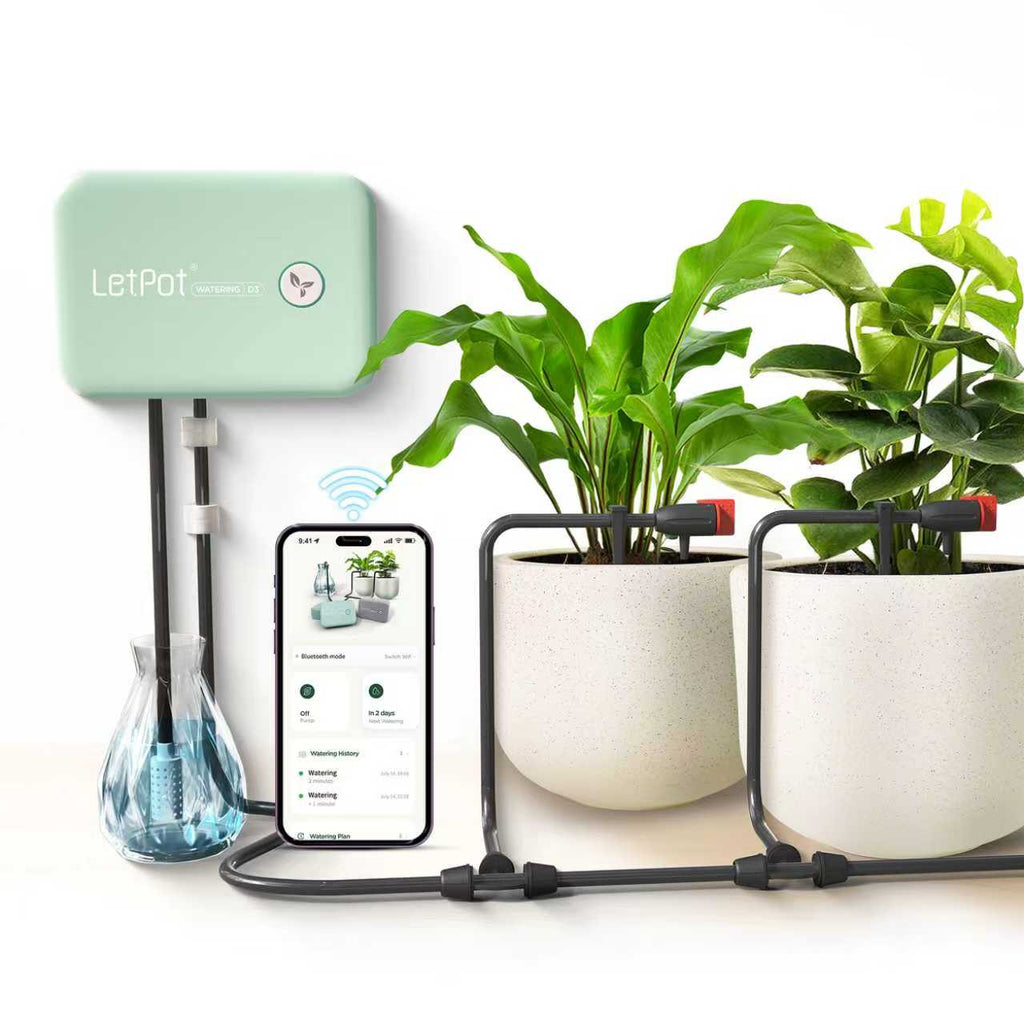
water dispenser for potted plants DI-Smart Automatic Watering SystemAbout LetPot Smart Drip Irrigation Kit The LetPot automatic plant watering system takes the effort out of daily plant careindoors or out. This irrigation system is thoughtfully designed for home convenience, letting you manage your plants from an app via WIFI or Bluetooth. It works as a reliable auto watering system for plants, irrigating up to 20 pots at once. Thanks to built in soundproofing, the device stays quiet in any room. Frequent travelers

About LetPot Smart Drip Irrigation Kit

The LetPot automatic plant watering system takes the effort out of daily plant care—indoors or out. This irrigation system is thoughtfully designed for home convenience, letting you manage your plants from an app via WIFI or Bluetooth. It works as a reliable auto watering system for plants, irrigating up to 20 pots at once.
Thanks to built-in soundproofing, the device stays quiet in any room. Frequent travelers and anyone who wants consistent care will love how it delivers hydration right when plants need it.

LetPot DIY Drip Irrigation Kit

Product Features

  • Dual connectivity using WIFI and Bluetooth for flexible control.
  • Smart water-flow detection and instant low-water alerts via the app.
  • Schedules set directly from the app or by pressing the button.
  • Durable, waterproof IPX66 build keeps the unit safe from leaks and splashes.
  • Adjustable drippers on bamboo-inspired pipes let you control flow for each plant.
  • Mineral filter reduces blockages and ensures a steady, reliable flow.
  1. Comes with all parts needed to hydrate up to 10 pots efficiently.
  2. No clips or glue required—hang or mount easily to start right away.
  3. Extremely quiet pump delivers near-silent operation for peaceful spaces.

What`s in the box

  • Power Adaptor x1
  • Filter ×1
  • Adjustable Dripper x10
  • Tee Connector x10
  • Water Pipe Bracket x10
  • Water Pipe 10m
  • LetPot Drip Irrigation Controller x1

APP Water Shortage Detection

LetPot's irrigation system features low-water detection sensors. When the tank drops, your phone is alerted instantly. Notifications help you avoid losing plants to neglect or dehydration.

Adjustable Drip Head

Each head is adjusted for the perfect flow. Water every pot exactly the way it needs. The result is healthy hydration with less waste.

IP66 Waterproof

IP66 protection keeps everything working safely inside or outside. Rain and splashes cannot harm the durable LetPot drip solution in any setting.

Silent Water Pump

The included pump distributes water quietly, keeping any living area peaceful and undisturbed.

Version V2.3.6 arrived on January 12, 2023, increasing network power and improving phone alerts. LetPot's app is updated every two weeks for better operation and smoother performance.

Why Choose the LetPot Automatic Plant Watering System?

Whether you need a dependable self watering system for pots or a complete auto watering systems setup for your balcony garden, LetPot delivers. Its drip irrigation keeps water delivery efficient—no drop goes to waste. Your plants receive steady hydration for healthier growth every day.
Bamboo-look drip pipes organize water delivery to many pots smoothly. Each dripper can be fine-tuned for precise needs. A built-in filter guards against clogging, preserving the device day after day.

How the Automatic Plant Waterer Improves Your Routine

With this automatic plant waterer, enjoy less stress and more free time. Set everything up through the app and manage care even when away from home. Waterproof construction ensures reliable function indoors or outdoors. Operation is ultra-quiet, making it suitable for any room. LetPot is the smarter way to keep your green space healthy—without daily effort.
Shipping Notes
  • Free Standard Shipping on $100+ Orders to the USA.
  • Except Preorder products are shipped in 48 hours.
  • Delivery to the USA:
  1. Standard Shipping : 3-10 business days
  • If time is of the essence, please consider selecting expedited delivery for faster service.
Exchange/Return Notes
  • We offer a 30-day return/exchange service after receiving.
  • Final sale items are not eligible for returns or exchanges.
  • To process your return/exchange, please contact us at [email protected]
  • Please click here for more details>>> Return & Exchange Policy
SKU: 77803609180

Discover Niche Categories That Outsell water dispenser for potted plants

Top-Converting Item to Boost Your Average Order

4.8 ★★★★★
Based on 22 reviews
Sort
Highest Rating
Newest First
Oldest First
Product Reviews
W
Verified Purchase
WU.
Lexington, US
★★★★★ 4
Good overview of the leading Agentic Framework. Will become outdated quickly.
Format: Paperback
3.5 Stars rounded up. Not a bad place to start if you need to get up to speed fast with Claude Code, understand its vast feature set, how it works under the hood, best practices, and the various agent primitives and how to get the most out of them. Agentic frameworks (Claude Code in particular) are quickly becoming table stakes for anyone working in tech, so it's best to start now. I appreciated the author's ability to flesh out areas where Anthropic's documentation is lacking in depth and nuance, and for some not already working with Claude in their own repos, the fact that he provides "toy" repos where one can experiment with the tools without fear of consequence. Where the book falls short is that most of the stuff in here is already covered pretty well already in Anthropic's docs, or even better so in their free "Skilljar" courses. What's more, some areas are given a bit of a shallow treatment, while others are a bit better done. So it's a bit inconsistent in that sense. Also, I can see how this book will quickly lose its currency in a few months at the pace things are going. Ultimately, for me, the price of this book was a bit rich for my liking given the criticisms above. Still, I feel like I got valuable info that rounded up what I already knew from working with this agentic framework. Recommended.
WAS THIS REVIEW HELPFUL?YesReportShare
Reviewed in the United States on May 28, 2026
B
Brahmananda Reddy
Phoenix, US
★★★★★ 5
Practical AI Engineering Beyond Prompts — One of the Better Books on Agentic Coding
Format: Paperback
This book is not another “AI coding hype” book. A lot of books talk about agents at a very high level. This one actually explains how things work when you try to use them inside real development workflows. That was the biggest difference for me. What I liked most was the focus on context engineering, memory, MCP, hooks, subagents, and workflow orchestration instead of just “prompt better.” The author spends time explaining why long-running agent systems fail, how context grows over time, and why most AI coding setups become messy without structure. The examples also feel practical — The HookHub project, Next.js setup, GitHub workflows, Claude memory files, and MCP integrations make it easier to connect theory with actual implementation. From my retail domain experience perspective, I could immediately connect this to forecasting and pricing workflows. For example: * agents helping analysts generate specs before model development * automated code review for promo forecasting pipelines * isolated subagents for pricing, promotions, assortment * persistent memory for business rules across teams * MCP integrations to pull context from internal systems safely The section around context isolation and subagents especially stood out because that is very similar to how enterprise forecasting teams already operate in reality. Different teams own different decision spaces. One thing I appreciated: the author does not oversell AI. There is a strong focus on constraints, context pollution, hallucinations, performance degradation, and workflow reliability. That makes the book feel grounded instead of marketing-heavy. This is not for complete beginners though. If someone has never worked with Git, APIs, coding agents, or LLM workflows, parts of the book may feel overwhelming early on. The author clearly says this is not beginner-level content. Overall, probably one of the more practical books I have read recently on agentic coding systems. Good for: * software engineers * AI engineers * enterprise architecture teams * technical product teams * analytics leaders trying to operationalize AI development workflows Especially useful if your organization is trying to move from “AI demos” into actual production workflows.
WAS THIS REVIEW HELPFUL?YesReportShare
Reviewed in the United States on May 20, 2026
U
UA
Bozeman, US
★★★★★ 5
A Good Reality Check on How AI Agents Actually Work in Enterprise Systems
Format: Paperback
Most AI books stop at prompts. This one goes deeper into how agent systems actually behave once you try to use them inside large workflows with memory, tools, permissions, automation, and multiple agents working together. That part felt very relevant for healthcare and enterprise environments. The book does a good job explaining why context engineering matters and how poor context handling creates hallucinations, inconsistent outputs, and degraded performance over time. Honestly, that is one of the biggest problems organizations underestimate right now. In healthcare workflows, context matters a lot: * prior interactions * business rules * auditability * escalation logic * safety constraints * tool permissions * workflow boundaries The sections on persistent memory, scoped context, subagents, and structured workflows connected strongly to that reality. I work in enterprise analytics, and while reading this book I kept thinking about use cases like: * pharmacy workflow automation * prior authorization support systems * coding assistants for healthcare engineering teams * AI copilots for operational analytics * agent-based escalation systems * claims and workflow orchestration The MCP chapters were also useful because they explain integration challenges clearly instead of treating tooling as magic. What made this book stand out for me was the balance between implementation and architecture. The author explains: * why long contexts fail * how context poisoning happens * why isolation matters * when parallel agents help * when they actually create more complexity That level of honesty is missing in many AI books right now. Another thing: the examples are not overly academic — The Next.js project setup, GitHub automation, Claude desktop workflows, memory systems, hooks, and subagents make the learning process feel practical and hands-on. One limitation: this book assumes technical background. Someone completely new to coding agents, LLMs, Git, or development workflows may struggle in the first few chapters. But for engineers, AI teams, enterprise architects, and technical leaders trying to understand where agentic coding is actually going, this book is worth reading. Especially for organizations trying to operationalize AI safely instead of just experimenting with chatbots.
WAS THIS REVIEW HELPFUL?YesReportShare
Reviewed in the United States on May 20, 2026
C
Christopher West
Pawtucket, US
★★★★★ 5
Great book! Practical and for developers that already use AI!
Format: Paperback
I purchased "Agentic Coding" by Claude Code due to my desire for an alternative to generic "Prompt Template" type resources related to AI-based development. This book accomplishes just that. As opposed to merely viewing Claude Code as a "magic box", the author has explained how to utilize it in conjunction with other actual development processes. The authors' emphasis on "context engineering" (i.e., structuring data/information; managing knowledge in a project; guiding an AI agent to produce consistent results vs. producing random/unknown results) represents the strongest component of the book. It should be noted that the book appears to be intended primarily for experienced developers with prior experience in software development and/or familiarity with AI-based development tools. Should you be familiar with Git, the command-line interface, and/or modern development processes, you may find this resource very helpful. Conversely, I did appreciate the fact that there were no novice-oriented descriptions provided throughout the book. The aspect of the book that I found most valuable, however, is the extremely pragmatic nature of the material contained within. The examples illustrated through developing/maintaining CLAUDE.md files; utilizing Claude Code in combination with GitHub Workflows; employing MCP Servers; and creating multi-agent or sub-agent workflows all seemed to reflect a clear focus on "real world usage" rather than theoretical constructs. In addition, each chapter builds upon previous chapters in such a manner as to provide a logical progression through which the reader can easily understand and ultimately implement the concepts learned. I also appreciated that the author included guidance on responsible utilization of the tool(s), as well as maintaining control over what changes are made by the agent. While numerous books regarding AI focus solely on what AI tools can accomplish, this book addresses both how to utilize these tools effectively in a real codebase, as well as responsibility and safety considerations. In summary, this is not a book for individuals completely inexperienced in either programming or generative AI. However, if you are currently experimenting with tools such as Claude, Cursor, GitHub Actions, or MCP, this is likely one of the more useful and practical books available on the subject. Recommended for software engineers seeking to transition from simply "prompting an AI" into establishing a repeatable/professional workflow process surrounding agentic coding.
WAS THIS REVIEW HELPFUL?YesReportShare
Reviewed in the United States on April 11, 2026
P
Paul Pollock
Houston, US
★★★★★ 4
⭐⭐⭐⭐ (so far)
Format: Paperback
I'm maybe a third of the way through this and already rethinking how I talk to coding agents. The reframe from "prompt engineering" to "context engineering" sounds like semantics until Marco walks you through why context poisoning, context clash, the Goldilocks zone for system prompts. That chapter alone reorganized something in my head. I keep going back to the line about garbage in, garbage out being the real reason agentic systems underperform. The hands-on stuff lands well too. Building the HookHub project from scratch, wiring up Playwright MCP, watching Claude generate a CLAUDE.md file and then not automatically loading a memory file you just created — that moment where you expect magic and get silence instead? That's the kind of honest teaching I appreciate. It made the "why" behind memory hierarchies click.
WAS THIS REVIEW HELPFUL?YesReportShare
Reviewed in the United States on May 12, 2026

recommand products