SKU: 78376240594
bird's nest fern toxic to dogs

bird's nest fern toxic to dogs Shop 'Bird's Nest Fern - Asplenium nidus' Care & Info

Sale price$18.13 Regular price$20.15
Save 10%

Pay in installments of $5.04 with ShopPay, AfterPay and Klarna

Shipping Estimate
USA
  • USA
  • CAN

Ships within 48 hours · Estimated delivery Aug 8 - Aug 13

Promo Codes Available:

For Your Every Summer RSVP, with Code: SUMMER15

Description

bird's nest fern toxic to dogs Shop 'Bird's Nest Fern - Asplenium nidus' Care & InfoThe Birds Nest Fern, known as Asplenium nidus, is a striking fern prized for its bold, wavy fronds and lush, sculptural appearance. This fern is especially admired for how it naturally creates a nest of fronds that gently unfurl from a central point, resembling a birds nesthence the common name. Native to the tropical rainforests of Southeast Asia, Australia, and the Pacific Islands, Birds Nest Fern thrives in warm, humid, and shaded environments. In

The Bird’s Nest Fern, known as Asplenium nidus, is a striking fern prized for its bold, wavy fronds and lush, sculptural appearance. This fern is especially admired for how it naturally creates a “nest” of fronds that gently unfurl from a central point, resembling a bird’s nest—hence the common name. 

Native to the tropical rainforests of Southeast Asia, Australia, and the Pacific Islands, Bird’s Nest Fern thrives in warm, humid, and shaded environments. In the wild, it often grows epiphytically, nestled high in tree canopies where it collects organic debris and moisture. This natural habitat gives clues to how it prefers to be grown at home: warm, indirect light and high humidity are key. 

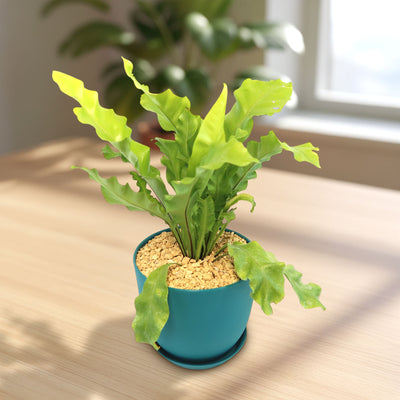
The bird’s nest fern plant features bright, glossy green fronds that grow in a circular rosette pattern, giving the plant a neat, symmetrical look.

Unlike many ferns that have finely divided leaves, Asplenium nidus has broad, tongue-shaped fronds with rippled or wavy margins.

These leathery leaves add strong architectural interest and a bold textural contrast in both houseplant collections and tropical landscape beds.

When mature, Bird’s Nest Fern can reach about 4 feet tall and 3 feet wide, depending on conditions.

Indoors, it typically stays closer to the lower end of that size range unless given ample humidity and consistent warmth.

It does not grow aggressively or require frequent pruning, making it a low-maintenance plant for those who want lush greenery without the fuss.

The Bird’s Nest Fern does not produce flowers in the traditional sense, as it is a true fern and reproduces via spores. These spores are produced in small rows or dots on the undersides of mature fronds. While not as showy as flowers, the reproductive structures give the plant a botanical charm and interest for fern collectors and hobbyists. 

One of the unique aspects of Asplenium nidus is its adaptability as both an indoor and outdoor plant in warmer climates, as well as its ability to improve air quality. It is often placed in bathrooms and kitchens thanks to its love of humidity and tolerance of indirect light.  

When and How to Water Your Bird’s Nest Fern 

The Bird’s Nest Ferns are mildly drought-tolerant; they store water in their leathery fronds. Always water thoroughly when the top 1–2 inches of soil feel dry. Avoid letting the soil completely dry out, especially during active growth, as it can cause browning tips and stunt development. Bird's Nest Ferns should be watered deeply every 5-7 days from spring to early fall, then reduced to once every 10-14 days in winter. 

From March to September, during the growing season, water every 5–7 days using about 1/3 to 1/2 cup for small to medium pots, making sure water drains freely. Keep humidity high and mist occasionally if your indoor air is dry. Avoid watering directly into the rosette to prevent rot. 

From October to February, during the dormant period, reduce watering to once every 10–14 days with smaller quantities, around 1/4 cup for medium containers. Let the soil mostly dry out between watering, but never become bone dry. Lower light and cooler air will slow the plant’s water needs. 

Light Requirements – Where to Place Your Bird's Nest Fern 

When growing indoors, the Bird’s Nest Fern thrives in bright indirect light for 6–8 hours daily, avoiding direct sunlight to protect its fronds.

Place your fern near an east-facing window or a few feet away from a south or west window filtered with sheer curtains.

It can tolerate low light but will grow more slowly. Rotate the pot occasionally to maintain even foliage.

When grown outdoors, place your Bird’s Nest Fern in bright filtered light or dappled shade for 4–6 hours a day, never in full sun.

Morning sun or deep shade under trees or patios is ideal. Avoid harsh midday rays that can burn the fronds. For either setting, too little light causes slow growth and pale leaves, while too much causes crisping or browning.  

Optimal Soil & Fertilizer Needs 

Bird’s Nest Fern thrives in loose, well-draining, and slightly acidic soil rich in organic matter. Planet Desert has specialized potting soil, opens in a new tabGo to soil cactus mix blend 1 gal 4 qt cacti succulent dirt compost growing media that includes an organic substrate with mycorrhizae to help with the growth of a healthy root system and help your bird's nest fern thrive. Avoid compacted or overly sandy soils that dry out too fast. 

Fertilize your bird’s nest fern once a year in the spring with a balanced liquid NPK fertilizer of about 5-10-5. Over-fertilizing causes frond burns and salt buildup, so avoid feeding in the dormant season. In winter, skip fertilizing completely. The plant’s metabolism slows down and doesn’t need nutrients during rest. 

Bird’s Nest Fern Indoor Requirements 

When growing indoors, Bird’s Nest Fern thrives in temperatures between 65°F and 80°F, with humidity levels of at least 50% and exposure to filtered bright light. These tropical ferns are native to humid rainforests, so maintaining warmth and moisture indoors is key. Keep them away from air conditioners, heating vents, and drafty windows to avoid cold or dry air stress. Ideal indoor spots include bathrooms or kitchens where humidity is naturally higher. If needed, place the pot on a pebble tray with water or use a humidifier to boost the surrounding moisture. 

Hardiness Zones & More 

When growing outdoors, it is hardy in USDA zones 10–11 and prefers temperatures above 55°F, with bright indirect light and 60–80% humidity.

If temperatures dip below 50°F, bring it indoors.

Place in shaded patios, under canopies, or in fern gardens where moisture and shade are consistent.

Extended cold or dry wind exposure can cause frond browning and leaf drop, so protect accordingly. This plant is native to tropical rainforests and needs similar conditions. 

Wildlife – Bird’s Nest Fern Attract the Following Friendly Pollinators 

The Bird’s Nest Fern still attracts helpful insects like beneficial wasps, hoverflies, and frogs due to its moisture and form. Its wide, bowl-like rosette traps moisture, drawing in insects and tiny animals that help regulate pest populations. It’s a passive part of a healthy garden ecosystem. 

According to the ASPCA, Bird’s Nest Fern is non-toxic to dogs, cats, and horses, making it a safe choice for pet-friendly homes. This makes it ideal for indoor placement where curious pets roam. 

How to Propagate Your Asplenium nidus 

Bird’s Nest Fern is most commonly propagated by division, not spores like other ferns. To divide, remove the plant from its pot and gently separate offshoots or pups with attached roots. Use clean, sharp scissors or hands and pot the divisions in fresh, moist soil. Avoid disturbing the central rosette, as it is the plant’s main growth point. Keep new plants warm and humid, with indirect light, until well-rooted. 

Key Takeaways

  1. Bird’s Nest Fern is known for its bright green, leathery fronds with ruffled or wavy edges that grow in a circular rosette, mimicking a bird’s nest.
  2. As a true fern, it doesn’t bloom; instead, it reproduces by releasing spores from the undersides of mature fronds.
  3. It thrives in humidity-rich environments like bathrooms and kitchens, making it a natural choice for tropical-style interiors.
  4. This fern helps improve indoor air quality by filtering out pollutants and adding fresh oxygen to enclosed spaces.
  5. According to the ASPCA, Asplenium nidus is non-toxic to cats and dogs, making it a safe and stylish option for pet owners.

The Bottom Line 

Overall, the Bird’s Nest Fern (Asplenium nidus) is a striking, easy-to-care-for fern that brings lush tropical greenery into any indoor or shaded outdoor space. With its ruffled, upright fronds forming a nest-like crown, it offers unique texture and visual interest. It’s moderately drought-tolerant, safe for pets, thrives in high humidity, and is a perfect match for beginners looking for non-fussy foliage. Whether used in containers, bathrooms, or as part of a shade garden, it rewards minimal effort with maximum impact. 

Shipping Notes
  • Free Standard Shipping on $100+ Orders to the USA.
  • Except Preorder products are shipped in 48 hours.
  • Delivery to the USA:
  1. Standard Shipping : 3-10 business days
  • If time is of the essence, please consider selecting expedited delivery for faster service.
Exchange/Return Notes
  • We offer a 30-day return/exchange service after receiving.
  • Final sale items are not eligible for returns or exchanges.
  • To process your return/exchange, please contact us at [email protected]
  • Please click here for more details>>> Return & Exchange Policy
SKU: 78376240594

Discover Niche Categories That Outsell bird's nest fern toxic to dogs

Top-Converting Item to Boost Your Average Order

4.1 ★★★★★
Based on 12 reviews
Sort
Highest Rating
Newest First
Oldest First
Product Reviews
J
Verified Purchase
JP De Oliveira Estêvão
Whiting, US
★★★★★ 5
Smells Like You Have Your Life Together
Scent: Bergamot, Size: 16 Fl Oz (Pack of 1)
Cremo Body Wash with Italian Bergamot, Neroli Blossom, and Fresh Vetiver smells far more expensive than it has any right to. The scent hits that sweet spot between fresh and refined. The bergamot gives it a clean citrus lift, the neroli adds a smooth floral edge, and the vetiver grounds it with a subtle, masculine depth that does not scream but absolutely speaks. The lather is rich and concentrated, so you only need a small amount. It feels more like something you would find in a boutique hotel than on a regular store shelf. The fragrance lingers just enough to be noticed without overpowering your cologne or filling the entire room. If you want to step out of the shower smelling like competence and quiet confidence, this one delivers. It is polished without trying too hard, and it makes everyday showers feel slightly upgraded.
WAS THIS REVIEW HELPFUL?YesReportShare
Reviewed in the United States on February 28, 2026
K
Verified Purchase
Kiley Gallentine
San Leandro, US
★★★★★ 5
Profound and timely
Format: Paperback
If I could give this book 6 stars I would. The way the world is right now, I needed to do a deep dive into anger. And I needed to see how God wants me to handle my anger. There were some very challenging and humbling parts to this book that I needed to hear. All the application questions at the end of each chapter helped me solidify what I learned and what I needed to evaluate personally. Which leads me to the statement that this book was deeply personal to me and I am grateful for the changes it’s helped me make to reflect God more and myself less.
WAS THIS REVIEW HELPFUL?YesReportShare
Reviewed in the United States on March 26, 2026
J
Verified Purchase
John Beeson
New York, US
★★★★★ 5
Profoundly biblical and wise
Format: Paperback
David Powlison’s Good and Angry is a powerful book. In the book Powlison dives deep into what anger is and then gets very practical about how to biblically deal with your own anger issues (issues, he assures us, we all have). From the outset, Powlison makes it clear that anger, while dangerous, can be handled to produce good. “At its core anger is very simple,” Powlison says, “It expresses ‘I’m against that’” (39). Powlison says that each of us handles anger differently. Some of us freeze over, some of us quietly brood, some of us simmer, some of us explode. Powlison encourages us not to look at the way others mismanage worse than us, but rather, how do we mismanage anger? Each type has their own blind spots. Powlison then dives into anger itself. Anger is about our displeasure toward something, so what are we displeased with? And why? How are we justified? Unjustified in our anger? And what do I want to happen? Anger is physiological. As embodied beings, anger manifests itself in us physiologically. How is it impacting me when I’m angry? Powlison then dives into mercy, what he calls a constructive displeasure, or constructive anger. When the constructive displeasure of mercy is functioning as it ought, it has four characteristics: patience (a wonderful biblical synonym of patience is “forbearance”), forgiveness (which is “mercifully unfair” (80)), charity (a spirit of magnanimity), and constructive conflict (“Mercy is not a free pass. It is an invitation to turn and repent” (94). All of these fundamentally point to the work of God and his righteous response of anger to our rebellion. “The constructive displeasure of mercy means the redemption of the world” (102). Powlison walks through how God’s anger works: through his righteous and holy response to our sin, to him taking his wrath upon his son on the cross. He concludes, “God’s wrath is your hope. God’s wrath is my hope. We don’t often hear that, but it appears everywhere in the Bible. Wrath is our hope because love masters anger” (121). The final portion of the book steps back and helps us move through analyzing our own anger. Powlison uses James 4:1-12 to help us analyze our own anger issues. At the heart of this analysis is James’s own analysis of his hearer, that they are fighting and quarrelling because of their “desires that battle within” them. In other words, if we have an anger problem (which we all do), we have a malformed desire problem. In other words, we have a heart problem. Significant in digging into this question is the ability to analyze my own motives. The issue isn’t what has happened with me, but is my heart and my heart’s motives and desires in the midst of any given situation. Key questions to ask myself when in a moment of anger are: “what do I want?” “what do I fear?” and “what do I most love?” (154-55). Powlison concludes with a strong word of hope. God is in the process of changing us and reshaping our heart. Our problem, Powlison says, is that we tend to talk to the wrong person in the midst of our anger – ourselves. But when we turn and talk to our Good Shepherd, we will experience hope and change. I’m so grateful for Powlison's Good and Angry. It is a profoundly biblical and wise book with both subtle and profound insights. I know I have been impacted by the book personally and will both turn to it in the future for personal use and as a resource for others who struggle with anger.
WAS THIS REVIEW HELPFUL?YesReportShare
Reviewed in the United States on April 21, 2017
A
Verified Purchase
AMZRKB
Grantham, US
★★★★★ 5
But he is also convinced that your anger does not have to be a problem and this book is intended to help redirect so that we can
Format: Paperback
David Powlison thinks you have an anger problem, and a serious one at that. It is not because he knows you personally, but because he is one who has long studied the fallen heart. But he is also convinced that your anger does not have to be a problem and this book is intended to help redirect so that we can be both good and angry. Anger, as Powlison who is the executive directory of CCEF, defines it, is a sense of opposition to something that is both important and wrong. That means it is a moral response. As those who are created in the image of God we all have come wired for the capacity to express anger. But, as Powlison carefully shows, we have a problem. Our anger is misdirected and misguided because of sin. Not only in the little daily frustrations and irritations, but also in extremely destructive ways. The goal, according to Powlison, is not to eliminate anger, but to have it remade into the image of God by the grace of the gospel. Far from being a therapeutic self-help book, his concern is that we come to understand how anger can coexist with forgiveness, patience, charity, and constructive displeasure. This book should prove to be an excellent resource. However, if you pick it up with the intention to help someone else—your husband, wife, child, friend, or congregant—be prepared to confront the reality of your own anger first. Powlison has a wonderful way of acutely diagnosing anger as a personal problem for all, even those who do not consider themselves angry. A couple of highlights would be his detailed examination of God's wrath showing readers why it is actually because of God's wrath that we have hope. His chapters dealing with every day anger, long-held bitterness, and anger against God also flow from a counselor's heart as he addresses difficult and awful painful truths.
WAS THIS REVIEW HELPFUL?YesReportShare
Reviewed in the United States on September 23, 2016
F
Verified Purchase
FantasyGirl
Boise, US
★★★★★ 4
Good Christian Perspective on Anger
Format: Paperback
I read this book over the course of three months; it was not hard to get through but other books had to be read first because of library due dates and without intent, it kept getting pushed lower on my priority read list. I finally got back to it earlier this week and finished up the remaining chapters. After reading it, I have a better understanding of anger through a Christian perspective. Author David Powlinson is a counselor so he brings with him expertise in working with people who have suffered bad things. Unlike some counselors who give guidance without the Scripture, Powlinson incorporates God and His love in each chapter since God is the ultimate source of freeing us from the burden of anger and the other emotions that accompany anger. The book is broken down into four sections: Our Experience, What is Anger?, How to Change, and Tackling the Hard Cases. Everyone is plagued by anger of different intensities and gets angry for different reasons and everyone deals with it in different ways, yet we are all the same in that we need to face our anger and seek God’s guidance so we may handle our anger in a constructive and positive way that glorifies Him. That is why I recommend this book to everyone, especially those who may be going through a hardship in life that makes them angry. I did not agree with everything Powlinson said or may not have understood where he was coming from on some things, but I still think he did a great job writing a book on a massive and complicated subject.
WAS THIS REVIEW HELPFUL?YesReportShare
Reviewed in the United States on January 6, 2018

recommand products