SKU: 7969553862
philodendron hairy red

philodendron hairy red Philodendron squamicaule – Foliage Factory

Sale price$21.57 Regular price$23.97
Save 10%

Pay in installments of $5.99 with ShopPay, AfterPay and Klarna

Shipping Estimate
USA
  • USA
  • CAN

Ships within 48 hours · Estimated delivery Sep 25 - Sep 30

Promo Codes Available:

For Your Every Summer RSVP, with Code: SUMMER15

Description

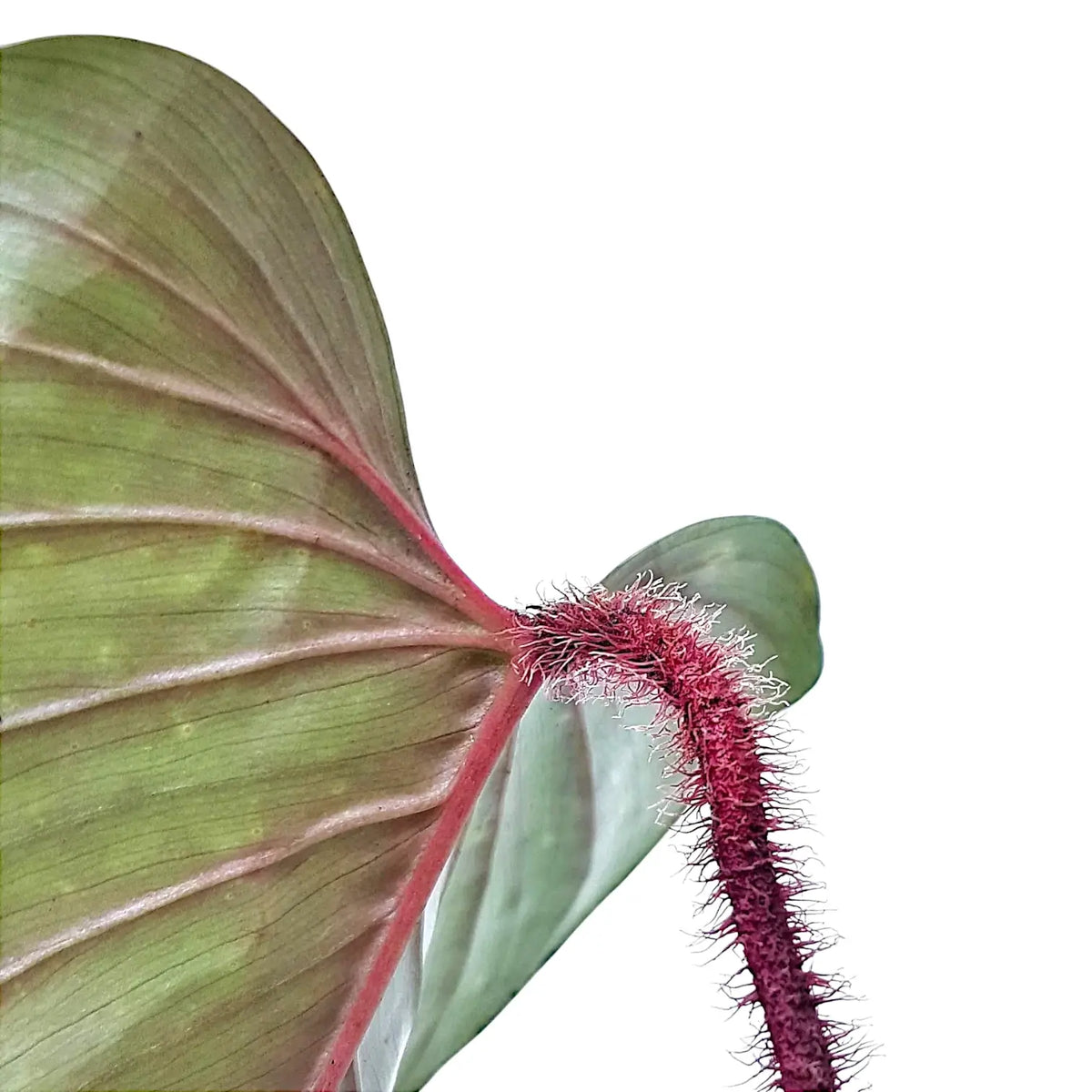
philodendron hairy red Philodendron squamicaule – Foliage FactoryPhilodendron squamicaule Philodendron squamicaule has green climbing foliage and textured petioles that can give the stem area a scaly look. New leaves reveal the petiole texture as they expand and harden. The plant grows as a climbing aroid with nodes along the stem. A coarse vertical surface guides the stem upward and holds textured petioles along the support. Textured petioles on Philodendron squamicaule Leaf form: Green leaves are held on textured

Philodendron squamicaule

Philodendron squamicaule has green climbing foliage and textured petioles that can give the stem area a scaly look. New leaves reveal the petiole texture as they expand and harden.

The plant grows as a climbing aroid with nodes along the stem. A coarse vertical surface guides the stem upward and holds textured petioles along the support.

Textured petioles on Philodendron squamicaule

  • Leaf form: Green leaves are held on textured petioles along the climbing stem.
  • Petioles: Textured petioles and stem sections can show a scaly surface.
  • Stem behaviour: The climbing stem forms nodes that can root into a coarse support.
  • New growth: Petiole texture becomes more defined as new leaves expand and harden.
  • Indoor outline: Upright growth holds textured petioles along the climbing stem.
  • Origin: Recorded from wet tropical forest regions of Central America into northwestern South America.

Growth context for Philodendron squamicaule

Philodendron squamicaule has textured petioles and stem sections, especially as new growth hardens along a support. Nodes close to a coarse surface can root into the support as the stem climbs.

Because the texture sits around petioles and new growth, very dry air can mark tender tissue while the leaves expand. A stable vertical surface, bright filtered light and a root mix with good air movement help new growth harden with fewer dry marks.

Growing Philodendron squamicaule on a coarse support

  • Position: Set it in bright indirect light; harsh direct sun can mark the petioles and leaf blades.
  • Water: Water after the upper substrate has partly dried, then let excess water drain away fully.
  • Leaf expansion: Moderate to high humidity reduces dry marks on expanding leaves and petiole tissue.
  • Temperature: Warm indoor conditions help new roots form along the climbing nodes.
  • Substrate: A loose aroid mix keeps air around node roots as the climbing stem attaches.
  • Climbing surface: Give the stem a pole or coarse board so aerial roots can enter the surface as it lengthens.
  • Repotting: Repot when roots fill the pot or the support becomes unstable, keeping the stem base above dense wet mix.
  • Fertilising: Feed lightly in active growth; flush the substrate occasionally if mineral salts collect around the roots.
  • Pruning: Remove damaged leaves cleanly and guide new stems before they bend away from the support.
  • Semi-hydroponics: An inert mineral mix can work if the stem base stays aerated and roots are not held in stagnant water.

Philodendron squamicaule issues around roots, petioles and new leaves

  • Dry leaf edges: Low humidity or missed watering can mark new leaves before they harden.
  • Petiole marks: Very dry air can roughen or mark tender petiole tissue while new leaves expand.
  • Root rot: Dense substrate can stay wet around the root zone and damage new root tips.
  • Aerial roots: Roots may fail to grip smooth supports; a coarse surface gives new roots more contact points.
  • Loose growth: Stems that lean away from support can produce smaller leaves as nodes lose contact with the support.
  • Pests: Check around textured petioles, new growth and leaf undersides for mites, mealybugs or scale.

Philodendron squamicaule safety

Philodendron squamicaule should be kept away from pets and children, as chewed plant tissue can irritate the mouth and stomach.

Published description and name of Philodendron squamicaule

Philodendron squamicaule was described by Thomas B. Croat and Michael H. Grayum and published in Annals of the Missouri Botanical Garden in 1997. The name squamicaule refers to the scaly stem or stalk detail visible in the plant’s textured growth.

With a coarse support and enough humidity, Philodendron squamicaule extends upright growth with textured petioles along the stem.

Shipping Notes
  • Free Standard Shipping on $100+ Orders to the USA.
  • Except Preorder products are shipped in 48 hours.
  • Delivery to the USA:
  1. Standard Shipping : 3-10 business days
  • If time is of the essence, please consider selecting expedited delivery for faster service.
Exchange/Return Notes
  • We offer a 30-day return/exchange service after receiving.
  • Final sale items are not eligible for returns or exchanges.
  • To process your return/exchange, please contact us at [email protected]
  • Please click here for more details>>> Return & Exchange Policy
SKU: 7969553862

Discover Niche Categories That Outsell philodendron hairy red

Top-Converting Item to Boost Your Average Order

4.1 ★★★★★
Based on 14 reviews
Sort
Highest Rating
Newest First
Oldest First
Product Reviews
R
Verified Purchase
Ready Writer
Belleville, US
★★★★★ 5
An indispensible Hebrew Language resource.
Format: Hardcover
This book is an amazing resource for anyone who has completed preliminary Hebrew such as with Pratico and Van Pelt in their Basics of Biblical Hebrew. This book goes above and beyond, it gives the diagnostic origin patterns for adjectives, patterns in noun formation as well as other components of speech, contrasts each of the seven major verb forms and the minor forms as well, and gives an excellent evolution of the utilization of the Hebrew language and its update in characters. It explains in its initial history a lot of unique statements in the Torah, and illustrations throughout give the reader an excellent idea about the Hebrew Scriptures. I bought this to aid in designing a language studies course at seminary and it has stood me in great help so far, going beyond anything I would have expected to get out of an intermediate level grammar and is an amazing, invaluable, and priceless resource, both to the professor, and the student. I recommend all people taking Hebrew purchase this book and add it to their collection and read it through cover to cover as well as using it as a topical reference guide.
WAS THIS REVIEW HELPFUL?YesReportShare
Reviewed in the United States on October 30, 2016
E
Verified Purchase
Edwin & Melissa
San Leandro, US
★★★★★ 5
can potentially be overwhelming
Format: Hardcover
This is a good resource for introduction to syntax. However, the vast amount of examples has benefits as well as disadvantages. The benefit is that it is comprehensive in information which makes it good for a reference. The disadvantage is that the many subcategories can cause one to be discouraged as the quantity of information may be overwhelming. Nonetheless that is the nature of learning a language. It is still a good resource if you can maintain the brain power to understand the technical language if you have a novice background to linguistics. The volume could be more pedagogical however that would cater to the self learner and perhaps that was not the intent of the author. This volume seems to be designed for the classroom setting. However it is still decent for the self learner.
WAS THIS REVIEW HELPFUL?YesReportShare
Reviewed in the United States on June 30, 2014
H
Verified Purchase
Hp2020
Port Orchard, US
★★★★★ 5
Favorite Hebrew Reference Book
Format: Hardcover
This is the Hebrew grammar that I use the most often. While I also use Williams and Arnold and Choi, this grammar is more comprehensive, and its size certainly reflects this. It probably betrays my inclination towards the exactness of Greek to like this grammar so much. As my Hebrew professor often tells us, all these grammar categories are contrived to some extent, so at some point it isn't helpful anymore to go further in depth on the uses of the so-called "cases." All in all, I usually find it easy to locate the grammatical point in which I am interested, though sometimes I have to resort to looking up every instance a Hebrew particle occurs throughout the book. For this looking up of various nuances of a particle, I sometimes find Williams more user friendly. Nevertheless, Waltke and O'Connor's volume has been my resource of choice.
WAS THIS REVIEW HELPFUL?YesReportShare
Reviewed in the United States on November 6, 2012
S
Verified Purchase
Stephen T
Cuba, US
★★★★★ 4
deep
Format: Hardcover
If you are a serious student of Hebrew this is the only way to go. The book explains how the language is built from the ground up. If you are like me you have found learning Hebrew challenging (that's a joke). I have tried learning vocabulary, rote memorization, even coming up with silly English sentences to help me remember words (The goddess "Hera" is quick) (sad, I know). This tool is essential approaching the language from the building block side of things and I am now able to look at the prayer book and recognize forms and tenses I never understood before. It is for the serious student who REALLY wants to learn the language.
WAS THIS REVIEW HELPFUL?YesReportShare
Reviewed in the United States on February 27, 2009
C
Verified Purchase
Christopher C. Alsruhe
Alexandria, US
★★★★★ 5
Can't do Without
Format: Hardcover
I have been a fan of Gesenius for a long time. While I knew there was updated information to consider, I thought his text was enough. But although his text is certainly still necessary, and necessarily covers issues that the book reviewed here does not, it is clear that one must turn to Waltke & O'Connor to reach a greater level of accuracy. Writing so long after Gesenius, they have presented new and accurate information based on the latest research, not only of Ancient Hebrew, but also based on cognate Semitic languages. I have found the sections on Hebrew verbs the most enlightening and correcting, e.g., that the Pi'el stem is NOT intensive. Such intenseness must be detected from a combination of the lexical verb meaning, the stem, and the text/co-text. This book also presents other up-to-date information on the forming of nouns from verbs, etc. As others have noted, the layout and presentation is great. It really can't be presented any easier, I don't think. One must read Gesenius, for he presents very important information across the board, including much on phonology and linguistics not covered by Waltke & O'Connor. But to stick with Gesenius will leave one in error on some points. Waltke & O'Connor, simply put, make the corrections and make studying Biblical Hebrew exciting, and even much easier to learn.
WAS THIS REVIEW HELPFUL?YesReportShare
Reviewed in the United States on January 13, 2004

recommand products