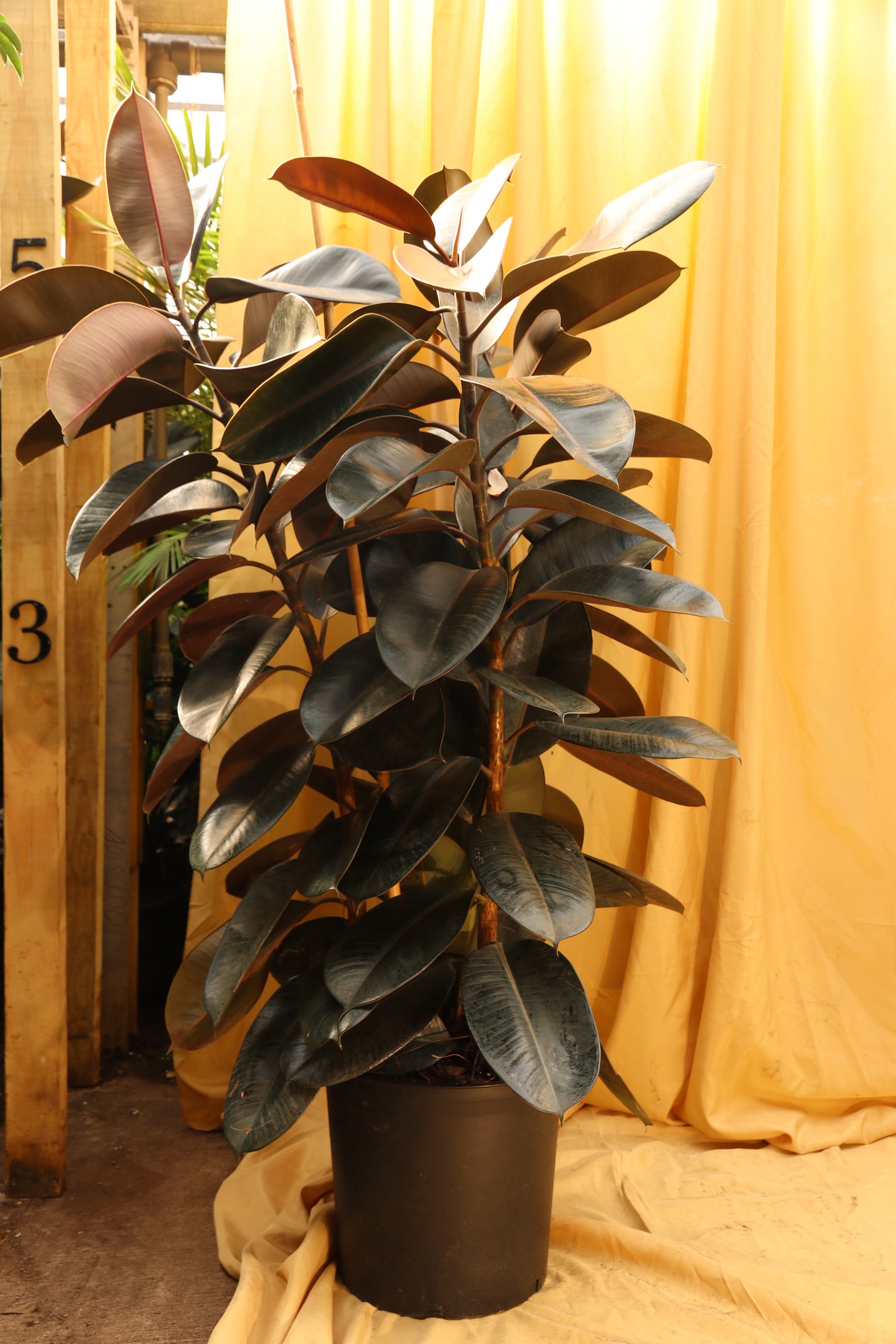
SKU: 8392956424
difference between rubber plant and rubber tree

difference between rubber plant and rubber tree Full Size Rubber Tree Bush

Sale price$23.49 Regular price$26.10
Save 10%

Pay in installments of $6.53 with ShopPay, AfterPay and Klarna

Shipping Estimate
USA
  • USA
  • CAN

Ships within 48 hours · Estimated delivery Aug 4 - Aug 9

Promo Codes Available:

For Your Every Summer RSVP, with Code: SUMMER15

Description

difference between rubber plant and rubber tree Full Size Rubber Tree BushDescription Looking for a plant that brings authentic rainforest beauty into your home? Then we cant wait to introduce you to the magnificent Rubber Tree a stunning statement piece that will turn your space into a peaceful botanical retreat. Native to the Amazon rainforests, the Hevea brasiliensis gave the world natural latex. We're here to help you bring this tree into your home, where its impressive presence will definitely be a conversation

Description

Looking for a plant that brings authentic rainforest beauty into your home? Then we can’t wait to introduce you to the magnificent Rubber Tree - a stunning statement piece that will turn your space into a peaceful botanical retreat.

Native to the Amazon rainforests, the Hevea brasiliensis gave the world natural latex. We're here to help you bring this tree into your home, where its impressive presence will definitely be a conversation starter. With smooth bark and wonderfully glossy leaves, this beauty deserves a special (large) place in your plant collection.

Care 

Is a rubber tree a good indoor plant?

The rubber tree needs more space than many houseplants, but we believe it's absolutely worth it for the joy it brings! If you have the ceiling height, this beautiful specimen will become the heart of your room.

Are rubber trees hard to keep alive? 

Your rubber tree will thrive with consistent, loving attention to its basic needs. But it only needs regular care with steady temperatures, watering, and bright light. We promise it's not overwhelming! With our guidance, it will flourish.

This Amazonian beauty rewards dedicated care with years of green happiness, becoming a cherished part of your home and daily routine.

How often should I water a rubber plant? 

We recommend watering your rubber tree when the top 2-3 inches (5-8 cm) of soil feel dry. Think of recreating that perfect rainforest environment - consistently moist but never waterlogged. Check regularly whether it has just the right amount of moisture.

Where should I place a rubber tree in my house? 

Your rubber tree is happiest near an east- or south-facing window with bright, indirect light. We suggest avoiding direct afternoon sun, which can stress the leaves. Finding the perfect spot for your new giant friend is part of the joy! 

Can rubber tree plants live in bathrooms? 

Bathrooms can be wonderful homes for rubber trees! If your bathroom has bright light and enough space for growth, your plant will love the almost-tropical humidity. Make sure there’s proper ventilation, and you’re good to go!

What fertilizer should I use for a rubber tree? 

We recommend feeding your rubber tree with a balanced liquid fertilizer monthly during spring and summer. Think of it as providing loving nutrition for steady, healthy growth. Regular feeding helps your gentle giant plant stay strong and vibrant!

What does rubber tree plant care involve? 

Caring for your rubber tree involves providing bright indirect light, consistent moisture, regular feeding, and occasional leaf cleaning. We see plant care as being a beautiful relationship - the more attention you give, the more your plant flourishes!

Does a rubber tree need sunlight? 

Your rubber tree needs bright, indirect sunlight for at least 6 hours daily to stay healthy and happy. We always recommend filtered light similar to its rainforest home - gentle but consistent throughout the day. Direct afternoon sun can damage leaves.

Pet-friendly?

We care deeply about all family members, including pets. Unfortunately, the rubber tree isn't pet-friendly due to its latex sap containing ficin and other compounds. 

Are rubber tree plants toxic to dogs? 

Rubber trees are toxic to dogs, as their latex sap contains ficin compounds that can cause gastrointestinal upset and oral irritation. If your dog has ingested any part of your rubber tree plant, please contact your veterinarian immediately.

We're here to help you choose pet-safe alternatives if needed, ensuring both your plants and pets can coexist safely.

How toxic is a rubber plant to cats? 

The rubber tree is toxic to cats, potentially causing oral irritation, drooling, and digestive issues. If your cat has chewed on your rubber tree, please seek veterinary care right away. We understand how important pet safety is.

We can recommend beautiful cat-friendly plants that provide a similar impact while keeping your feline friends completely safe.


Factoids

What is the difference between a rubber plant and a rubber tree? 

The rubber tree (Hevea brasiliensis) is the authentic latex-producing species that grows impressively large, while the rubber plant (Ficus elastica) is its smaller ornamental cousin. We're proud to offer you the genuine rubber tree with Amazonian heritage!

Do rubber trees make rubber? 

Your rubber tree (Hevea brasiliensis) is the very species that produces commercial latex for countless products. So you're nurturing a piece of industrial history in your home - a plant that’s shaped the world (and looks great while doing it)!

Does a rubber tree purify air? 

Your rubber tree contributes to air purification through its large leaves, creating oxygen and improving humidity levels. While not the most efficient air purifier, it brings a piece of the Amazon's natural air-cleaning power into your space.

What is the lifespan of a rubber tree? 

With proper care, your indoor rubber tree can live for a truly long time, even several decades! Wild specimens can reach 100 years. We're honored to help you start this long-term relationship with a truly special gentle giant.

Do they still use rubber trees to make rubber? 

Hevea brasiliensis remains the world's primary natural rubber source, with plantations across Southeast Asia producing latex for tires, medical supplies, and so much more. It’s amazing that your houseplant shares DNA with the trees that keep the world moving.

What is the spiritual meaning of a rubber tree? 

The rubber tree symbolizes resilience, adaptability, and abundance - qualities we admire deeply. Indigenous Amazonian peoples considered it sacred because it represented the forest's generosity, while modern interpretations connect it to flexibility in life's challenges and personal growth.

Is the rubber tree fruit edible? 

The rubber tree fruit isn't edible - really they're seed capsules that explode when ripe, naturally dispersing seeds. Your indoor rubber tree rarely fruits, rather focusing its energy on producing those beautiful leaves we all love so much.


Buy a Rubber Tree

We'd love to help you welcome a magnificent rubber tree into your home! This stunning plant brings authentic Amazonian beauty and creates a truly special atmosphere in any large space. Our team is passionate about perfect matches.

Let us guide you through our video shopping experience to find your ideal rubber tree. We'll be with you every step of the way, from selection to delivery to ongoing care. Your space deserves this living piece of botanical history, and we're here to make sure it thrives under your loving care!


Shipping Notes
  • Free Standard Shipping on $100+ Orders to the USA.
  • Except Preorder products are shipped in 48 hours.
  • Delivery to the USA:
  1. Standard Shipping : 3-10 business days
  • If time is of the essence, please consider selecting expedited delivery for faster service.
Exchange/Return Notes
  • We offer a 30-day return/exchange service after receiving.
  • Final sale items are not eligible for returns or exchanges.
  • To process your return/exchange, please contact us at [email protected]
  • Please click here for more details>>> Return & Exchange Policy
SKU: 8392956424

Discover Niche Categories That Outsell difference between rubber plant and rubber tree

Top-Converting Item to Boost Your Average Order

4.6 ★★★★★
Based on 6 reviews
Sort
Highest Rating
Newest First
Oldest First
Product Reviews
L
Verified Purchase
Lisa Mitchell, MFT, ATR
Birmingham, US
★★★★★ 5
A letter of Gratitude to Irv Yalom for Creatures of a Day.
Format: Hardcover
Dear Irv Yalom, This letter is a declaration of gratitude for your newly published book, Creatures of a Day, and the artful legacy you’ve bestowed upon the field of psychotherapy. In the era of fast technology and mass production, your attention to relationship and the handcrafted nature of therapy is a life line. In all of your 50 years as a psychotherapist, you didn’t sell out for clinical blueprints and formulaic approaches. Instead, you opted to stay true to what you knew--the here and now, the importance of the therapeutic relationship, and your own internal thoughts and experiences as essential elements for your work with clients. Creatures of a Day waves a flag and asks us to take notice. It invites us back into the mystery of our work and reminds us to celebrate our humanness. Your masterful story telling allows us to see you and your clients in action, mistakes and vulnerabilities included, and shares pivotal moments that will provoke thoughtful learning for generations of therapists. So thank you for this. You show us your mistakes You see, your books (especially Love’s Executioner and Creatures of a Day) let us into your thoughts and experiences. We get to hear you talk to yourself and occasionally grapple with doubt. We get to know your own vulnerabilities and how they influence your therapeutic relationships. This is such a rare view. And I am hungry for it. There are too few books, too few videos, and fewer workshops or trainings that offer this kind of perspective for therapists. We don’t get to see masters make mistakes. We don’t get to hear supervisors or consultants narrate their doubts. So, I consider your book an invitation to write about my own similar encounters in my work. And to continue to make this kind of conversation central to my trainings and retreats for therapists. Thank you for the inspiration and the permission. You offer central themes and an individualized perspective As a collection of psychotherapy tales, I think of Creatures of a Day as a series. Like a series of paintings that are created around central themes, your tales invite us to look at the existential themes of aging, death, and connectedness. And, just like a painting series, each reader will take with them a message that is individualized and of unique importance to him/her. In this way, you are truly exhibiting your art as a writer and a psychotherapist. In Creatures of a Day, two patients read the same book and take from it a very different, but beautifully applicable, message. A nurse perceives the angry words she hissed to her dying patient completely opposite of the way in which they were received by the woman she was treating. And a case that you filed away as a blunder turns out to have been a life changer that is only revealed about a decade or so later. This is a reminder to me that while we can’t predict how our art is received, we can in fact commit to creating and collaborating in the very best way we can. You invite humanness and the art of relationship I’d like to let you know that in addition to the invitation to write about my experience as a therapist, I welcome your permission to be human with my clients. And, with that comes a renewed dedication to knowing and experiencing what being human is for me. This means deepening my relationship with my art, continuing my work in therapy, and showing up with the same honesty and openness that you let us see in your book. You make risk a good thing You ask your patients to risk and use this in as a very important subject during the course of treatment. You take several risks in Creatures of a Day, and show us that risks are a vital part of being an authentic and real therapist. You show us that in your work you are just being honest and attending to your experience and the client’s experience. In fact it is more risky to be untruthful or hide than it is to show up and attend the the relationship. You inspire me I won’t stop practicing. You inspire me to continue to write about my own work. And in my own small way, carry your legacy forward. Once again, thank you for your guidance, your influence, and your legacy. Lisa Mitchell, MFT, ATR, LPC www.innercanvas.com
WAS THIS REVIEW HELPFUL?YesReportShare
Reviewed in the United States on March 31, 2015
C
Verified Purchase
Coleman Family
West Palm Beach, US
★★★★★ 5
Short book, big recommendation!
Format: Hardcover
Great book, smooth read that is not overly technical for those who aren't therapists themselves. Examines large existential questions in a digestible format with each chapter being a different real world story. Highly recommend.
WAS THIS REVIEW HELPFUL?YesReportShare
Reviewed in the United States on April 6, 2026
L
Verified Purchase
Lee M Vance
Grantham, US
★★★★★ 4
Yalom as always, but fizzing out.
Format: Hardcover
When entering the field of psychology, I was first introduced to Yalom. As I look back on my early career, I realize that he has influenced my thinking more than I'd like to admit. His focus on relationships and death anxiety are central in this work, as they were in the past. You get a real sense of how he works and we are invited into the intimate and sacred corners of his office and his mind. However, his depth - his use of metaphors and his robust explanations are declining. He is still a profound and articulate writer but I have noticed a drop off in his writing that began with the Spinoza Problem and continues here. Ironically, Yalom is fading, his writing abilities are dying - which makes his own wrestling with his mortality even more visceral to me as a reader. I continue to be thankful for his insight and work.
WAS THIS REVIEW HELPFUL?YesReportShare
Reviewed in the United States on August 8, 2015
M
Verified Purchase
MaryB
Whiting, US
★★★★★ 5
Another great book by an exceptional writer and story teller.
Format: Hardcover
One day I was strolling through a bookstore and saw a novel by Irvin Yalom titled "Lying on the Couch". The fact that it was written by a psychiatrist with a private practice who was also a professor at Stanford University intrigued me. I wasn't expecting much from the book other than a light read but to my (delightful) surprise, the story had great depth and Dr. Yalom proved to be an excellent writer and story teller. So much so, that I have since read every book he's written. You don't have to be a student of therapy or a therapist to appreciate this book or any other by Dr. Yalom. His writing speaks to everyone and leaves everyone with a gift of personal insight. There are many good writers but only a few great ones. Dr. Yalom is among the greats. He is wise, humble, and deeply honest about his own struggles with the big questions in life. If you haven't met Dr. Yalom, I urge you to read any one of his books. You won't be disappointed!
WAS THIS REVIEW HELPFUL?YesReportShare
Reviewed in the United States on March 7, 2015
L
Verified Purchase
L. Daniels
Carnegie, US
★★★★★ 5
Don't miss out!
Format: Kindle
Though I knew of Irvin Yalom's books, I somehow missed reading any of them before, during or after my licensure as a mental health professional. "Creatures of a Day" is my first Yalom book, but with certainty, I can say that it won't be my last. For if his previous books are half as good as this one... they'll all be worth reading. Creatures of a Day contains ten "portraits" of clients and Yalom's work with them. Portraits is the right word since the descriptions are so vivid and compelling that one might actually feel they're in the room watching Yalom and the clients do the dance of therapy. The topics of death and meaning in life connect the stories as one might expect from a humanist/existentialist therapist. More than one of the stories were sadly sweet and brought tears to my eyes as I read... yet I could not put down the book and read it within just a few sessions. As a therapist, who also eschews diagnosis and manualized treatments, seeing a master therapist at work was invaluable. And surprisingly, Yalom doesn't gloss over the "mistakes" he makes or focus only on his expertise. This book more than anything shows the power of moments that matter, the healing connection that can happen when one person fully meets another where they're at. All therapists should read this book, but it shouldn't be limited to professionals. Everyone will relate to these stories and the people they depict so humanly well... Don't miss out on Yalom's work, especially "Creatures of a Day."
WAS THIS REVIEW HELPFUL?YesReportShare
Reviewed in the United States on March 3, 2015

recommand products