SKU: 83966748626
buy bunny succulents

buy bunny succulents Buy Pachyphytum 'Pink Bunny' Australia

Sale price$26.62 Regular price$29.58
Save 10%

Pay in installments of $7.39 with ShopPay, AfterPay and Klarna

Shipping Estimate
USA
  • USA
  • CAN

Ships within 48 hours · Estimated delivery Aug 3 - Aug 8

Promo Codes Available:

For Your Every Summer RSVP, with Code: SUMMER15

Description

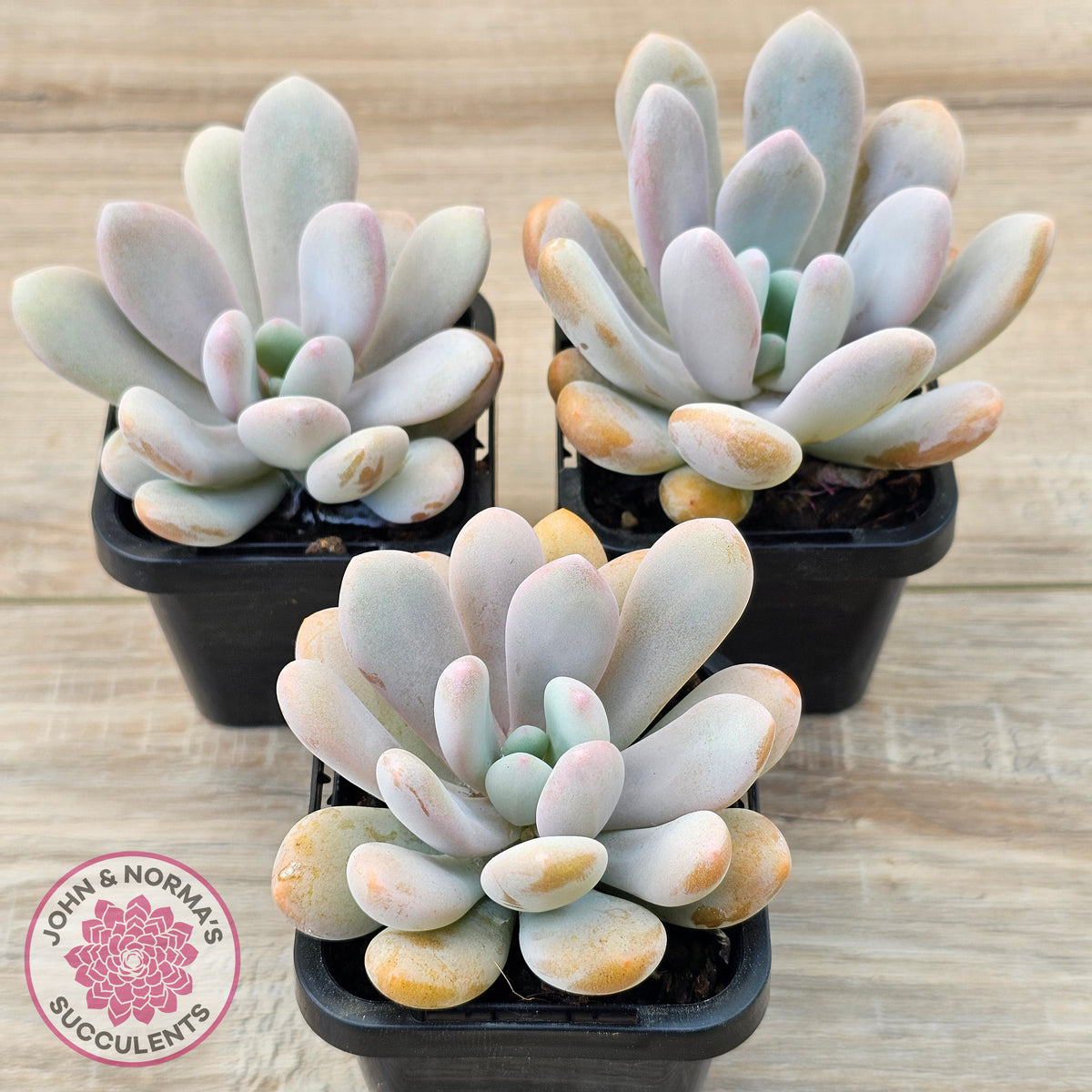
buy bunny succulents Buy Pachyphytum 'Pink Bunny' AustraliaPachyphytum 'Pink Bunny' is a new and exciting intergeneric hybrid plant not yet readily available that is sure to be a hit among succulent enthusiasts. Its long, slender leaves are shaped like bunny ears, which gives it a unique and charming appeal. The leaves grow up to 10cm long and have a grey blue colour with pink highlights and turn completely pink when stressed. They are also accentuated by a light coating of powdery farina adding to its charm.

Pachyphytum 'Pink Bunny' is a new and exciting intergeneric hybrid plant not yet readily available that is sure to be a hit among succulent enthusiasts. Its long, slender leaves are shaped like bunny ears, which gives it a unique and charming appeal. The leaves grow up to 10cm long and have a grey-blue colour with pink highlights and turn completely pink when stressed. They are also accentuated by a light coating of powdery farina adding to its charm.

Pachyphytum 'Pink Bunny' is easy to care for and requires minimal maintenance, making it an ideal plant for beginners. It is a slow-growing succulent that forms offsets at its base as it matures, allowing for easy propagation. This plant thrives in bright, indirect light, and can also tolerate sun most of the year only requiring protection from the hot afternoon sun over summer.

Watering Pachyphytum 'Pink Bunny' is also easy; it prefers to dry out between watering sessions, which helps prevent root rot. It is best to water this plant sparingly during the winter months when it goes dormant.

In terms of soil, Pachyphytum 'Pink Bunny' prefers well-draining soil with a pH range of 6.0 to 7.5. A cactus or succulent mix with added perlite or sand would be suitable. This plant can be grown both indoors and outdoors and is perfect for container gardening or rock gardens.

Pachyphytum 'Pink Bunny' is not frost-tolerant and prefers a warm, dry climate. It is best suited for subtropical to warm temperate climates and is ideal for cultivation in Australia's coastal regions.

In conclusion, Pachyphytum 'Pink Bunny' is a stunning and easy-to-care-for succulent with a unique and charming appearance. It is perfect for beginner gardeners and collectors looking for an attractive addition to their collection. Its grey-blue leaves that turn completely pink when stressed and bunny ear-shaped foliage make it a standout plant in any garden or home.

Plants for sale shown in 70mm pot. You will receive same or similar plants as those shown in images. Colours will vary depending on time of year and growing conditions.

First time customers...  Please read our Shipping Guide, in top or bottom menu, before placing your order.

Please Note:

  • All plants are sent bare rooted with no pots and soil, or minimum soil only.
  • Due to the drying process necessary for sending plants through the mail, plants may look slightly different than images shown on our website
  • Some plants, may look wrinkled when they arrive, may be somewhat limp, or soft to the touch. This is normal as they have been dried out for for a number of days before shipping to avoid rotting in the mail.
  • Succulents are very hardy plants and they will recover quickly, providing you unpack them as soon as you receive them follow some simple care instructions you will find with your order.

If you have any questions or concerns at all, please message us via our Facebook page at John & Norma's Succulents for the fastest Response.


Shipping Notes
  • Free Standard Shipping on $100+ Orders to the USA.
  • Except Preorder products are shipped in 48 hours.
  • Delivery to the USA:
  1. Standard Shipping : 3-10 business days
  • If time is of the essence, please consider selecting expedited delivery for faster service.
Exchange/Return Notes
  • We offer a 30-day return/exchange service after receiving.
  • Final sale items are not eligible for returns or exchanges.
  • To process your return/exchange, please contact us at [email protected]
  • Please click here for more details>>> Return & Exchange Policy
SKU: 83966748626

Discover Niche Categories That Outsell buy bunny succulents

Top-Converting Item to Boost Your Average Order

4.9 ★★★★★
Based on 17 reviews
Sort
Highest Rating
Newest First
Oldest First
Product Reviews
J
Verified Purchase
jk Smiles
Battle Creek, US
★★★★★ 5
A book on dialogue should be experienced first as a book on tape
Format: Audio CD
I think of this more as a great master class lecture. Dialogue should be seemingly simple (we all talk), but McKee defines its essence and differences for prose, stage and cinema. The bulk is narrated by McKee, but the scene examples are read by voice actors and they do quite well. Even the roots of the English language are examined in order to make better decisions on your character's particular use of words. After listening the 10 hours twice while commuting, I finally picked up the book and read it. The book on tape is a better way to initially absorb the material, while the actual book helps to clarify the info. A must for all writers, especially screenwriters.
WAS THIS REVIEW HELPFUL?YesReportShare
Reviewed in the United States on August 30, 2018
L
Verified Purchase
Lori T. Sly
Lexington, US
★★★★★ 4
Helpful, but not as good as "Story" by same author, and it disses certain genres
Format: Hardcover
This book contains a lot of helpful information on how to write dialogue. It's dense with dialogue analysis and insights, tough to take in by just reading it through once. But it is helpful. McKee covers the three dialogue tiers (said, unsaid, unsayable) as well as how dialogue ties into story turning points and scene conflict type. I still have lots of practice ahead of me to figure out how best to do this in my story. I will definitely use his advice as a guide. He understands dialogue at a much deeper level than I do. However, many of McKee's dialogue examples did not speak to me. While I liked reading the dialogue examples for Breaking Bad, 30 Rock, The Sopranos, Frasier, A Raisin in the Sun, and The Great Gatsby, and agreed they were good, I disliked the dialogue from Shakespeare, Elmore Leonard, Sideways, Fraulein Else, and Lost in Translation. McKee says fine dialogue turns the reader/audience into a mind reader; I guess I'm not interested in movies which expect me to be as much of a mind reader as those latter examples did. I totally missed the subtext of the dialogue in those until he explained it to me as an aside. And that's after I already saw most of those movies! If I have to guess what every character means with every line, that's too much work and too little entertainment for me. Maybe mystery lovers liked the dialogue in "Lost in Translation"; I'm not a mystery lover. McKee quoted one novelist as saying that the crux of good writing is to, "Make em laugh, make em cry, make em wait." Lost In Translation and its dialogue did none of that for me. The subtext was so confusing and subtle that I lost interest in the movie. I can't even remember what it was about anymore, only that it won some award and I had no clue why. McKee says that with rare exceptions, a scene should never be outwardly and entirely about what it seems to be about. Dialogue should imply, not explain, its subtext. An ever-present subtext is the guiding principle of realism. Nonrealism, on the other hand, employs on-the-nose dialogue in all its genres and subgenres: myth and fairytale, science fiction and time travel, animation, the musical, the supernatural, Theatre of the Absurd, action/adventure, farce, horror, allegory, magical realism, postmodernism, dieselpunk retrofuturism, and the like. It's a bit unclear how, if at all, anyone writing in any of these "nonreal" genres should take his dialogue advice. It seems to me that even sci fi scenes need some good dialogue with subtext to be engaging. With McKee, all the accolades go to what is implied and unsaid over what is said. I agree that subtext matters, but for me, he's out of proportion with how much it matters to most people and how hard audiences are willing to work to discover the intended subtext. Also, memorable spoken character lines can elevate movie themes and characterization like nothing else. In the end, I think this book is geared more toward writers who want other advanced writers as their audience rather than the average reader or movie watcher. And McKee admits it is definitely not geared toward sci fi, fairytales/myths, action/adventure, horror or allegory. It's almost as if he's saying those genres can't have excellent dialogue. I disagree. But it was still a helpful book to read, and one I will be thinking about and trying to more fully understand for a long time. McKee understands how character's subconscious drives can deepen what they say or avoid saying, and how dialogue interacts with many other aspects of a story to make it all work together.
WAS THIS REVIEW HELPFUL?YesReportShare
Reviewed in the United States on December 12, 2019
R
Verified Purchase
Ray Pryor
Waukegan, US
★★★★★ 5
Amazing.
Format: Kindle
Just like a good movie, the first 10 pages = mind blown. Wow, such really, really good material here. If you're new, this will help you a ton. If you're experienced, this book will help you realize WHY great dialogue is so great, enabling you to create the magic again and again. I love how McKee covers several medias ( screen, theater, novel ) but still stays true and clear on the concept. A virtual masterclass on the subject. One of the best screenwriting books out there, and Yes, it's well worth all the hype.
WAS THIS REVIEW HELPFUL?YesReportShare
Reviewed in the United States on April 18, 2017
K
Verified Purchase
Kindle Customer
Louisville, US
★★★★★ 5
So to speak
Format: Kindle
Previews did not show the Table of Contents, but it is worth searching the web for. The coverage includes practical techniques as well as case studies. Notes cover titles on topics over several decades. This book has four parts about what dialogue is, how it can mended, and how it can be created and designed. Trialogue, the third thing through which a pair of characters channel conflict in conversation, is an interesting concept because it overlaps social networks or media and comms devices; it is also looked at historically. Dialogue is reportedly the quickest way to fix a narrative text since it appeals to intuition. Those levels of depth are what the book is about. They can be found in first person voice. The approach could easily fill a site on the order of tropes for favorite titles, but for deconstruction and revision, which are also relevant to works in progress. It talks about finding characters in the dark, though not necessarily from the milieu, unless it were compressed and made to transfer meaning like in poetry, but reflexive so that it is symmetrical to the characters or human nature. If there is a boundary to be found, then this method is going to hit the lines to find out what happens then. The impact on the rest of the narrative elements is discussed. This extends back through the early philosophers, through tragedy, the merging of European roots into English, and the study of personalities to contemporary customs. Voice is plot.
WAS THIS REVIEW HELPFUL?YesReportShare
Reviewed in the United States on June 12, 2017
C
Verified Purchase
cf otto
Natrona Heights, US
★★★★★ 5
ONE OF THE TWO BEST BOOKS ON SCREENWRITING
Format: Hardcover
Probably the best book on screenwriting ever (besides Egri), though there is also much here for the novelist and playwright. I am a professional TV writer, of long-standing (35 years), and I can tell you I used this book to figure out how to fix the problems of a complex pilot I'm writing; the author truly " guided me home." And lest you think I'm a McKee sycophant, I am not. I found little in STORY for me. The only thing I disagree with in DIALOGUE is that the author sells his own work short: it isn't just for those who are "lost" in their writing, like me, and the student, it's for anyone who writes fiction for a living, in any form, no matter how much experience they have. It's that good.
WAS THIS REVIEW HELPFUL?YesReportShare
Reviewed in the United States on October 14, 2016

recommand products