SKU: 87195355573
coconut palm sugar wholesale

coconut palm sugar wholesale Coconut Palm Sugar - NY Spice Shop

Sale price$20.07 Regular price$22.30
Save 10%

Pay in installments of $5.58 with ShopPay, AfterPay and Klarna

Shipping Estimate
USA
  • USA
  • CAN

Ships within 48 hours · Estimated delivery Aug 4 - Aug 9

Promo Codes Available:

For Your Every Summer RSVP, with Code: SUMMER15

Description

coconut palm sugar wholesale Coconut Palm Sugar - NY Spice ShopToasty, rich aroma Finely granulated texture Also known simply as coconut sugar Subtle sweetness with notes of caramel Coconut palm sugar (also known as coconut sugar) is a natural sweetener made from the sap of the coconut palm flower. Like maple sugar, the coconut palms sap is harvested and heated until it dries into sugar crystals. This minimally processed sugar has a less intense sweetness than heavily processed white sugar, with light, toasty


  • Toasty, rich aroma
  • Finely granulated texture
  • Also known simply as coconut sugar
  • Subtle sweetness with notes of caramel

 Coconut palm sugar (also known as coconut sugar) is a natural sweetener made from the sap of the coconut palm flower. Like maple sugar, the coconut palm’s sap is harvested and heated until it dries into sugar crystals. This minimally processed sugar has a less intense sweetness than heavily processed white sugar, with light, toasty notes of caramel. This makes it an excellent substitute for traditional brown sugar, and it can also replace other sugars in most recipes.

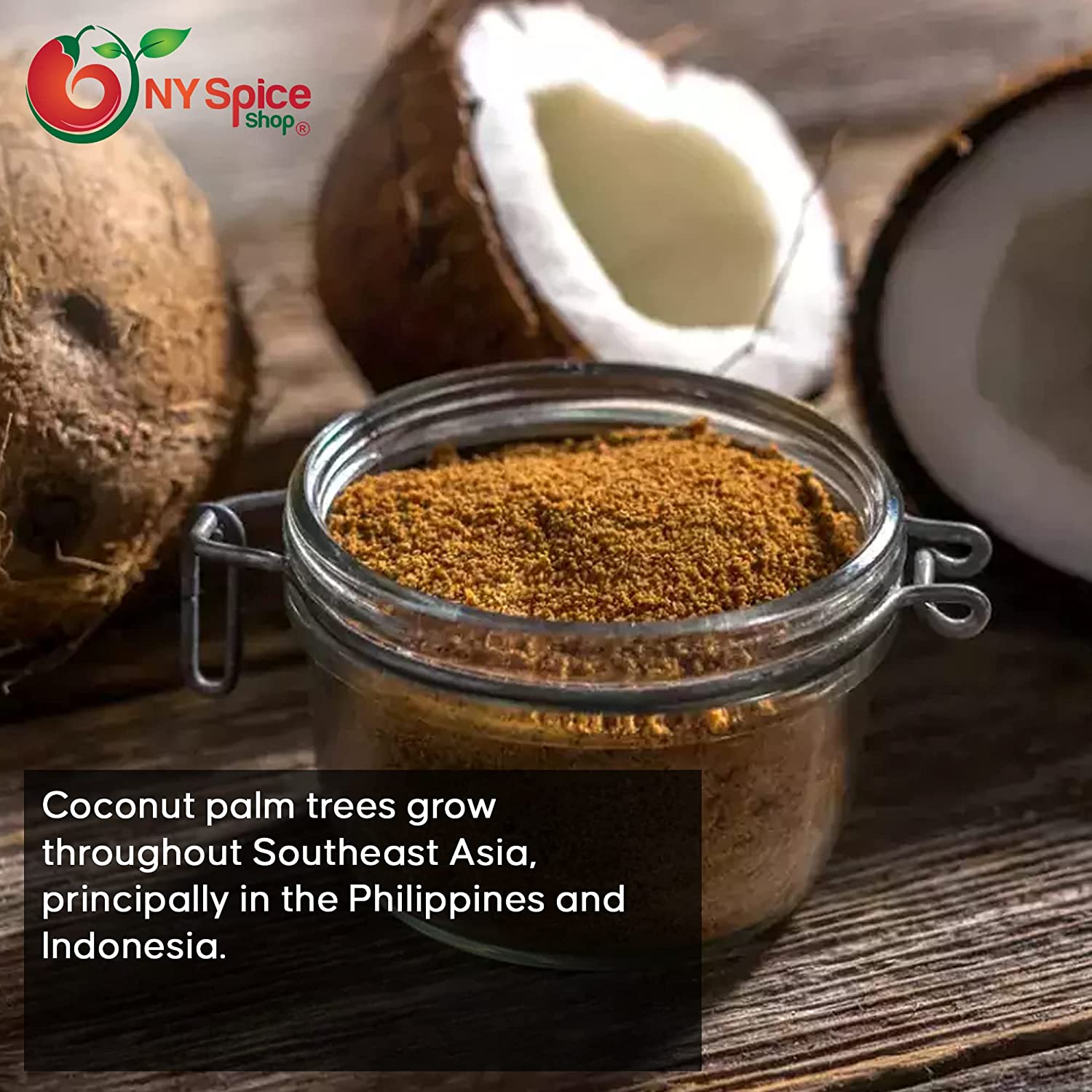
Coconut palm trees grow throughout Southeast Asia, principally in the Philippines and Indonesia. A coconut palm tree can produce sap for 20 years and can grow well in arid climates with minimal water. Coconut palms can produce more sugar per acre than sugar cane. Often, when a coconut palm tree has stopped producing coconuts (generally around the age of 50+ years old), it is "retired" to sap collection to produce coconut palm sugar

Common Uses: 

  • Natural sweetener in tea, coffee, and hot drinks
  • Used in baking and desserts
  • Sweetening cereals, granola, oatmeal
  • Added to sauces, marinades, and dressings
  • Stirred into smoothies or yogurt

How to Use?

  • Use 1:1 in place of white or brown sugar in recipes
  • Sweeten tea, coffee, smoothies
  • Add to oatmeal, yogurt, or sauces
  • Excellent in baking and dessert recipes

Best Recipe Pairings: 

  • Coffee & cappuccino
  • Sweet breads and muffins
  • Caramel desserts
  • Pancakes and waffles
  • Nut butters and fruit sauces

Serving Size: Typical serving size: 1 teaspoon (4–5 g) — provides sweetness and a rich caramel note.

Shelf Life: 12–24 months when stored in sealed packaging in a cool, dry place. Best kept airtight to prevent moisture absorption.

Botanical/Scientific Name: Cocos nucifera (sap harvested from coconut palm flowers)

Origin: Typically harvested in Indonesia and similar tropical regions, then processed and packaged.

Storage Directions: Store in a cool, dry place; airtight container after opening to prevent clumping and moisture.

Ingredients: Coconut Sap Sugar

Allergen Information: Shares equipment with peanuts, tree nuts, wheat, milk, soy, eggs, & sesame. 

Shipping Notes
  • Free Standard Shipping on $100+ Orders to the USA.
  • Except Preorder products are shipped in 48 hours.
  • Delivery to the USA:
  1. Standard Shipping : 3-10 business days
  • If time is of the essence, please consider selecting expedited delivery for faster service.
Exchange/Return Notes
  • We offer a 30-day return/exchange service after receiving.
  • Final sale items are not eligible for returns or exchanges.
  • To process your return/exchange, please contact us at [email protected]
  • Please click here for more details>>> Return & Exchange Policy
SKU: 87195355573

Discover Niche Categories That Outsell coconut palm sugar wholesale

Top-Converting Item to Boost Your Average Order

4.4 ★★★★★
Based on 14 reviews
Sort
Highest Rating
Newest First
Oldest First
Product Reviews
R
Ruddin
New York, US
★★★★★ 5
immersive
Format: Hardcover
Once in awhile when I feel there are a lot of things pulling at me all at once, I will read this book to guide me/ give me ideas to sort out all the pulls. Highly recommended for those who find works in the connected world expect us to attend to all details and requests immediately but we know that are not the right deals for us.
WAS THIS REVIEW HELPFUL?YesReportShare
Reviewed in the United States on January 11, 2006
M
Monsop Collado Madrigal.
Pawtucket, US
★★★★★ 3
A Few Gems, but Not the Right Fit for Me
Format: Kindle
This book focuses on the 80/20 principle, emphasizing the importance of identifying and maximizing the 20% of activities that yield the greatest results. While it offers valuable insights on growth, creativity, and leveraging strengths, it didn’t resonate with me personally, and I found the reading experience less enjoyable. Key Takeaways: • Growth requires creating something new and meaningful, not maintaining the status quo. • Focus on your “20% spike”—your unique strengths—and develop them like an athlete. • Use the 80/20 principle to identify the most profitable parts of a business. Overall, the ideas are useful, but the book didn’t fully capture my interest or provide practical applications I could relate to.
WAS THIS REVIEW HELPFUL?YesReportShare
Reviewed in the United States on January 19, 2025
B
Verified Purchase
Bubbalicious
Fort Morgan, US
★★★★★ 1
An empty-hearted effort
Format: Kindle
Managing personal efficiency is no doubt an important skill. And judging from the author's success from the first book, I assume he is a credible author. But this book is just way too shallow and lacks the evidence of any sinerity for the readers. If you are new to the concept of life efficiency management, it might be good to read his first book. If you are looking for a good framework or advice on how to achieve your goal, then you will for sure be disappointed. This whole book is just about stressing the importance of efficiency management. Absolutely anything else!
WAS THIS REVIEW HELPFUL?YesReportShare
Reviewed in the United States on October 20, 2012
G
Verified Purchase
gg
Belleville, US
★★★★★ 4
Four Stars
Format: Hardcover
great for the 80/20 library
WAS THIS REVIEW HELPFUL?YesReportShare
Reviewed in the United States on April 26, 2016
K
Verified Purchase
KT
Carnegie, US
★★★★★ 5
Book Review of The Alchemist
Format: Paperback
In The Alchemist, Paulo Coelho uses diction, syntax, and the hero cycle to keep the pace of the book constant, and keep the reader intrigued. But, he does have a few flaws present in the book. The Alchemist is a book about a boy named Santiago, who goes on an adventure to find his “Personal Legend” or treasure. Coelho uses the hero cycle to add more emphasis on the plot, which overall makes the story more entertaining. In the story, the Old King tells Santiago that “when someone wants to realize his or her Personal Legend,” he will “always [be] nearby.” (67) This is an example of atonement with the father, because the Old King’s closeness creates a father like figure in him, who is there to support Santiago. The hero cycle for me made the story more enjoyable and kept me reading. Also most of the book is him trying to obtain his Personal Legend, which is “what you have always wanted to accomplish.” (23) Compared to other books I have read this year in my English class, this one was easier to follow in terms of diction. The language that Paulo Coelho uses in the novel overall is not too difficult to understand. Word choice is done very well, and lets the reader flow through the book at a constant pace. The diction also makes the book a novel for a wide range of readers. The hero cycle with the clean diction made the story very enjoyable. While reading this book, I found that it was fairly easy to understand the passage, and that it was very inviting. Paulo Coelho structures the syntax of the book in an easy-to-understand format. Throughout the book, the syntax helps the reader understand where they are on the page, and it also positively affects the pace set by the diction in the book. Towards the middle of the novel, the boy says that “An army is coming,” and he knows because he “had a vision.” This dialogue is quickly followed up by a response from a camel driver, saying that “the desert fills men’s hearts with visions.” (104) The quick pace of dialogue keeps the book driving keeps the pace constantly in motion. The syntax made it easier for me to follow the story and follow which character was speaking and what they where feeling or doing. Even though I enjoyed a great bit of the book, there was still another bit that I didn’t fully enjoy. At the beginning of the Alchemist, the book seems to go a slower speed then the rest of it. The first portion of the book has a lot to do with introducing Santiago, the plot, the setting, and more. There is a part in the story where it goes from page 35 to page 38 with very little dialogue, which I felt stopped progress of the story. The first part also has to do a lot with how he discovers his Personal Legend. It took me a little while longer to read the first part of the book then the rest because I was mostly bored while reading it. I also felt that there was more descriptive text than the rest of the book, which really dragged out the first part. In conclusion, the book has lots of great traits and only a few bad ones. I would definitely recommend this book to a friend or anyone who enjoys reading about adventure.
WAS THIS REVIEW HELPFUL?YesReportShare
Reviewed in the United States on January 12, 2016

recommand products