SKU: 87882165931
fan like palm plant

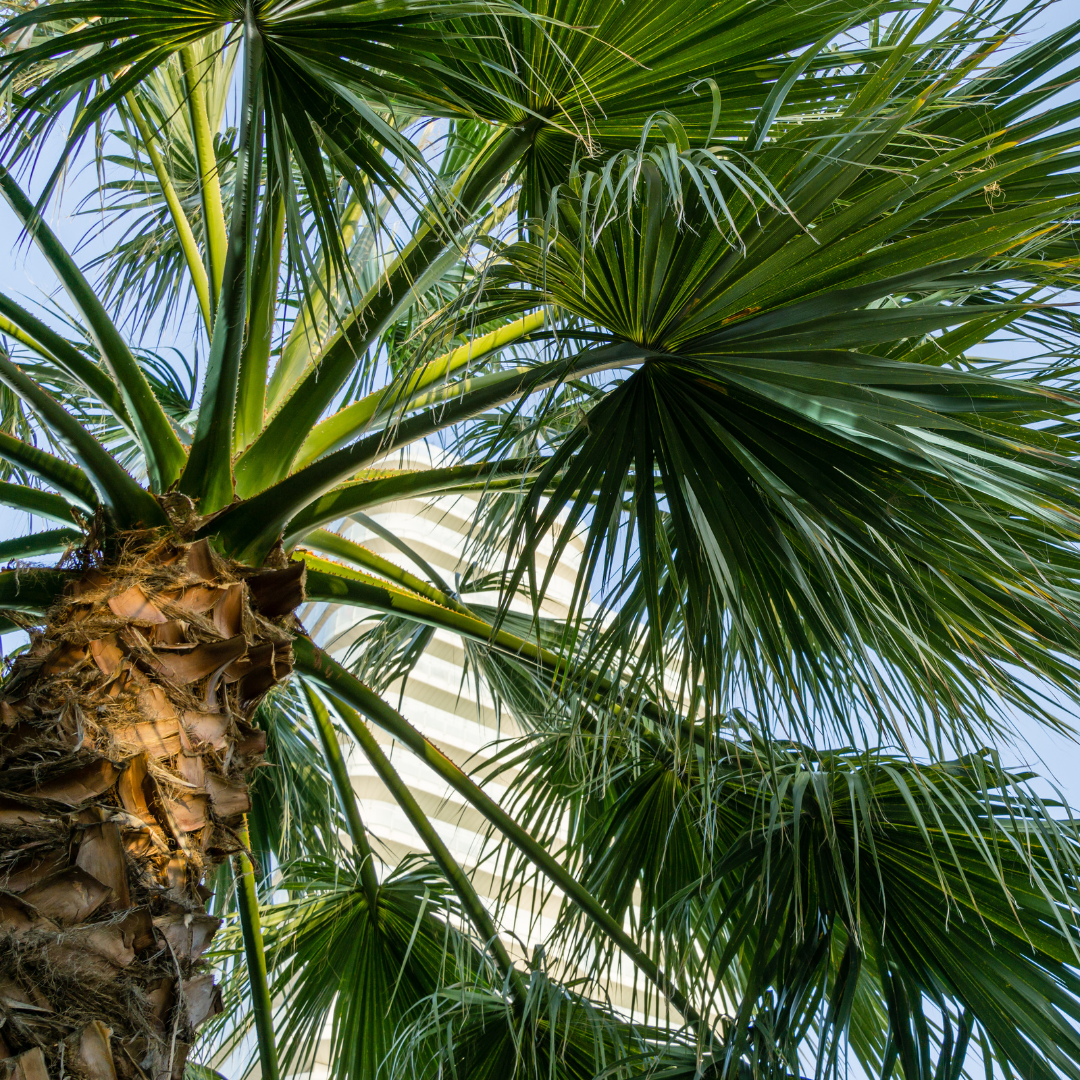
fan like palm plant Buy Mexican Fan Palm Phoenix, AZ | Washingtonia robusta

Sale price$19.95 Regular price$22.17
Save 10%

Pay in installments of $5.54 with ShopPay, AfterPay and Klarna

Shipping Estimate
USA
  • USA
  • CAN

Ships within 48 hours · Estimated delivery Sep 21 - Sep 26

Promo Codes Available:

For Your Every Summer RSVP, with Code: SUMMER15

Description

fan like palm plant Buy Mexican Fan Palm Phoenix, AZ | Washingtonia robustaThe Toughest Tall Palm for Phoenix Heat Mexican Fan Palm The Mexican Fan Palm (Washingtonia robusta) is the ultimate heat tough, drought tolerant palm for Phoenix and the surrounding Valley. Soaring to 5070 feet at maturity with a slender, graceful trunk and a crown of bold fan shaped fronds, this palm defines the Arizona skyline. Mexican Fan Palms are incredibly low maintenance once established surviving on minimal irrigation, laughing off 115F

The Toughest Tall Palm for Phoenix Heat — Mexican Fan Palm

The Mexican Fan Palm (Washingtonia robusta) is the ultimate heat-tough, drought-tolerant palm for Phoenix and the surrounding Valley. Soaring to 50–70 feet at maturity with a slender, graceful trunk and a crown of bold fan-shaped fronds, this palm defines the Arizona skyline. Mexican Fan Palms are incredibly low-maintenance once established — surviving on minimal irrigation, laughing off 115°F summers, and thriving in the poorest soils. Whether you’re adding dramatic height to a Scottsdale resort-style yard, creating a palm-lined entry in Mesa, or planting a windbreak row in Chandler — the Mexican Fan Palm delivers unmatched vertical impact on the lowest water budget of any landscape palm.

Mexican Fan Palm Plant Details

Attribute Detail
Scientific Name Washingtonia robusta
Common Names Mexican Fan Palm, Mexican Washingtonia, Skyduster Palm
Mature Height 50–70 feet
Mature Width 10–15 feet (canopy spread)
Growth Rate Fast — 3–5 feet per year in Phoenix
Sun Full sun (6+ hrs). Thrives in reflected heat from walls and pavement.
Water Very low once established. Extremely drought-tolerant.
USDA Zones 9–11 (Phoenix is Zone 9b–10a)
Soil Extremely adaptable. Handles Arizona caliche, sand, clay, and rocky soils.
Foliage Evergreen — large fan-shaped fronds year-round
Trunk Slender, smooth reddish-brown trunk with distinctive swollen base

Mexican Fan Palm Uses in Phoenix Landscapes

Dramatic Vertical Accents & Skyline Trees

Nothing adds height and drama to a Phoenix landscape like a mature Mexican Fan Palm. Their slender trunks and elevated canopy create striking silhouettes against Arizona sunsets. Plant as a single focal point in Scottsdale front yards, or group 3–5 at staggered heights for a resort-style statement in Tempe or Paradise Valley properties.

Palm-Lined Driveways & Entryways

Mexican Fan Palms are the classic choice for lining driveways and property entrances throughout the Valley. Space 15–20 feet apart on both sides for a grand allée effect. Their narrow footprint means they won’t crowd walkways or driveways as they mature — perfect for Mesa, Gilbert, and Peoria streetscapes.

Low-Water Windbreaks & Property Borders

Planted in a row at 15-foot intervals, Mexican Fan Palms create an effective windbreak and visual screen at height. They’re ideal for the edges of large Chandler and Surprise properties where you need vertical screening without heavy irrigation costs. Pair with Texas Sage or Ruellia at the base for a layered desert look.

Best Time to Plant Mexican Fan Palm in Phoenix

Fall (October–November) is the ideal planting window. Warm soil accelerates root establishment while cooler air reduces transplant stress. The palm gets 6–8 months of root growth before enduring its first full Phoenix summer. Spring (February–April) is the second-best option. Mexican Fan Palms are tough enough to survive summer planting, but fall gives them the best start.

How to Plant Mexican Fan Palm

  1. Dig wide, not deep — excavate 2–3x the root ball width at the same depth. Don’t plant too deep — the root flare should sit at soil level.
  2. Check for caliche — break through any hardpan layer to ensure drainage. Mexican Fan Palms tolerate poor soil but not standing water.
  3. Backfill with native soil — these palms don’t need amendments. A light 20% organic blend is fine if desired.
  4. Spacing — 15–20 feet apart for grouped plantings; 25+ feet for standalone specimens.
  5. Water basin — build a 3–4 inch soil ring to direct water to the root zone during establishment.
  6. Mulch — 2–3 inches of gravel or bark mulch to retain moisture and suppress weeds.

Watering Mexican Fan Palm in Phoenix

First Year Watering Schedule

  • Weeks 1–2: Every 1–2 days, deep and slow (20–30 min drip cycle)
  • Months 1–2: Every 3–4 days
  • Months 3–6: Every 7–10 days (every 5–7 days in peak summer)
  • After Year 1: Every 10–14 days in summer; monthly or less in winter

Drip Irrigation

Place 2 emitters (2 GPH each) 18–24 inches from the trunk. Once established (2+ years), Mexican Fan Palms need very little supplemental water — many mature specimens in Phoenix survive on rainfall alone. This is one of the lowest-water palms you can plant.

How fast does Mexican Fan Palm grow in Phoenix?
Mexican Fan Palms are fast growers, adding 3–5 feet per year in Phoenix with regular watering during establishment. A 15-gallon palm can reach 25–30 feet within 5–6 years.

Is Mexican Fan Palm drought tolerant?
Extremely. Once established, Mexican Fan Palms are among the most drought-tolerant palms available. Mature trees often thrive on little to no supplemental irrigation in the Phoenix Valley — a major advantage over Queen Palms and other tropical palms.

What’s the difference between Mexican Fan Palm and California Fan Palm?
Mexican Fan Palms (Washingtonia robusta) are taller and more slender than California Fan Palms (Washingtonia filifera), which are stockier with a thicker trunk. Mexican Fan Palms grow faster and taller — up to 70 feet — while California Fan Palms typically top out at 40–50 feet.

Do Mexican Fan Palms need trimming?
Yes — Mexican Fan Palms should be trimmed annually to remove dead fronds. Without trimming, spent fronds form a dense "skirt" around the trunk. Most Phoenix homeowners schedule a professional palm trim once a year, typically in late spring.

You May Also Like

  • Queen Palm — a fast-growing feather palm for lush tropical shade, reaching 30–40 feet.
  • Mediterranean Fan Palm — a compact multi-trunk fan palm, ideal for desert modern landscapes and smaller spaces.
  • Pineapple Palm — a bold statement palm with a unique crown shaft, perfect for entryways and focal points.
  • Pygmy Date Palm — a petite feather palm for patios, courtyards, and poolside plantings.

How Many Mexican Fan Palm Do I Need?

Mexican Fan Palm is a tall, fast, slender single-trunk specimen palm placed for vertical drama, not planted in hedge rows. Its narrow 10 to 15 foot canopy lets you line it tighter than most big trees.

  • Single focal point: one palm makes a skyline statement in a front yard or by a pool. Set the trunk back from the house so the high crown clears the roofline.
  • Grove or allée: plant odd-numbered groups of 3 to 5 at staggered heights, or a driveway row at 15 to 20 feet on center for a grand allée.
  • Windbreak or screen row: space at about 15 feet on center for vertical screening on a large property.

Mexican Fan Palm Season-by-Season in Phoenix

  • Spring (Feb to Apr): fast new frond growth resumes as soil warms. A strong second planting window; late spring is the usual time for the annual frond trim.
  • Summer (May to Sep): peak growth, putting on several feet and shrugging off 115°F heat and monsoon winds. One of the lowest-water palms once established.
  • Fall (Oct to Nov): the ideal planting season, giving roots 6 to 8 months before the next summer.
  • Winter (Dec to Jan): evergreen and cold-hardy to about 20°F. A hard Valley freeze can brown fronds, but the palm pushes fresh growth in spring; no routine cover needed.

At a Glance

✔ Heat-Loving (Reflected-Heat Tolerant)   ✔ Drought-Tolerant   ✔ Evergreen   ✔ Low-Maintenance   ✔ Shade-Providing   ✔ Cold-Hardy to 20°F

Plant It With

  • Mediterranean Fan Palm: a compact multi-trunk fan palm to layer lower, denser form below the tall trunks.
  • Pygmy Date Palm: a petite feather palm for the patio or poolside understory.
  • Texas Sage: a low-water purple-blooming shrub to soften the base of the palms.
  • Desert Spoon: a silvery architectural rosette for bold contrast against the slender trunks.

Is Mexican Fan Palm Right for Your Yard?

Mexican Fan Palm is right for you if you want fast, dramatic height on the lowest water budget of any palm, for full sun and reflected heat, almost any well-drained soil, and a yard with vertical room for a 50 to 70 foot tree. It is not a fit for small lots, near pools where frond litter is a concern, or under power lines, since it gets very tall and drops a frond skirt without an annual trim.

Shipping Notes
  • Free Standard Shipping on $100+ Orders to the USA.
  • Except Preorder products are shipped in 48 hours.
  • Delivery to the USA:
  1. Standard Shipping : 3-10 business days
  • If time is of the essence, please consider selecting expedited delivery for faster service.
Exchange/Return Notes
  • We offer a 30-day return/exchange service after receiving.
  • Final sale items are not eligible for returns or exchanges.
  • To process your return/exchange, please contact us at [email protected]
  • Please click here for more details>>> Return & Exchange Policy
SKU: 87882165931

Discover Niche Categories That Outsell fan like palm plant

Top-Converting Item to Boost Your Average Order

4.9 ★★★★★
Based on 30 reviews
Sort
Highest Rating
Newest First
Oldest First
Product Reviews
S
Verified Purchase
Shelby Pritchard
Waukegan, US
★★★★★ 4
"Moral reform is not the same as Christian growth."
A while back, a ministry acquaintance of mine decided to impart a little "wisdom" to this children's pastor. His advice? Well, in the context of discussing preaching and teaching, he said: "Kids just need to be told what to do." Explaining, he adding "Obeying parents, reading Bible, that kind of thing." Within context, he was heavily implying that they don't need theology, or the teaching about why we do what we do. Instead, he was settling for simple moralism. As an amusing contrast, I had begun reading Show Them Jesus only shortly before that. Whatever good intentions may have lain in his heart, that acquaintance sadly failed to remember the axiom "Rules, without relationship, breeds rebellion." Show Them Jesus takes the Biblical philosophy that showing children Jesus, and helping them know him, allows morals and behavior to flow naturally from that relationship. Rules that children will want to follow themselves, rather than complain about and find every chance to break or bend, which is inevitable with simple moralism. The book is divided into two sections. The first is "Why Teach The Good News" and the second "How to Teach the Good News." Each chapter within those sections has a title, a subtitle, and a relevant quote. For example Chapter 4 has "The Factory-Preset Fourth Grader" with the subtitle "Because the good news changes hard hearts." While the titles are usually inventive and fun, they are also insightful enough to specifically address the problem and solution offered in that chapter. The basic premise of the book is summed up in a statement made early on. "Rather than coax the kids into temporarily acting better, Joe [a fellow teacher at the author's church] told about Jesus and trusted God to use that message to make the kids become better." The author, upon discovering this, tried it, tested it, and found it to be so true that he wanted to share it with the world. Hence, the book. In the aforementioned Chapter 4, one of my favorite chapters, the author begins with an all too familiar situation. He had just finished teaching on greed, specifically, not being greedy. Next up was snack time, and the class promptly began fighting over who got more cookies. Noting that simply moral teaching just wasn't cutting it, as studies show, and lives display. Taking the time to dissect each of the good reasons we try to motivate good behavior, he finds each lacking when compared with a genuine fascination and love for God. Part 1 absolutely shines in the approachable language, relatable stories, and Biblical evidence. His philosophy is, like the Bible, simple, yet profound. It strips away tradition to reveal the hollow human efforts behind it and instead purposes the solid and soul-transforming power of the Good News of the Gospel. At this point, I was begging to know how to best address this in my own preaching, and eagerly leaped into Part 2. Beginning in chapter 6, the author begins on a slightly wobbly note. He admits he has never been to college, nor received formal training with teaching or biblical interpretation. Sadly, this shows. Chapter 6 covers showing Jesus from the Old Testament, and is populated by as many mountain peaks of beauty as it is valleys of misunderstandings. One of the peaks is his looking at each passage in light of how man has failed (or will fail) through sin, and how God responds to that. This is formally known as Bryan Chappell's "Fallen Condition Focus." (1) Using this, the author rides this principle, not to the modern day, but first, to how Jesus either solved the problem, or offered a better solution than the one in the OT. He does this with one of three questions: "Who God is," "What God does," and "Jesus Solves Problems," This is actually a pretty interesting approach, and one that many teachers would benefit greatly from. He lays incredible emphasis on getting past the human players and looking to God for the lesson to be learned. He even recommends ditching pre-made lessons to try out this "good news" focused approach, an idea I (after reading far too many moralistic and simplistic and topical) I heartily agree with. Later, however, the author writes that each passage can have several themes and main ideas. While that's true to a point, concepts like the "Hermetical Idea" and/or "Exegetical Idea" rely on the fact that passages contain one big idea, and additional elements explain or apply it. He also offers the idea that some OT passages are wrought with a "tension" and incompleteness until Jesus is applied. While this sounds nice, it also means saying that God's Word was incapable of conveying the truth he wanted until thousands of years after it was written. What then of the original, biblical author's intent to his original audience? Sometimes, it seems, in the eagerness to find Jesus, Show Them Jesus misses that God is also, well, God. Using the author's own approach to find how God loved sinners would show how God continued to love them in that way in Jesus, rather than heavily hint that there are/were problems with the Bible and it's stories until 33 AD. Thankfully, the remaining chapters, stepping into Christ's time, then into modern application, obviously don't suffer as much from interpretive issues. Chapter 8 is heavy on practical application of this, not only in teaching, but in other classroom policies. It breaks down class rewards, discipline, corporate worship, and even how to handle misbehavior in light of the "good news" model. It's an incredibly hard-hitting chapter that needs to be read and re-read. The final chapter ends with a reminder to stay the course, even when it doesn't seem to be working, or life is frustrating, or even you yourself struggle with this "good news" focus. Christ is there, he loves you, and he will aid you. The conclusion, featuring a sermon excerpt of Spurgeon's, as his Gospel-centered message inspired D. L. Moody to speak far more often of Christ in his own preaching. This hearkens back to the opening of the book, as there, another teacher inspired the author on his own journey. The book closes by challenging the readers to inspire those around them as they too teach Christ. At it's brightest, Show Them Jesus is a brilliant beacon of hope that has the power to turn the stagnant and ineffective moralism upside down and inside out by reminding Christians of the power of God's good news in Christ. Like a surgical knife, it cuts away at false motivations and selfish desires to do right, and makes way for the Bible's truth to penetrate our hearts. He offers the problem, he offers a solution, and now it's our turn to step up to the plate and follow his lead in showing others Jesus. Notable Quotables: Chapter 1: Because Jesus is All We Need - "The good news means you relate to God based on what Jesus has done for you, not what you’ve done to prove yourself worthy." Chapter 4: The Factory-Preset Fourth Grader - "None of us learns to love anyone—including God—by having someone tell us to love them. You love people because you find them beautiful and lovable, and because they love you. The good thing is that God is far, far more beautiful and love-worthy than anything or anyone else, and he loves us far, far more than anyone else ever could." Chapter 8: The Grapes That Taught Good News - "The kids’ attitudes also confirmed what my gut felt when I first heard about the [Bible] bucks: a classroom culture built on rewards for performance wouldn’t fit the good news I planned to teach. It wouldn’t do to teach that God’s rewards in salvation come freely, by grace, but that rewards in the church come by being good and memorizing verses." Chapter 9: The War on Sin - "Moral reform is not the same as Christian growth." 8/10
WAS THIS REVIEW HELPFUL?YesReportShare
Reviewed in the United States on July 28, 2018
S
Verified Purchase
Salt Lick
Battle Creek, US
★★★★★ 5
Full of great ideas
Format: Paperback
While not well written, the book does deal with a critical topic, i.e. Why do kids leave the church soon after Sunday school? Jack identifies the singular reason and gives very helpful examples of how to prevent the trend from continuing in your S.S. or home. It shows good hands-on, tried and tested ways, not just theory, to help kids (and adults) fall in love with Jesus. Jack reminds us that as teachers or parents we are totally dependent on the Lord to give us that love. I was also helped by the section on discipline/keeping order in the S.S. I expect to use this book to help improve the teaching and discipline in our S.S, Perhaps, most importantly, personal application is needed first.
WAS THIS REVIEW HELPFUL?YesReportShare
Reviewed in the United States on August 27, 2014
T
Verified Purchase
T. Mora
Charlottesville, US
★★★★★ 5
Life changing
Format: Kindle
This is without a doubt the best book I have ever read aside from the Bible. This book taught me more in one day than 25 years in church. I had never been more excited about Jesus or the bible until this book, my son has caught on and loves to talk about it. My one goal as a parent, the only thing I truly want for my son is to have a love for god and an understanding of Gods love for him and I didn't know how to reach that goal until I read this. I prayed about it, and this book came up on my suggestion list with one review, could of been the mans wife, but I just knew that it wasn't a coincidence. I have since read it twice in my kindle and came back to order it in hardcover. Every parent and ministry leader should read this heavenly book. I have never read an author that was so humble, not the humble that makes you smirk but the type that makes you cry because you don't feel like you are being schooled or judged but somehow this man gets right on your level and speaks to your soul. Jack, thank you, for your humility, for your obedience, for your love for God, you have changed our lives and I will always be grateful.
WAS THIS REVIEW HELPFUL?YesReportShare
Reviewed in the United States on August 28, 2014
J
Verified Purchase
Jason Hughes
Pawtucket, US
★★★★★ 5
Relevant to the present day.
Format: Paperback
Joseph Stalin makes the concepts of dialectical and historical materialism accessible to the lay-person in this work. It's short, but dense and does a good job of explaining why the communist party of the 1920s and 1930s chose to pursue the policies they did. A fascinating insight into the fundamental world-view of a controversial world figure. Only 44 pages, but you will likely reread it several times in order to truly internalize its messaging. Thankful to the seller for making this essay available as the works of polarizing political figures are often censored, suppressed or outright banned in many places. The English translation does a fine job of conveying the original essay written in Russian.
WAS THIS REVIEW HELPFUL?YesReportShare
Reviewed in the United States on March 2, 2024
R
Verified Purchase
Robin
Omaha, US
★★★★★ 5
5/5
Format: Paperback
A great book written by a great man
WAS THIS REVIEW HELPFUL?YesReportShare
Reviewed in the United States on May 8, 2026

recommand products