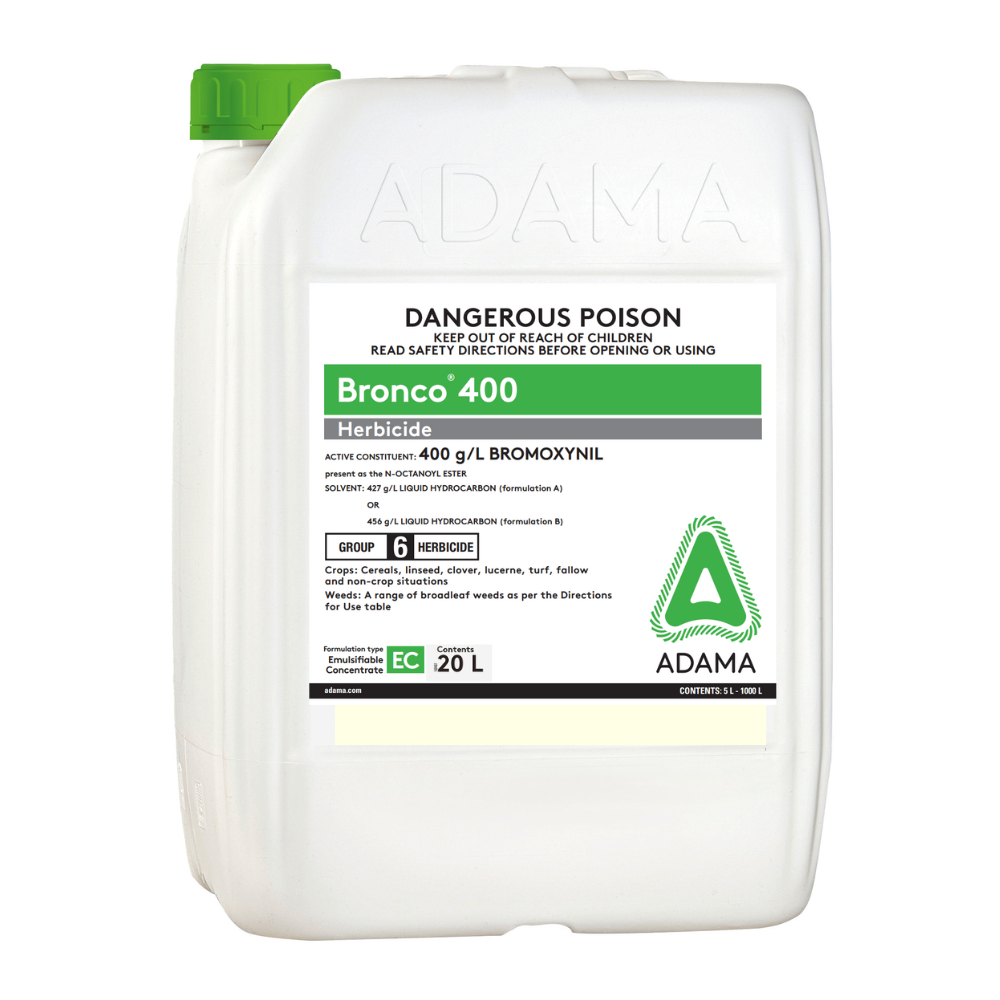
SKU: 88938710869
bone dry herbicide label

bone dry herbicide label Adama Bronco 400 20L Bromoxynil

Sale price$21.25 Regular price$23.61
Save 10%

Pay in installments of $5.90 with ShopPay, AfterPay and Klarna

Shipping Estimate
USA
  • USA
  • CAN

Ships within 48 hours · Estimated delivery Oct 2 - Oct 7

Promo Codes Available:

For Your Every Summer RSVP, with Code: SUMMER15

Description

bone dry herbicide label Adama Bronco 400 20L BromoxynilGroup 6 Herbicide Bronco 400 Herbicide is a selective broadleaf herbicide containing 400 g L Bromoxynil, designed for use in cereals, linseed, clover, lucerne pastures, turf, fallow, and non crop areas. It is a Group 6 herbicide that works by inhibiting photosynthesis in target weeds. The product effectively controls a wide range of broadleaf weeds, including capeweed, wild radish, turnip weed, wireweed, and thistles. It is rainfast within three hours

Group 6 Herbicide

Bronco 400 Herbicide is a selective broadleaf herbicide containing 400 g/L Bromoxynil, designed for use in cereals, linseed, clover, lucerne pastures, turf, fallow, and non-crop areas. It is a Group 6 herbicide that works by inhibiting photosynthesis in target weeds. The product effectively controls a wide range of broadleaf weeds, including capeweed, wild radish, turnip weed, wireweed, and thistles. It is rainfast within three hours and can be applied via boom spraying, aerial spraying, or knapsack application. With a withholding period of 8 weeks for grazing and stock food, Bronco 400 ensures effective weed control when applied at the correct growth stage and recommended rates. 


Key Features:

  • Controls a wide range of broadleaf weeds in cereals, linseed, clover, lucerne, turf, fallow, and non-crop areas.

  • Contains 400 g/L Bromoxynil as the active ingredient.

  • Classified as a Group 6 herbicide, inhibiting photosystem II in weeds.

  • Formulated as an emulsifiable concentrate (EC) for easy mixing and application.

  • Effective on young, actively growing weeds.

  • Rainfast within three hours after application.

  • Can be applied using boom sprayers, aerial application, and knapsack spraying.

  • Compatible with selected herbicides for broader weed control.

  • Withholding period of 8 weeks for grazing and stock food.

  • Does not affect cereal crop growth when used according to label directions.


Maximising Performance:

  • Apply to young, actively growing weeds for best results.

  • Ensure full coverage of weed foliage using the correct water volume.

  • Avoid application in hot, dry, or waterlogged conditions.

  • Do not apply if rain is expected within three hours to prevent wash-off.

  • Use higher rates for larger or dense weed infestations.

  • Follow proper tank-mixing procedures when combining with other herbicides.

  • Avoid spraying in windy conditions to reduce drift onto non-target crops.

  • Use a minimum of 50 L per hectare for cereals and at least 500 L per hectare for turf.

  • Regularly monitor treated areas for weed regrowth and apply follow-up treatments if needed.


Weeds Controlled:

Bronco 400 Herbicide is effective in controlling a variety of broadleaf weeds in cereals, linseed, clover, lucerne pastures, turf, fallow, and non-crop areas. Below are the weeds controlled, categorized by weed type, along with their scientific names.

Broadleaf Weeds

  • Amsinckia (Amsinckia spp.)

  • Capeweed (Arctotheca calendula)

  • Chamomile (Matricaria matricarioides)

  • Common Peppercress (Lepidium africanum)

  • Corn Gromwell (Buglossoides arvensis)

  • Fat Hen (Chenopodium album)

  • Field Madder (Sherardia arvensis)

  • Lesser Swinecress (Coronopus didymus)

  • Mountain Sorrel (Oxalis acetosella)

  • Purple Calandrinia (Calandrinia menziesii)

  • Saffron Thistle (Carthamus lanatus)

  • Shepherd’s Purse (Capsella bursa-pastoris)

  • Tree Hogweed (Polygonum patulum)

  • Turnip Weed (Rapistrum rugosum)

  • Wild Radish (Raphanus raphanistrum)

  • Wild Mustard (Sisymbrium spp.)

  • Wild Turnip (Brassica tournefortii)

  • Wireweed (Polygonum aviculare)

Vining and Climbing Weeds

  • Black Bindweed (Fallopia convolvulus)

  • Three-Horned Bedstraw (Galium tricornutum)

Thistles and Spiny Weeds

  • Three-Cornered Jack (Doublegee) (Emex australis)

  • Variegated Thistle (Silybum marianum)

Poisonous and Noxious Weeds

  • Paterson’s Curse (Echium plantagineum)

  • Mexican Poppy (Argemone ochroleuca)

  • Fumitories (Fumaria spp.)

  • Pheasant’s Eye (Adonis microcarpa)

  • Fireweed (Senecio spp.)

Shipping Notes
  • Free Standard Shipping on $100+ Orders to the USA.
  • Except Preorder products are shipped in 48 hours.
  • Delivery to the USA:
  1. Standard Shipping : 3-10 business days
  • If time is of the essence, please consider selecting expedited delivery for faster service.
Exchange/Return Notes
  • We offer a 30-day return/exchange service after receiving.
  • Final sale items are not eligible for returns or exchanges.
  • To process your return/exchange, please contact us at [email protected]
  • Please click here for more details>>> Return & Exchange Policy
SKU: 88938710869

Discover Niche Categories That Outsell bone dry herbicide label

Top-Converting Item to Boost Your Average Order

4.3 ★★★★★
Based on 7 reviews
Sort
Highest Rating
Newest First
Oldest First
Product Reviews
C
Verified Purchase
Chris Brownell
Whiting, US
★★★★★ 4
Good buy
Style: Full Synthetic High Mileage, Size: 5 qt (Pack of 1), Configuration: 5W-20
Run of the mill oil but for a great price
WAS THIS REVIEW HELPFUL?YesReportShare
Reviewed in the United States on March 27, 2026
J
Verified Purchase
Jim
Draper, US
★★★★★ 5
The Excellence of Motion Preserved
Style: Full Synthetic High Mileage, Size: 1 qt (Pack of 1), Configuration: 5W-30
In the pursuit of the ideal, where reason governs and the forms of all things aspire to perfection, the Valvoline Full Synthetic High Mileage with MaxLife Technology 5W-30 Motor Oil presents itself as a manifestation of virtue within the mechanical realm. It is not merely oil, but a substance designed with foresight, sustaining the engine as the soul sustains the body. The viscosity is measured, neither excessive nor deficient, allowing parts to move in harmonious accord, reducing friction and preserving integrity. One observes that engines treated with this oil respond with steadiness and endurance, as if guided by a rational principle, minimizing wear and extending life in a manner that reflects the pursuit of the Good. I grant it five stars, for it exemplifies a balance between strength and refinement, a practical embodiment of foresight, wisdom, and care—ensuring that motion, that vital energy, continues undisturbed, much as a well-ordered soul achieves its fullest expression through the contemplation of virtue.
WAS THIS REVIEW HELPFUL?YesReportShare
Reviewed in the United States on December 13, 2025
P
Verified Purchase
Paul Garbarini
Louisville, US
★★★★★ 5
Extraordinary resource
Format: Paperback, Format: Paperback
I am a Cultural History Interpreter in SC. Working at a plantation historic site to bring suppressed history to light is challenging. Prof Sinha's book gives us easily accessible documentation to counter the "Lost Cause" devotees who appear on the site almost daily. Her writing style is clear and lucid, a trait for which I am extremely grateful. The site is including this volume in our staff library. For those just entering the field of Public History, it is indispensable. For the rest of it is a very valuable resource. Highly recommended!
WAS THIS REVIEW HELPFUL?YesReportShare
Reviewed in the United States on May 8, 2019
P
Port Orchard, US
★★★★★ 4
An important contribution
The historiography of secession is a complex one. For much of the last century there had been a tendency for historians to underplay the importance of slavery as a cause of the American civil war. Certaintly neo-Confederate apologists have sought to euphemize the cause of the conflict to an issue over tariffs, to matters of states rights, or to the "extremism" of the abolitionists. It is quite clear that these excuses will not survive a reading of this book. Sinha clearly shows, in her examination of South Carolina secessionism from nullifaction to fort Sumter, that slavery was the essence of its concerns. To show this she looks at the nullification crisis, the Mexican war, the Compromise of 1850, the South Carolinian movement to reopen the slave trade, and the secession crisis, based on exhaustive research of no less than 137 sets of private papers and diaries. But Sinha wishes not simply to refute the academically unimportant group of neo-Calhounites. She wishes to argue something broader. The South Carolinian defense of slavery was not, as many serious historians suggest today, simply the working out of the Southern American view of liberty. Increasingly, Sinha argues, South Carolina pro-slavery thought was not the expression of Southern Republicanism, but increasingly its very negation. It was not a coincidence that secessionism was strongest in South Carolina, the only state by 1832 where presidential electors and the governor were not popularly elected, where the legislature was crudely malapportioned, and where local offices were limited by the state government. It was also not a coincidence that slaves were a majority of South Carolinians, and slaveholders nearly a majority of South Carolinian whites. And it certainly was not a coincidence that non-slaveholders were noticeably less enthusiastic for nullification, secession in 1851 and secession in 1861. But although Southern nationalist discourse was clearly elitist and pro-slavery, does Sinha show that it was counter-revolutionary? A certain opposition to democracy was evident after all in the many, perhaps most, of the founding fathers. But as Sinha points out leading Carolinians like Calhoun, Senator James Chesnut and the creepy, incestuous James Hammond all sneered at the Declaration of Independence. She quotes one bravado warping PatricK Henry to declare "Give me Slavery or give me death." Notwithstanding the views of some historians to the contrary the South Carolinians criticized the North less for its oppression of wage laborers than the possiblity that those laborers could vote themselves into power. They did not condemn Lincoln as an intolerant Protestant but as a dangerous socialist and feminist. Moreover, they were not slow to raise the Nativist card against the immigrants who were bolstering the North's population. Calhoun's idea of a concurrent majority was not a thoughtful protection of minority rights, but a way to prevent one minority, his own, from ever being outvoted. Once the Confederacy was set up the elite dispensed with political parties. Looking at South Carolina they also began to dispense with competitive elections, while its ruthless elite certainly did not act sentimentally (or even decently) towards opinions on slavery. In conclusion there have been many frauds and bullies in American political life: the Nixons, the Hoovers, the McCarthys, the Tillmans and the Bilbos. But much of their malignancy was purely personal and they never threatened the core ideals of the republic. Calhoun was different, very different. Extremely intelligent, he was also utterly principled, and absolutely ruthless in carrying out that one principle. The problem was that the principle, despite all the complications of honor and paternalism, was slavery. More so than anyone else, Calhoun was the greatest enemy of liberty and freedom the United States ever had. Sinha's book is an important contribution to understanding that.
WAS THIS REVIEW HELPFUL?YesReportShare
Reviewed in the United States on December 29, 2000
A
Verified Purchase
Annie Hinson
Phoenix, US
★★★★★ 5
Great information on an understudied area
Format: Paperback
Thanks for an insight to the other side. Students of Southern history -- this is a must read. Pick it up
WAS THIS REVIEW HELPFUL?YesReportShare
Reviewed in the United States on August 1, 2013

recommand products