SKU: 89102287137
airplane plant succulent

airplane plant succulent Propeller Plant 'Crassula falcata' - Order Online

Sale price$20.26 Regular price$22.51
Save 10%

Pay in installments of $5.63 with ShopPay, AfterPay and Klarna

Shipping Estimate
USA
  • USA
  • CAN

Ships within 48 hours · Estimated delivery Sep 17 - Sep 22

Promo Codes Available:

For Your Every Summer RSVP, with Code: SUMMER15

Description

airplane plant succulent Propeller Plant 'Crassula falcata' - Order OnlineIf you are looking for a unique and low maintenance succulent plant to add to your collection? Then, look no further than the Propeller plant known as Crassula falcata (or Crassula Perfoliata var. falcata)! This unbranched succulent belongs to the Crassulaceae family and has its origin in South Africa. This Crassula falcata gets its common name, "propeller plant," from the distinct shape of its leaves, which resemble the blades of a propeller. It is

If you are looking for a unique and low-maintenance succulent plant to add to your collection? Then, look no further than the Propeller plant - known as Crassula falcata (or Crassula Perfoliata var. falcata)! Thisunbranched succulent belongs to theCrassulaceaefamily and has its origin in South Africa. 

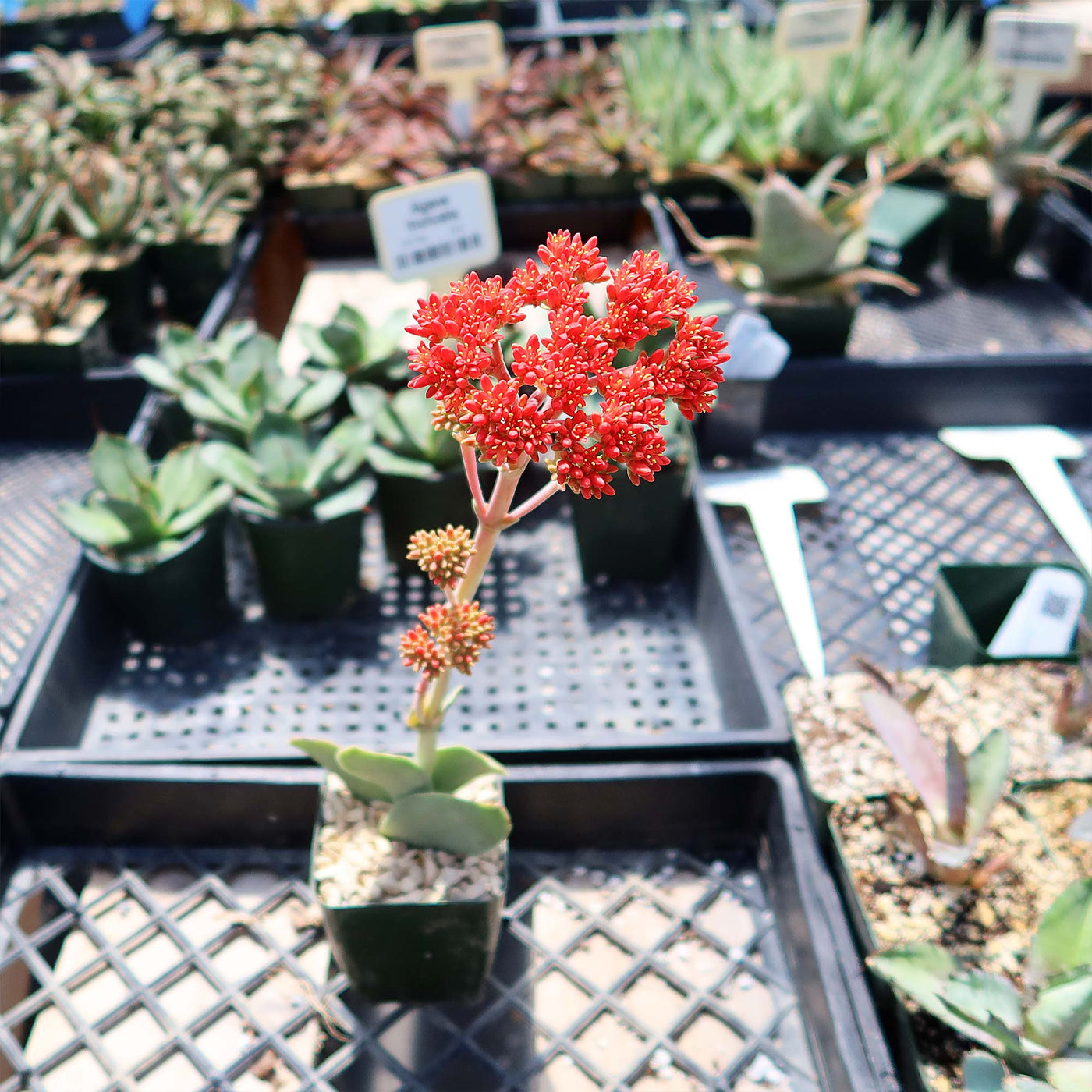
This Crassula falcata gets its common name, "propeller plant," from the distinct shape of its leaves, which resemble the blades of a propeller. It is also known as the airplane plant, distinguished by its propeller-shaped leaves, which give it a realistic appearance of taking off. These grey-green leaves with reddish edges are thick, triangular, and curved, which can become more pronounced as the plant grows in plenty of sunlight. It grows as a compact shrub, often reaching a height of 12 inches. 

The flowering of the propeller plant begins from late spring to early summer. Once fully bloomed, the star-shaped bright orange-red flowers easily last up to a month. The propeller crassula is easy to bloom but needs cooler conditions to encourage flowering in the summer months. Propeller succulents have a medium growth rate.  

To propagate Crassula falcata from stem or leaf cuttings during the spring or late summer of the season; is the best approach to grow healthy propeller Crassula from the mother plant. Additionally, offsets Crassula falcata will self-propagate, growing offsets. This summer dormant plant can be easily propagated and is one of the few succulents that grows well indoors. 

The propeller plant (Crassula falcata) is considered friendly to both humans and pets. So, you don't have to worry about any major toxicity issues with this propeller succulent.

Watering Needs 

When it comes to watering the Crassula falcata propeller plant, it's important to strike the right balance. This succulent doesn't like to be overwatered, as it can lead to root rot and other issues.  

The propeller plant prefers a "soak and dry" watering method. This means that you should thoroughly water your propeller plant, allowing the water to flow out of the drainage holes, and then wait for the soil to dry out completely before watering again. It's crucial to avoid letting the succulent sit in standing water, as this can cause root rot. During the hottest months of the year (summer), your plant may enter a dormant growth phase, which means its water requirements will be lower than usual.   

Remember, it's always better to underwater than to overwater this succulent. If you're unsure whether it needs watering, it's best to err on the side of caution and wait for the soil to dry out before giving it a drink. Observing the plant and checking the moisture level of the soil will help you determine the watering needs more accurately. 

Light Requirements 

For the best growth, this propeller plant should be exposed to full sun to partial sun. If growing indoors, it prefers a spot where it can get a good amount of bright, indirect sunlight, but not direct sunlight for prolonged periods. Placing it near a window with a sheer curtain or in a well-lit room would be ideal. 

If you notice that the leaves of your propeller plant are stretching or leaning toward the light source, it's a sign that it needs more bright sunlight. On the other hand, if the leaves start turning yellow or brown, they may be getting too much direct sunlight. 

Remember, finding the right balance is key. You want to provide enough light for your propeller plant to grow and thrive, but also protect it from intense, direct sunlight that can scorch its leaves. 

Optimal Soil & Fertilizer Needs 

Crassula falcatagrows healthily in well-drained soil. Use a well-drained specialty soil mix, as this type of potting soil mix has been precisely developed to imitate well-draining desert soils. Commercial succulent soil is affordable and accessible online. Here at Planet Desert, we have a specialty-formulated succulent potting mix that contains 5 natural substrates and organic mycorrhizae to promote the development of a strong root system that helps your propeller plant to thrive. 

As for fertilizer, the propeller plant doesn't require heavy feeding. You can use a balanced, water-soluble NPK fertilizer formulated. During the growing season (spring), fertilize your plant once a year. It's important not to over-fertilize your propeller plant, as this can cause excessive growth and weaken the plant. Always err on the side of caution and use a little less fertilizer than recommended, especially if your plant is in a small pot. 

Hardiness Zones & More 

The Crassula falcata propeller plant is native to South Africa; it is not cold hardy in general, but it can be grown outside in USDA hardiness zones 9-11. It prefers warm temperatures and can tolerate a range of temperatures between 50°F and 85°F. However, it is important to protect it from frost and freezing temperatures, as they can damage or kill the plant. 

In terms of humidity, the propeller plant is adaptable and can tolerate a range of humidity levels. It can thrive in average indoor humidity, but it also does well in drier conditions. However, it's important to note that excessively dry air can cause the leaves to shrivel, so it's a good idea to provide some moisture through occasional misting or placing a tray of water near the plant to increase humidity. 

Remember, providing the right temperature and humidity conditions can help your propeller plant thrive and stay healthy. 

Give this succulent a try if you're looking for an easy Crassula falcata propeller plant to care for!


Shipping Notes
  • Free Standard Shipping on $100+ Orders to the USA.
  • Except Preorder products are shipped in 48 hours.
  • Delivery to the USA:
  1. Standard Shipping : 3-10 business days
  • If time is of the essence, please consider selecting expedited delivery for faster service.
Exchange/Return Notes
  • We offer a 30-day return/exchange service after receiving.
  • Final sale items are not eligible for returns or exchanges.
  • To process your return/exchange, please contact us at [email protected]
  • Please click here for more details>>> Return & Exchange Policy
SKU: 89102287137

Discover Niche Categories That Outsell airplane plant succulent

Top-Converting Item to Boost Your Average Order

4.3 ★★★★★
Based on 7 reviews
Sort
Highest Rating
Newest First
Oldest First
Product Reviews
T
Verified Purchase
tavodu
Port Orchard, US
★★★★★ 5
Tried it, it worked!
Format: Paperback
I first have to say I practiced what the author tell us to do, and that semester I got A's on all my classes, and my GPA has improved considerably (I wish I had read this several years ago). I bought this book at the end of 2011 and decided to put to practice what it says. I was very amazed at my former roommate's 5.0 GPA and scholarship to Stanford once he got his minor in Biology. This guy would just come home, watch movies, go out with his girlfriend, play sports a lot, go dancing, etc. We never saw him cramming or pulling one all-nighter, NOT EVEN ONCE!. The other 2 guys were jealous studying like crazy but with 3.85 GPA. When I asked him about his success he said he wasn't doing anything special, except for staying in school until he finished his homework for the day. It didn't make sense since we saw him at home around 6 pm. "I just divide the work for each assignment unless it is too easy, and I never stay more than 1 or 2 hours doing just one assignment, That helps me usually get over 100% so at the end of the semester I don't have to worry too much about tests and other stuff like that; I don't read the whole thing, EVER! I would never be able to read the 100+ pages required each week, plus memorizing, and then doing an essay, it is ridiculous." I read a few books about getting A's (I am from Mexico so the grading system is different), but they all said the same: read the whole thing, learn everything to avoid surprises, repeat it but in your own words, make notes in every paragraph, develop mental maps, and so on... This book is different (some of the things are similar but not the same). Here's the most useful piece of advice I got from it: It is very often more important to know what NOT to study, than what to study. Time is very limited and we shouldn't waste it trying to read all the materials, learn absolutely everything for the tests, etc (especially the night before whatever is due). Your brain will shut off before you can do that, so you're better off knowing what you can and cannot do without burning out. I also have to say I enjoyed precious nights of deep sleep, and going to the test with a fresh mind (and scent), instead of tired, desperate, stinky, and trying to memorize 5 minutes before the test. This book is a lot about having free time to enjoy (not just getting drunk like some reviewers said) while others are wishing they would have studied earlier. It is a lot about structure and dividing the workload throughout the semester, month, week, day. You need to pay attention since at some point it could get a little tedious, like when he explains how to prepare for an essay. But if you try them they will work; the ultimate goal here is making college less tedious, more enjoyable, and an experience that will enrich your life instead of becoming a very expensive hell. It is also worth mentioning that the author is not giving you something he just though of, but these are common habits among top students attending top universities. I can also suggest you try the methods in the book and combine them with others such as mnemonics; I memorize whatever information I don't think I'll need in the future, and just pour it on the test, then forget about the rest; I do this ONLY with useless info that won't help me in any other class, and when I know the test will allow it (like multiple choice, short answers, yes/no, etc). Would definitely recommend it.
WAS THIS REVIEW HELPFUL?YesReportShare
Reviewed in the United States on September 14, 2012
M
Verified Purchase
Michelle Fehr
Omaha, US
★★★★★ 5
Struggling College Students...This is a Great Help!!
Format: Paperback
Picking up the book How to Become a Straight-A Student by Cal Newport I hoped to improve my study skills and eliminate my procrastination. Cal Newport is a professor at Georgetown University and is the author of five self-improvement books. He is the founder of Study Hacks, which is one of the Web’s most popular student advice blog. Newport uses his own knowledge of being a successful college student and conducted interviews receiving advice from top-scoring undergraduates from some of the “most rigorous colleges and universities – including Harvard, Princeton, Yale, Dartmouth, Brown, Columbia, Duke…” (3). Newport uses humor and an easy to understand conversational style of writing to keep the reader engaged. The book is set up in three parts. Part 1 is titled Study Basics and has 3 steps that it touches on. Part 2 is titled Quizzes and Exams and consists of 6 steps. Part 3 is titled Essays and Papers and has 8 steps. At the end of each part there are “Cheat Sheets” that summarize each part in a bullet style fashion. Two of the three steps spoken about in the book include “The Plan in Action” section. These sections use situational examples to give the reader a more visual explanation of the information the author describes. One of the most influential topics Newport touched on –I thought— was part one of his book – “Study Basics” (11). He splits this topic up into three steps. My favorite step was step one – “Manage Your Time in Five Minutes a Day” (19). The main idea of this section is to have a record of all your to-dos and deadlines on your calendar. Another thing I liked about the book was that Cal uses real life examples of successful college students to prove his point. He also uses direct quotes from top-rated students at major universities that said things like “Time management is critical – it’s a skill that you absolutely must develop over the course of your time at college” (19). Looking at the perspective from a student that already manages their time and occasionally gets that one low grade that they cannot for the life of the get up and is looking for helpful tips to fine tune that B to an A— this book is probably not for you. Although I do see the down side to this book to an audience that is already studious and knows how to manage their time, but overall, Newport has a lot of advice to give to student who are in the early stages of learning how to be a good student. A person might give a bad rating because it did not help them. People like me who chose to read this book because they were never really taught how to study, manage their time, or how write a college paper or know tricks in taking exams and tests – this book will help you; for that I am giving this book a 5/5 star.
WAS THIS REVIEW HELPFUL?YesReportShare
Reviewed in the United States on December 10, 2017
J
Verified Purchase
Jenny Rogers
Charlottesville, US
★★★★★ 5
this book was great, it helped me when I was a college student 10 years ago...
Format: Paperback
Now I work as a guidance counselor and I bought 5 copies to gift to my advisees for new years gift!
WAS THIS REVIEW HELPFUL?YesReportShare
Reviewed in the United States on January 24, 2026
J
Verified Purchase
Jerry Ninan Mathullah
Dallas, US
★★★★★ 5
This book was a game changer for me…
Format: Paperback
I’ve attempted college twice. On my first attempt I ended up with a 1.8 GPA which resulted in academic probation and a fair amount of tears. I took an almost ten year long hiatus thinking college wasn’t for me before trying again. Except this second time I knew I had to do something different, and that’s when I picked up this book. On my second attempt I ended up with a 3.9 GPA upon graduation and also felt I didn’t have to work myself to the bone to get those grades. I found the chapters on note taking and time management to be particularly useful. While it’s true that my success also had to do with some maturity I had gained over ten years, this book gave me the tools and a system that helped me immensely. It not only helped me academically, but taught me how to “work smarter, not harder.” In short, get the book. You won’t regret spending the money on it.
WAS THIS REVIEW HELPFUL?YesReportShare
Reviewed in the United States on July 26, 2024
A
Verified Purchase
Amazing!!!
Massapequa, US
★★★★★ 4
Good book
Format: Paperback
Good book
WAS THIS REVIEW HELPFUL?YesReportShare
Reviewed in the United States on May 12, 2026

recommand products