SKU: 89962747041
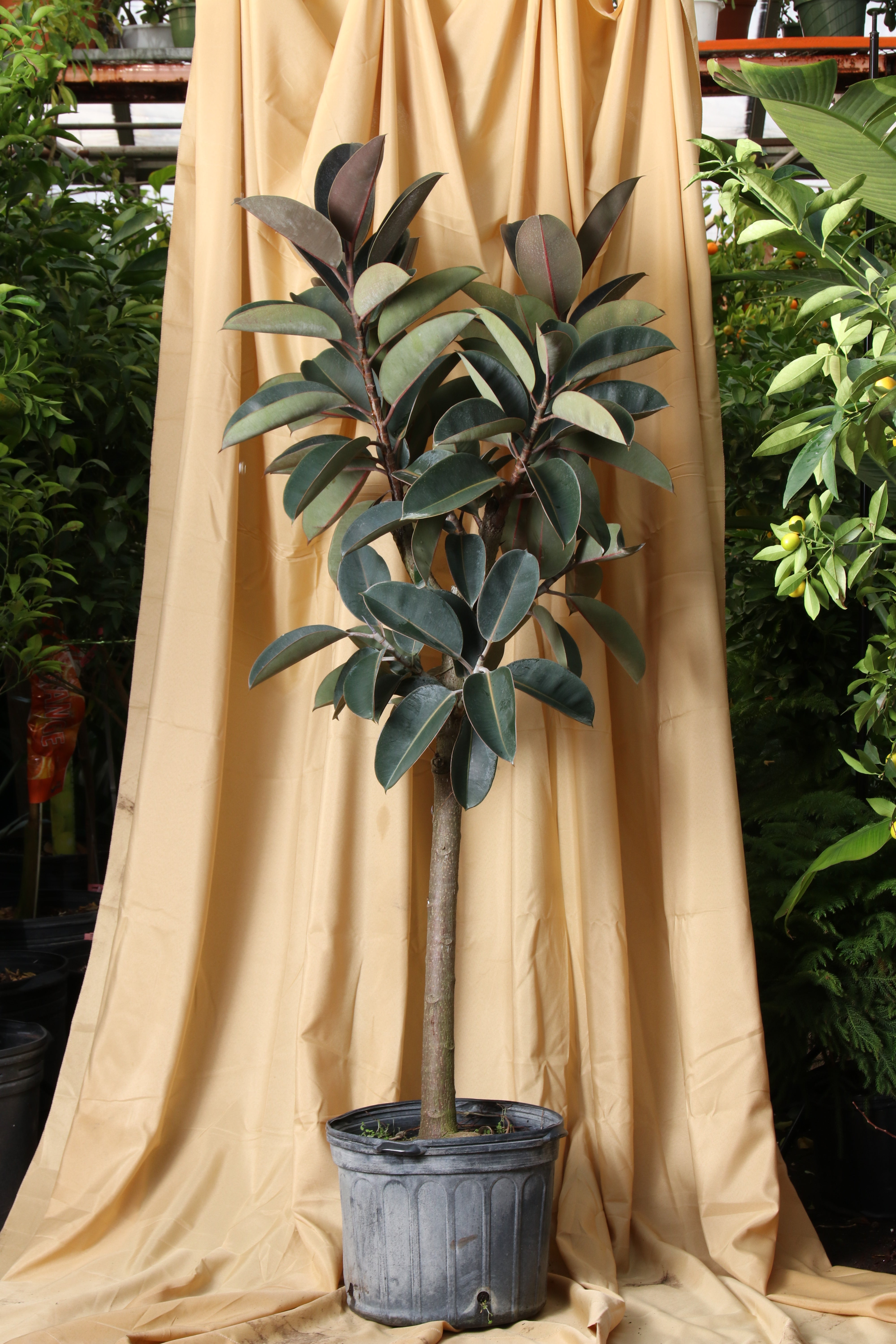
rubber tree plant ficus elastica

rubber tree plant ficus elastica Full Size Rubber Tree STD (Mature Trunk)

Sale price$21.18 Regular price$23.53
Save 10%

Pay in installments of $5.88 with ShopPay, AfterPay and Klarna

Shipping Estimate
USA
  • USA
  • CAN

Ships within 48 hours · Estimated delivery Oct 3 - Oct 8

Promo Codes Available:

For Your Every Summer RSVP, with Code: SUMMER15

Description

rubber tree plant ficus elastica Full Size Rubber Tree STD (Mature Trunk)Description Looking for a plant that brings authentic rainforest beauty into your home? Then we cant wait to introduce you to the magnificent Rubber Tree a stunning statement piece that will turn your space into a peaceful botanical retreat. Native to the Amazon rainforests, the Hevea brasiliensis gave the world natural latex. We're here to help you bring this tree into your home, where its impressive presence will definitely be a conversation

Description

Looking for a plant that brings authentic rainforest beauty into your home? Then we can’t wait to introduce you to the magnificent Rubber Tree - a stunning statement piece that will turn your space into a peaceful botanical retreat.

Native to the Amazon rainforests, the Hevea brasiliensis gave the world natural latex. We're here to help you bring this tree into your home, where its impressive presence will definitely be a conversation starter. With smooth bark and wonderfully glossy leaves, this beauty deserves a special (large) place in your plant collection.

Care 

Is a rubber tree a good indoor plant?

The rubber tree needs more space than many houseplants, but we believe it's absolutely worth it for the joy it brings! If you have the ceiling height, this beautiful specimen will become the heart of your room.

Are rubber trees hard to keep alive? 

Your rubber tree will thrive with consistent, loving attention to its basic needs. But it only needs regular care with steady temperatures, watering, and bright light. We promise it's not overwhelming! With our guidance, it will flourish.

This Amazonian beauty rewards dedicated care with years of green happiness, becoming a cherished part of your home and daily routine.

How often should I water a rubber plant? 

We recommend watering your rubber tree when the top 2-3 inches (5-8 cm) of soil feel dry. Think of recreating that perfect rainforest environment - consistently moist but never waterlogged. Check regularly whether it has just the right amount of moisture.

Where should I place a rubber tree in my house? 

Your rubber tree is happiest near an east- or south-facing window with bright, indirect light. We suggest avoiding direct afternoon sun, which can stress the leaves. Finding the perfect spot for your new giant friend is part of the joy! 

Can rubber tree plants live in bathrooms? 

Bathrooms can be wonderful homes for rubber trees! If your bathroom has bright light and enough space for growth, your plant will love the almost-tropical humidity. Make sure there’s proper ventilation, and you’re good to go!

What fertilizer should I use for a rubber tree? 

We recommend feeding your rubber tree with a balanced liquid fertilizer monthly during spring and summer. Think of it as providing loving nutrition for steady, healthy growth. Regular feeding helps your gentle giant plant stay strong and vibrant!

What does rubber tree plant care involve? 

Caring for your rubber tree involves providing bright indirect light, consistent moisture, regular feeding, and occasional leaf cleaning. We see plant care as being a beautiful relationship - the more attention you give, the more your plant flourishes!

Does a rubber tree need sunlight? 

Your rubber tree needs bright, indirect sunlight for at least 6 hours daily to stay healthy and happy. We always recommend filtered light similar to its rainforest home - gentle but consistent throughout the day. Direct afternoon sun can damage leaves.

Pet-friendly?

We care deeply about all family members, including pets. Unfortunately, the rubber tree isn't pet-friendly due to its latex sap containing ficin and other compounds. 

Are rubber tree plants toxic to dogs? 

Rubber trees are toxic to dogs, as their latex sap contains ficin compounds that can cause gastrointestinal upset and oral irritation. If your dog has ingested any part of your rubber tree plant, please contact your veterinarian immediately.

We're here to help you choose pet-safe alternatives if needed, ensuring both your plants and pets can coexist safely.

How toxic is a rubber plant to cats? 

The rubber tree is toxic to cats, potentially causing oral irritation, drooling, and digestive issues. If your cat has chewed on your rubber tree, please seek veterinary care right away. We understand how important pet safety is.

We can recommend beautiful cat-friendly plants that provide a similar impact while keeping your feline friends completely safe.


Factoids

What is the difference between a rubber plant and a rubber tree? 

The rubber tree (Hevea brasiliensis) is the authentic latex-producing species that grows impressively large, while the rubber plant (Ficus elastica) is its smaller ornamental cousin. We're proud to offer you the genuine rubber tree with Amazonian heritage!

Do rubber trees make rubber? 

Your rubber tree (Hevea brasiliensis) is the very species that produces commercial latex for countless products. So you're nurturing a piece of industrial history in your home - a plant that’s shaped the world (and looks great while doing it)!

Does a rubber tree purify air? 

Your rubber tree contributes to air purification through its large leaves, creating oxygen and improving humidity levels. While not the most efficient air purifier, it brings a piece of the Amazon's natural air-cleaning power into your space.

What is the lifespan of a rubber tree? 

With proper care, your indoor rubber tree can live for a truly long time, even several decades! Wild specimens can reach 100 years. We're honored to help you start this long-term relationship with a truly special gentle giant.

Do they still use rubber trees to make rubber? 

Hevea brasiliensis remains the world's primary natural rubber source, with plantations across Southeast Asia producing latex for tires, medical supplies, and so much more. It’s amazing that your houseplant shares DNA with the trees that keep the world moving.

What is the spiritual meaning of a rubber tree? 

The rubber tree symbolizes resilience, adaptability, and abundance - qualities we admire deeply. Indigenous Amazonian peoples considered it sacred because it represented the forest's generosity, while modern interpretations connect it to flexibility in life's challenges and personal growth.

Is the rubber tree fruit edible? 

The rubber tree fruit isn't edible - really they're seed capsules that explode when ripe, naturally dispersing seeds. Your indoor rubber tree rarely fruits, rather focusing its energy on producing those beautiful leaves we all love so much.


Buy a Rubber Tree

We'd love to help you welcome a magnificent rubber tree into your home! This stunning plant brings authentic Amazonian beauty and creates a truly special atmosphere in any large space. Our team is passionate about perfect matches.

Let us guide you through our video shopping experience to find your ideal rubber tree. We'll be with you every step of the way, from selection to delivery to ongoing care. Your space deserves this living piece of botanical history, and we're here to make sure it thrives under your loving care!


Shipping Notes
  • Free Standard Shipping on $100+ Orders to the USA.
  • Except Preorder products are shipped in 48 hours.
  • Delivery to the USA:
  1. Standard Shipping : 3-10 business days
  • If time is of the essence, please consider selecting expedited delivery for faster service.
Exchange/Return Notes
  • We offer a 30-day return/exchange service after receiving.
  • Final sale items are not eligible for returns or exchanges.
  • To process your return/exchange, please contact us at [email protected]
  • Please click here for more details>>> Return & Exchange Policy
SKU: 89962747041

Discover Niche Categories That Outsell rubber tree plant ficus elastica

Top-Converting Item to Boost Your Average Order

4.0 ★★★★★
Based on 14 reviews
Sort
Highest Rating
Newest First
Oldest First
Product Reviews
J
Verified Purchase
Jon Hunt
Draper, US
★★★★★ 5
One Nation Under God.....Divisible
Format: Hardcover
"How Corporate America invented Christian America" is a perfect subtitle to Kevin Kruse's excellent book, "One Nation Under God", for as the author discusses, this is what happened to our culture over the course of several decades. It's an eye-opener and he presents an offering full of depth and insight. As Kruse reminds us in the epilogue, the source of America's becoming a "Christian" nation stems from the vitriol of those clergymen who opposed the New Deal. James Fifield and Abraham Vereide, two early proponents of this new America they sought, gave way to Billy Graham and Pat Robertson, who cemented the fact that God and the Republican party were joined at the hip. A large part of the book deals with how U.S. presidents dealt with the issue. Dwight Eisenhower presided over the change in the Pledge of Allegiance to include, "One Nation under God" and that American currency now bore the phrase "In God We Trust". His chapters lay the necessary groundwork nicely for the two most revealing chapters, "Our So-Called Religious Leaders", which largely deal with efforts to pass a constitutional amendment requiring school prayer, and "Which Side Are You On?", an intense look at how shamelessly Richard Nixon and his administration publicy made God "their own". While it is hard to imagine today the thousands of billboards and leaflets displayed in the manner that they were in the 1960s, the undercurrent of nastiness that exists to "promote" God remains. You can hear it in the Tea Party. What Kevin Kruse reminds us is that religion was, and still is, as divisive a force as any we have had in the past and have in America today.
WAS THIS REVIEW HELPFUL?YesReportShare
Reviewed in the United States on April 27, 2015
A
Verified Purchase
Alice Friedemann
Boise, US
★★★★★ 5
How Corporate America created free-enterprise Jesus to undo the New Deal
This book tells the history of how corporate America have tried to undo New Deal reforms since the 1940s by creating a new free-enterprise religion, and to erode the separation of church and state. Corporate America’s creation of a free-enterprise selfish Jesus began in 1935 with the founding of an organization called Spiritual Mobilization. Some of the corporations who donated money to this and similar organizations include: American Cyanamid and chemical corporation, Associated Refineries, AT&T, Bechtel Corporation, Caterpillar Tractor Company, Chevrolet, Chicago & Southern Airline, Chrysler corporation, Colgate-Palmolive Company, Deering-Milliken, Detroit Edison, Disney, DuPont, Eastern Airlines, General Electric, General Foods, General Motors, Goodwill, Goodyear Tire & Rubber, IBM, J. C. Penney, J. Walter Thompson, Mark A. Hanna, Marriott, Marshall Field, Monsanto Chemical Company, National Association of Manufacturers, Pacific Mutual Life Insurance, Paramount Pictures, PepsiCo, Precision Valve Corp, Quaker Oats, Republic Steel Corp, Richfield Oil Co., San Diego Gas & Electric, Schick Safety Razor, Standard Oil Company, Sun Oil company, Sun shipbuilding company, Union Carbide and Carbon Corporation, United Airlines, US Rubber company, US steel corporation, Utah Power & Light, Warner Bros. Pictures, Weyerhauser. In the 1930s, corporations were well known to have brought on the Great Depression with their tremendous greed and dishonesty. The New Deal reformed the financial system, distributed wealth more evenly, provided a social safety net, protected the people by regulating businesses to protect them from unsafe and unhealthy food, drugs, and other products, toxic pollution, aided farmers in slowing soil erosion to prevent more dust bowls (and feed Americans for hundreds of years-- good topsoil is America’s most important treasure), and other public services that benefited everyone. The New Deal embodied the ideals of the Social Gospel, a movement dedicated to the public good, economic equality, eradication of poverty, slums, child labor, an unclean environment, inadequate labor unions, poor schools, and war (Wiki Social Gospel). Corporate America fought against these reforms and has been trying to undo the New Deal ever since then. One of their most successful tactics was getting religious leaders to spout a new version of Jesus – a free-enterprise, Ayn Rand, selfish Jesus and eradicate the Social Gospel Jesus of the New Deal. At first ministers and people saw through since this propaganda was obviously craven corporate self-interest. So the propaganda was crafted more subtly, and sold to conservative religious leaders. Congregations then listened to sermons about the free-enterprise Jesus with open hearts and minds, which they would have laughed at if the speaker were a CEO. The new religion taught them to hate unions, social welfare, to fear and hate government, to be against abortion and birth control (mainly because the more people there are, the less industries have to pay them). It was broadcast from conservative religious radio and TV stations, and in the secular world. This is why you don’t have a chance of talking Uncle Bob out of voting for demagogues at the Thanksgiving table – you’re attacking his religion and core beliefs he’s heard since his first sermon, and his brain shuts down in anger. He’s been taught since he was a baby that he should hate and fear government, not corporations. People like to say that capitalism is imperfect, but the best system that exists. Well, it’s great at raping, pillaging, and poisoning land, water, and air than any other system. Industrial farming is depleting aquifers and eroding and compacting top soil to the point where it won’t produce much food after centuries rather than millennia. Global conventional oil production, where 90% of our oil comes from, peaked in 2005 (Aleklett et al. 2012; Kerr 2011; Murray 2012; Newby 2011; IEA 2010; Zittel et al. 2013), declining at a rate of 6% now and increasing to 9% by 2030 (Hook 2009). According to the Department of Energy, you’d want to prepare at least 20 years ahead of time for peak oil (Hirsch 2005), yet here we are 12 years after peak conventional oil, with both Democrats and Republicans assuming that endless growth on a finite planet will fix things. We don’t have endless energy, it turns out that earth is not a giant gas tank, and even if it were, exponential growth would drain it in centuries. There isn’t a single endeavor that doesn’t depend on energy, especially supply chains, mining, logging, construction, and road building, which are done with heavy-duty trucks, which can only accomplish their work with diesel engines that burn only diesel (Friedemann 2015). Since the social net is funded by an ever-expanding working population and growth, social security and Medicare are Ponzi schemes, as well as our financial system, which depends on growth to pay back debt. The corporations are about to get the death of the New Deal they’ve so wanted via the decline of our fossil-fueled civilization. There is no political party that can fix this, so it’s time to strengthen your community to become more resilient, self-sufficient, and able to supply food and other essentials locally. To fix water and sewage infrastructure. It’s time to embrace the social gospel and help community members less fortunate than you in the years ahead. Aleklett, K., et al. 2012. Peeking at peak oil. Berlin: Springer. Hook, M., et al. 2009. Giant oil field decline rates and their influence on world oil production. Energy Policy 37(6):2262–2272. Friedemann, A. 2015. When trucks stop running, Energy and the Future of Transportation. Springer. Kerr, R. 2011. Peak oil production may already be here. Science 331:1510–11. Murray, J., et al. 2012. Oil’s tipping point has passed. Nature 481:43–4. Newby, J. 2011. Oil Crunch (Fatih Birol). Catalyst. ABC TV. IEA. 2010. World energy outlook 2010, 116. International Energy Agency. Zittel, W, et al. 2013. Fossil and nuclear fuels. Energy Watch Group.
WAS THIS REVIEW HELPFUL?YesReportShare
Reviewed in the United States on January 9, 2017
S
Verified Purchase
Star Quest
Charlottesville, US
★★★★★ 4
Very Interesting and Important Book
Format: Hardcover
It took me a long time to read this book, but I highlighted and took notes all over it. It’s absolutely fascinating and well researched and I personally think it should be required reading in seminaries across the nation. Understanding how Christianity as a religion penetrated the fabric of American politics after FDR’s presidency and the New Deal is an important part of understanding American politics in the first place. I also realized what bothered me about this in the first place. Our founding fathers specifically wrote the bill of rights and the constitution to protect freedom of religion and also to keep it out of state affairs. This unfortunately is not what happened throughout the last 60 years. It is clear that prominent Christian figures throughout the decades have infiltrated American politics, some more than others. In my younger years I was oblivious to this and in some instances promoted American Christianity in the political discourse. After many years of intense research and study I understood why that is not healthy for our republican constitutional form of government. Ever Since president Regan said the famous words “God Bless America” at the end of a speech, the phrase has been shoved down the ears of the American populace over and over again by political leaders to this very day. The playing of the National Anthem synonymous with “God Bless America” phrases and tunes has also in my opinion and observations, contributed to religious nationalistic patriotism. And although I am by no means against loving and appreciating one’s country, I also see the coercive methods of these efforts and am concerned that is creates a blind sense of obedience to the state under a religious umbrella which tarnishes Christianity as a whole. I also acknowledge that having the state influence, dictate and decide what is right for our lives is just as unhealthy and dangerous. If looked at from a practical standpoint, understanding the founding documents of our nation’s founding and establishment is exactly what keeps the healthy political balance alive. I did have one issue with the authors writing and interpretation which significantly bothered me. The author categorized members such as Billy Graham and James Fifield among other pioneers of the movement as Christian Libertarians. I wholeheartedly disagree with that title. If one studies and understands the core of what Libertarianism is about, it is specifically against forcing or coercing any particular religion regardless of political or social means especially through the state. Libertarians acknowledge the right to believe in a religion or no religion. The fact that Reverend Graham utilized his religious position to influence politics is very much anti-libertarian and a vast majority of libertarians will very likely agree with that position. I suggest the author study libertarianism a bit more and do more research before tainting that label. Despite that hurdle, I still thought this was a very good and important book.
WAS THIS REVIEW HELPFUL?YesReportShare
Reviewed in the United States on May 11, 2019
J
Verified Purchase
Jon Becker
Bozeman, US
★★★★★ 5
Essential History for Retaining Reason and Rationality for Guiding the Nation
Awesome book on the History of people, themes and big money, corporate used in an attempt to make one religion the National Religion while neutering the First Amendment. It is true to it's title in detailing how Corporations and Religion came together to fight the New Deal of FDR. These two self serving entities fought for control of the people but did almost nothing to avert wide spread hunger and homelessness in the depression. The fortunes of corporations and insistence of religions on controlling the minds of people to produce jobs in their own occupations outweighed the immediate needs of the jobless and homeless. The opulent lifestyles of the big religions and their organizers came first over the health and welfare of the country, just like it had in Medieval Europe, where the Aristocrats and the Christian Churches ran the Continent. These two institutions were responsible for keeping Democracy out of Europe and ultimately creating the Soviet Revolutions in Russia that attempted to spread to the rest of the World. What is clear, from many books on this subject, that "Under God" means being subservient to God, the word of which comes from God's messengers. Subservience Under God means that when the opinions of the People differ from those of God as told through the Messenger, then God wins and the People Shut Up. Those that don't face stiff penalties. Fabulous History that everyone should know if they want to perpetuate a Democracy. The Roman Empire was "One Nation Under God", because the Christian Religion was the only legal Religion and it had only One God - no others were allowed and this was enforced with the sword. Rome will return to America if we are not careful.
WAS THIS REVIEW HELPFUL?YesReportShare
Reviewed in the United States on October 22, 2015
M
Verified Purchase
Michael Keller
Birmingham, US
★★★★★ 3
Stranded on third base
Format: Hardcover
Prof. Kruse wanders away from the promise of the subtitle of his book--"How corporate America Invented Christian America." He almost gets there when he describes the ideological opposition of the wealthy to F.D.R's "New Deal." and their caricature of the "social gospel" as Communist propaganda. His description of Truman's encounter with Billy Graham is wonderful. For a book published in 2015, Kruse makes only slight mention of the fact that the politics of money and religion in contemporary times becomes more pernicious every day. The main body of the book drifts into redundant detail about "who prayed with who" and the spiritual influence of prominent evangelists on presidents from Eisenhower to Bush with only faint reference to their ties with the Capitalist agenda. He portrays wealthy Christians as true religious zealots when, in fact, they and many of the politicians they supported were likely hypocrites using religion as a wedge issue to increase their power and pursue their agenda of unregulated Capitalism. It is remarkable that Kruse entirely fails to mention the Koch brothers--billionaires who bankroll countless ultra right-wing politicians with evangelical agendas, while they, themselves, are apparently Ayn-Rand-style libertarian atheists interested only in a social-Darwinian, Capitalist heaven. Prof. Kruse leaves us stranded on third base, when he could have hit a home run!
WAS THIS REVIEW HELPFUL?YesReportShare
Reviewed in the United States on May 7, 2015

recommand products