SKU: 9008122023
sago palm planter

sago palm planter Buy Sago Palm Phoenix, AZ | Cycas revoluta

Sale price$26.94 Regular price$29.93
Save 10%

Pay in installments of $7.48 with ShopPay, AfterPay and Klarna

Shipping Estimate
USA
  • USA
  • CAN

Ships within 48 hours · Estimated delivery Aug 4 - Aug 9

Promo Codes Available:

For Your Every Summer RSVP, with Code: SUMMER15

Description

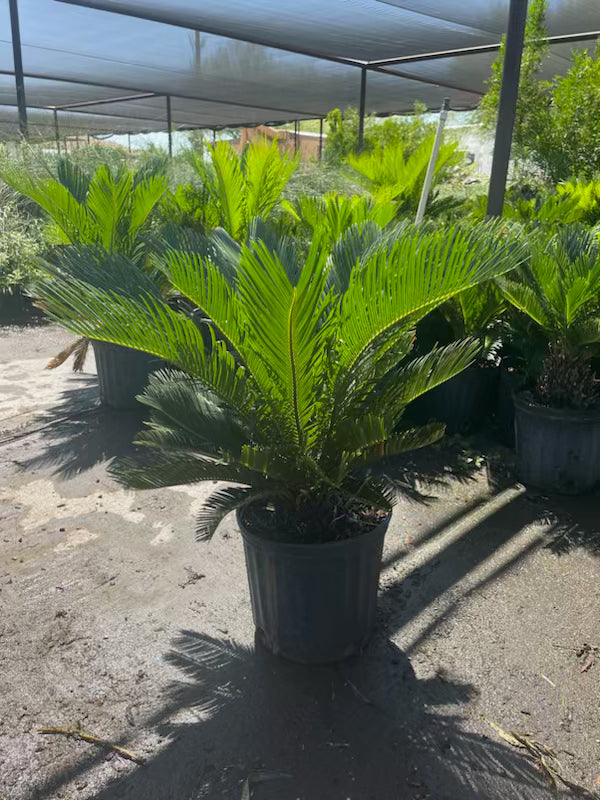
sago palm planter Buy Sago Palm Phoenix, AZ | Cycas revolutaA Prehistoric Showpiece for Phoenix Gardens Sago Palm The Sago Palm (Cycas revoluta) is one of the most striking and timeless accent plants for Phoenix landscapes. Despite its name, the Sago isnt actually a palm its a cycad, an ancient plant group that predates the dinosaurs. With stiff, glossy dark green fronds radiating in a perfect symmetrical rosette from a thick, rough textured trunk, the Sago Palm adds bold architectural drama to any setting.

A Prehistoric Showpiece for Phoenix Gardens — Sago Palm

The Sago Palm (Cycas revoluta) is one of the most striking and timeless accent plants for Phoenix landscapes. Despite its name, the Sago isn’t actually a palm — it’s a cycad, an ancient plant group that predates the dinosaurs. With stiff, glossy dark green fronds radiating in a perfect symmetrical rosette from a thick, rough-textured trunk, the Sago Palm adds bold architectural drama to any setting. Slow-growing and incredibly long-lived, Sagos thrive in the Phoenix heat with minimal water and care. Whether you’re designing a modern Scottsdale courtyard, accenting a Chandler entryway, or adding year-round texture to a Gilbert patio — the Sago Palm is a timeless, low-maintenance choice.

Sago Palm Plant Details

Attribute Detail
Scientific Name Cycas revoluta
Common Names Sago Palm, King Sago, Japanese Sago Palm
Mature Height 6–10 feet (very slow to reach full height)
Mature Width 6–8 feet (frond spread)
Growth Rate Very slow — 1–2 new frond flushes per year
Sun Full sun to partial shade. Handles reflected heat but appreciates afternoon shade in hottest months.
Water Low once established. Very drought-tolerant.
USDA Zones 8b–11 (Phoenix is Zone 9b–10a)
Soil Well-draining required. Adapts to Arizona caliche soils if drainage is adequate.
Foliage Evergreen — stiff, glossy dark green fronds year-round
Type Cycad (not a true palm)

Sago Palm Uses in Phoenix Landscapes

Modern Desert Entryways & Courtyards

Sago Palms are a designer favorite for framing front doors, flanking garage entries, and anchoring courtyard plantings in Scottsdale, Paradise Valley, and Arcadia. Their perfect symmetry and sculptural form pair beautifully with clean-lined architecture and gravel mulch. Plant a matched pair for formal balance, or use a single large specimen as a dramatic focal point.

Container & Patio Plantings

Because of their compact size and slow growth, Sago Palms are ideal for large containers on Chandler and Tempe patios, pool decks, and balconies. A 15-gallon Sago in a decorative pot adds instant tropical-modern texture to outdoor living spaces. They also work well in narrow side yards and tight planting beds where larger palms won’t fit.

Rock Garden & Desert Modern Accents

Sagos pair perfectly with desert rock mulch, agave, and other succulents for a textured, layered desert garden in Mesa, Gilbert, and Peoria. Their dark green fronds create striking contrast against lighter gravel and boulders. Group 3–5 at varying sizes for a naturalistic cycad garden effect.

Best Time to Plant Sago Palm in Phoenix

Fall (October–November) is the ideal planting window. Warm soil promotes root establishment while cooler air reduces stress. Spring (February–April) is the second-best window. Sago Palms can handle summer planting if kept consistently watered during the first few weeks, but a fall start gives the best results for long-term establishment.

How to Plant Sago Palm

  1. Dig wide, not deep — excavate 2–3x the root ball width at the same depth. Sagos have shallow root systems and must not be planted too deep.
  2. Check for caliche — good drainage is critical. Break through any hardpan layer. If drainage is poor, consider a raised bed or mound.
  3. Backfill with native soil — a light 20% sand or perlite amendment improves drainage in heavy soils.
  4. Spacing — plant 4–6 feet apart for grouped plantings; 6–8 feet from structures to allow full frond spread.
  5. Water basin — build a 3–4 inch soil ring to direct water to roots during establishment.
  6. Mulch — 2–3 inches of gravel mulch around the base. Avoid piling organic mulch against the trunk.

Watering Sago Palm in Phoenix

First Year Watering Schedule

  • Weeks 1–2: Every 2–3 days, deep and slow
  • Months 1–2: Every 4–5 days
  • Months 3–6: Every 7–10 days
  • After Year 1: Every 10–14 days in summer; monthly in winter

Drip Irrigation

Place 1–2 emitters (1–2 GPH) 12–18 inches from the trunk. Sago Palms are very drought-tolerant once established and are easily overwatered. Let the soil dry between waterings — soggy soil causes root rot, which is the #1 killer of Sagos in Arizona.

How fast does Sago Palm grow in Phoenix?
Sago Palms are very slow growers. They produce 1–2 flushes of new fronds per year and may add only an inch or two of trunk height annually. A 5-gallon Sago will take many years to reach its mature size of 6–10 feet. For instant impact, start with a larger 15 or 25-gallon specimen.

Is Sago Palm drought tolerant?
Very much so. Established Sago Palms are among the most drought-tolerant landscape plants available. They store moisture in their thick trunks and need only deep, infrequent watering once their root systems are established.

Are Sago Palms toxic?
Yes — all parts of the Sago Palm are toxic to pets (especially dogs) and humans if ingested. The seeds are the most toxic part. If you have curious pets, consider placing Sagos in areas pets can’t access, or choose a pet-safe alternative.

Is Sago Palm actually a palm?
No. Despite its common name, the Sago Palm is a cycad — a primitive plant group that has existed for over 200 million years. Cycads are more closely related to conifers than to true palms. Their prehistoric lineage gives them a unique, sculptural appearance that true palms don’t have.

Do Sago Palms survive Phoenix freeze events?
Sago Palms are cold-hardy to about 15°F, making them very resilient during Phoenix’s rare winter freezes. They may show some frond burn after a hard frost, but the plant typically recovers fully with new growth in spring.

You May Also Like

  • Pygmy Date Palm — a compact feather palm for patios and small spaces, with soft arching fronds.
  • Mediterranean Fan Palm — a multi-trunk fan palm with a sculptural form, great for desert modern designs.
  • Pineapple Palm — a bold statement palm with a massive crown and thick textured trunk.
  • Desert Spoon — a native Arizona accent plant with blue-green rosettes and a similar architectural feel.

How Many Sago Palms Do I Need?

Sago Palm is a slow, sculptural cycad with a 6 to 8 foot frond spread, so it is set as a specimen or grouped, never run as a hedge. Use these layouts:

  • Single focal point: one large Sago in a courtyard, entry bed, or decorative pot, set 6 to 8 feet from walls so the rosette spreads symmetrically.
  • Matched pair: flank a front door or garage with two for formal balance, each 6 to 8 feet off the structure.
  • Cycad grouping: cluster 3 to 5 at varying sizes 4 to 6 feet on center for a naturalistic rock-garden effect.

The fronds are stiff and lightly spine-tipped, so keep the rosette 2 to 3 feet back from walkways and seating where people brush past.

Sago Palm Season-by-Season in Phoenix

  • Spring (Feb–Apr): the main event, a single symmetrical flush of bright new fronds rises from the crown; a strong second planting window.
  • Summer (May–Sep): tough in heat and reflected heat, though afternoon shade keeps fronds their deepest green in the worst of it. Let soil dry between deep soaks, since wet summer roots invite rot. A second light flush can follow monsoon rains.
  • Fall (Oct–Nov): the prime low-desert planting season; the glossy crown holds as growth slows.
  • Winter (Dec–Jan): evergreen and cold-hardy to about 15°F, shrugging off typical Valley freezes. A hard frost may brown some fronds, but the plant pushes fresh growth in spring.

At a Glance

✔ Heat-Loving (Reflected-Heat Tolerant)   ✔ Drought-Tolerant   ✔ Evergreen   ✔ Pool-Friendly (Low-Litter)   ✔ Low-Maintenance   ✔ Deer & Rabbit-Resistant   ✔ Cold-Hardy to 15°F

Plant It With

  • Desert Spoon: a native blue-green rosette with a matching architectural feel for a low-water accent.
  • Pygmy Date Palm: a compact feather palm that softens the Sago's stiff rosette in a grouping.
  • Mediterranean Fan Palm: a sculptural multi-trunk palm for desert-modern layering.
  • Pineapple Palm: a bold full-size crown to tower over a Sago understory.

Is Sago Palm Right for Your Yard?

Sago Palm thrives in Phoenix sun with a little afternoon shade, asks for very little water, and adds timeless architectural form to courtyards, entries, pots, and rock gardens with almost no upkeep. It is not a fit if you have curious pets or small children, or want fast results: every part of the plant is toxic if chewed or eaten, and it is one of the slowest-growing plants you can buy.

Shipping Notes
  • Free Standard Shipping on $100+ Orders to the USA.
  • Except Preorder products are shipped in 48 hours.
  • Delivery to the USA:
  1. Standard Shipping : 3-10 business days
  • If time is of the essence, please consider selecting expedited delivery for faster service.
Exchange/Return Notes
  • We offer a 30-day return/exchange service after receiving.
  • Final sale items are not eligible for returns or exchanges.
  • To process your return/exchange, please contact us at [email protected]
  • Please click here for more details>>> Return & Exchange Policy
SKU: 9008122023

Discover Niche Categories That Outsell sago palm planter

Top-Converting Item to Boost Your Average Order

4.3 ★★★★★
Based on 30 reviews
Sort
Highest Rating
Newest First
Oldest First
Product Reviews
J
Verified Purchase
Jonnie Sparko
Battle Creek, US
★★★★★ 5
An Epic tale and more...
Format: Paperback
I couldn't be happier with this book. Not only does this carry the cosmic Spidey issues that crossed over through the three Spidey books of the time, Amazing, Spectacular, and Web of Spider-Man, but also the 1990 annuals of each book, which had our hero shrunken down to the size of an insect and smaller, fighting alongside Ant-Man against would be technology thieves and then through the Microverse. We have the full annuals so there's even stories featuring Mary Jane, Aunt May, and others in the Spidey universe. With the inclusion of the Punisher and Venom Amazing Spider-Man issues, it almost feels like three trades in one thick book of Spidey goodness. The art is fantastic also. From Sal Buscema's underrated Spectacular series, to Erik Larsen's Amazing series, and even Todd McFarlane's last Amazing Spider-Man issue where Spidey punches The Hulk so hard, he leaves him orbiting Earth! While this book has several writers and various other artists, I still find this to be a cohesive collection well worth the price of admission.
WAS THIS REVIEW HELPFUL?YesReportShare
Reviewed in the United States on December 12, 2013
A
Verified Purchase
Adam Graham
Draper, US
★★★★★ 4
Spidey SMASHES Hulk
Format: Paperback
This book presents nearly 500 pages of Spidey Comics from 1989-90, Collecting Amazing Spider-man 326-333 and Annual #24, Spectacular Spider-man 158-160 and Annual #10, and Web of Spider-man 59-61 and Annual #6. The big event of this comic ties into the much larger Acts of Vengeance story arc. Several supervillains team together, realizing that they've been losing to the same people for 25-30 years. They come up with the idea of trading and going after each other's enemies, thinking that the heroes will not know how to react. (Apparently, it never occurs to them that they will also not really be able to respond to the heroes techniques.) Because Spidey at that point had three magazines a month, that met he'd be hit with three times the rivals. But after serving the first attack of Graviton, Spidey has an accident that ramps up his powers and makes all attacks on him go very badly for the villain with one villain even getting accidentally killed in the process. I have to admit that there was something wonderfully pleasing about Spidey knocking around the likes of Magneto and the Hulk like they were rag dolls. Seriously, the first nine issues in this book, are Spidey kicking one threat after another as he has power on par with the Silver Surfer. We don't learn until the last issue the real reason for the power and longtime readers had to be scared that this was another alien costume, and in a way it was, but if this was like the symbiote, it was a good force that bestowed the uni-power when it was needed. The whole thing has a pretty satisfying ending. Probably my chief complaint with this book is that the true core of the Cosmic Power ends on page 210, really, AS #329-333 have nothing to do with the Cosmic Powers story and the Annuals are very vaguely related. AS #329 and 330 is a somewhat violent (but not overly so by today's standards) crossover with the Punisher battling drug cartels and a US government plot to smuggle drugs. The story has some serious moments but ends with one of the goofiest concepts in comics ("Cocaine Standard" 'nuff said). Issues #331-333 is solid story of Eddie Brock/Venom escaping prison and it's interesting in its own right. There's a three part story spread across all three annuals in which Spider-man is shrinking. At first in the Amazing Spider-man Annual, it looks like it's because of inhaling Ant Man's shrinking gas but it's not that at all as we find out in the other two annuals. The story is decent enough, though Marvel's decision to make people buy all three annuals back in 1990 was somewhat chintzy, though defensible since the story runs 70 pages. For 70 pages, it was good but not great. However, Marvel actually reprinted everything in the annuals which is a bit of a mixed bag for readers. On one hand, you get the full Annuals with all the extras. On the other, it breaks up the "Spidey's Totally Tiny Adventure Story" and you get a very mixed bag of extras. My thoughts: "The Mercy Bomb"-A story told in part by Spider-man co-creator Steve Ditko. Seemed to have an anti-war message but didn't tie into anything and was just blah. Grade: D "A Time to Choose/The Choice":Whatever can be said for spreading the 70 page Spider-man story across three annuals. There was really no reason to break this story of a reformed Sandman facing a tough choice when he's offered a chance to go back to the old life of crime by the Trapster and the Wizard. It's an okay story but seems a little forced. Grade: C+ "Pete and MJ's New Pad"-After the loss of their condo to an unethical real estate developer, Pete and MJ moved into a new apartment. This special feature took a look at the apartment revealing that it's an average apartment with nothing interesting in it. Grade: D "Amazing Fantasy"- A not so Amazing dream sequence filler. Grade: F "Pale Reflection"- Former Spider-man villain Hobie Brown goes on a job and learns that he can get beat up. Really? Grade: D- "What I Did on My Summer Vacation"-A ten page story featuring juvenile delinquent turned crimefighter Rocket Racer, who'd appear in Spider-man: TAS. An okay but not great story. Grade: B "Sales Day for a Shootout:" Aunt May helps the Punisher kill terrorists. Actually surprised at how positively the Punisher was portrayed in this. Grade: B+ "Eleven Angry Men and One Angry Woman:" This take on Twelve Angry men as Mary Jane as the only hold out on a jury ready to acquit a defendant who claims Spider-man was a thief. There's some humor and a little bit of poignancy. Of course, the wife of Spider-man shouldn't be on this jury but it was a fun story. Grade: A- "Child Star"-One of the weirder stories in here involves a two year old getting the unipower that Spidey had because a couple summoned demons to help play the stock market. Grade: D The book ends with material from the first Trade Paperback printing of the main 9 issue Cosmic story which means that you get to find out the background of the book after it's over. In addition, there's a lot of ongoing plots in this book that were dropped into the middle of because of comic continuity. Joe Robinson is in jail and we really don't know why. Aunt May's friend Nathan is dying but we don't know when she met him or how deep their friendship is. The Black Cat begins to get, well catty, about Peter having married Mary Jane and threatens to break Flash Thompson's (now Peter's best friend) heart out of spite. However, this is just the nature of jumping into an ongoing comic book story. That said, with all the things I've mentioned, I can't bring myself to rate this less than 4 stars. The core material is awesome and so are most of the actual Spidey stories outside of it, despite the uneven nature of the non-Spidey stories. What's particularly pleasing is seeing the Parker-Watson marriage for fans of that relationship that was abandoned with One More Day. It's not a perfect marriage, but it's clear that it's a positive in Peter's life and it's written way that's not glamorized but is appealing. If you can take the book's hiccups, this is a good book for teenagers and adults.
WAS THIS REVIEW HELPFUL?YesReportShare
Reviewed in the United States on April 21, 2014
J
Verified Purchase
JT
Chelsea, US
★★★★★ 5
Acts of Vengeance
Format: Kindle
This is one of my favorite storylines and one of my first experiences reading Spidey. Lots of silly nostalgic fun. Seriously, I really enjoyed the villain cross-overs.
WAS THIS REVIEW HELPFUL?YesReportShare
Reviewed in the United States on September 1, 2022
J
J. Dollak
Louisville, US
★★★★★ 5
A redundant, but improved, collection of Spider-Man's cosmic arc.
Format: Paperback
I've put off getting this volume because many of the stories have been printed elsewhere, particularly the McFarlane work. Plus, there was already a trade paperback of the Cosmic Spider-Man arc... But this volume is a worthwhile replacement for those. Ignoring the Cosmic material, which is generally really enjoyable, there are a few other stories collected here. There's a two-issue story of Spider-Man teaming up with the Punisher. Then there's a short two-issue story of Spider-Man against Venom. After that... three annuals, covering Spidey's Totally Tiny Adventure. It's a pretty silly story that guest stars Ant-Man for the first issue. This story is unusual, since it feels like the kind of story I would expect Marvel to publish in the late 60s or 70s. Artwork in annuals usually seems a little sub-par, but it's nice to see these stories reprinted. Even better - the supplemental stories from the annuals are reprinted! We get solo stories for Solo, Sandman, Ant-Man, Prowler, Rocket Racer... I was pleased to find that the Rocket Racer story ties into the Scourge storyline from Captain America! There are other bonus pages, reprinting artwork, introductions from other collections, etc. They even include some of the Spider-Man trading cards from the old Marvel Universe cards! I'd also like to take the opportunity to point out how much I enjoy Erik Larsen's artwork on Spider-Man. He brought his own flavor to Peter and Mary Jane. Supporting cast characters are well-defined. He has a lot of fun with background characters or people who get one or two lines. I read these comics when they first came out, and these reprints are far more enjoyable. The coloring is well matched up, the paper is great, and everything is lined up perfectly.
WAS THIS REVIEW HELPFUL?YesReportShare
Reviewed in the United States on January 3, 2015
A
Amazon Customer
Lake Worth, US
★★★★★ 5
Reprint
Format: Paperback
They’re about to reprint this book soon
WAS THIS REVIEW HELPFUL?YesReportShare
Reviewed in the United States on August 10, 2019

recommand products