SKU: 90536926582
succulent pale green

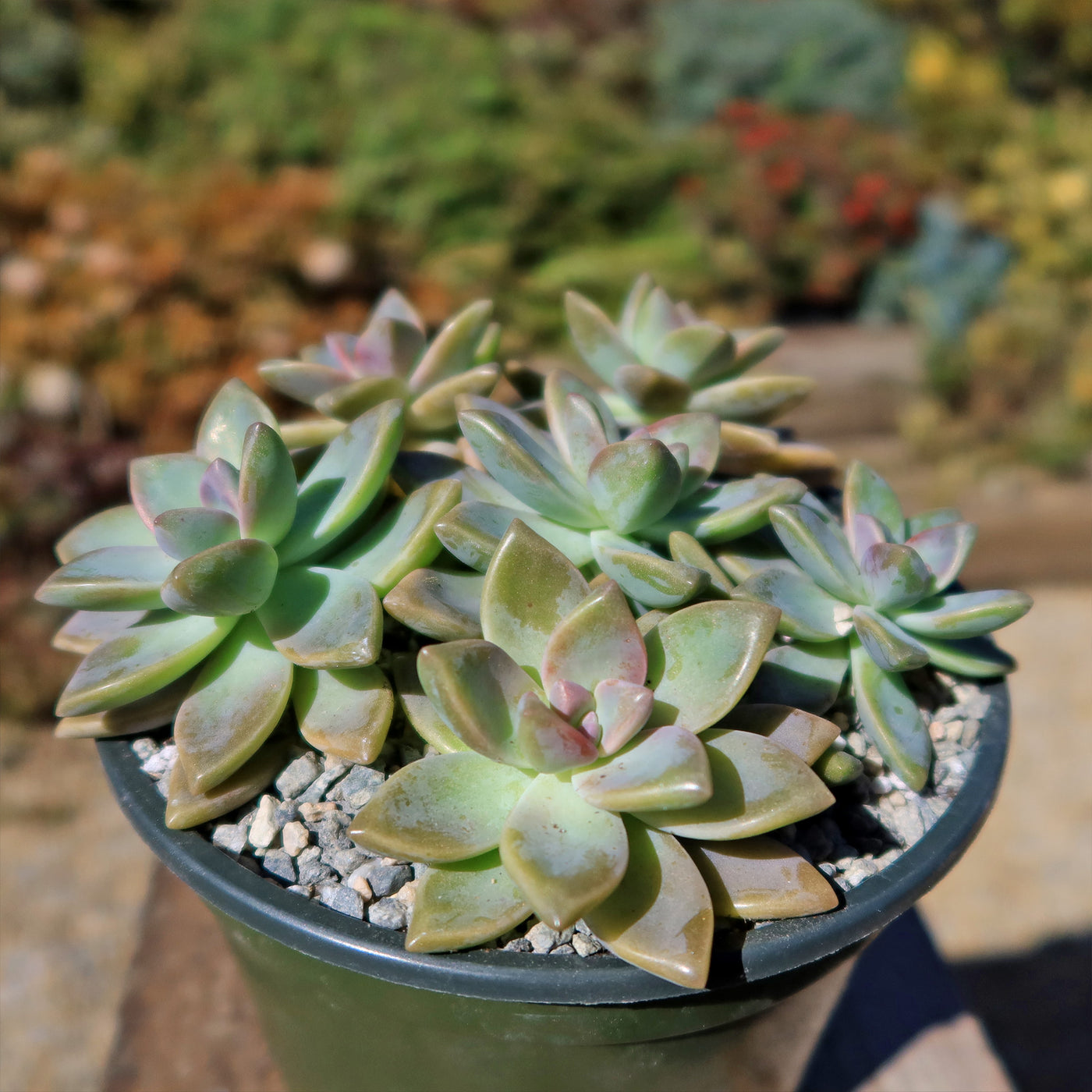
succulent pale green Shop 'Ghost Plant - Graptopetalum paraguayense' Care and Info

Sale price$24.78 Regular price$27.53
Save 10%

Pay in installments of $6.88 with ShopPay, AfterPay and Klarna

Shipping Estimate
USA
  • USA
  • CAN

Ships within 48 hours · Estimated delivery Jul 31 - Aug 5

Promo Codes Available:

For Your Every Summer RSVP, with Code: SUMMER15

Description

succulent pale green Shop 'Ghost Plant - Graptopetalum paraguayense' Care and InfoIntroducing the ghost plant, known as Graptopetalum paraguayense, which is a low maintenance pet friendly plant that belongs to the Graptopetalum genus. Native to Mexico, it is known for its rosette shaped leaves and beautiful flowers. The ghost plant gets its name due to the pale, ghostly appearance of its leaves. It is also known by other common names such as mother of pearl plant and sedum weinbergii. The ghost plant has thick, fleshy, pointed,

Introducing the ghost plant, known as Graptopetalum paraguayense, which is a low-maintenance pet-friendly plant that belongs to the Graptopetalum genus. Native to Mexico, it is known for its rosette-shaped leaves and beautiful flowers.  

The ghost plant gets its name due to the pale, ghostly appearance of its leaves. It is also known by other common names such as mother of pearl plant and sedum weinbergii. 

The ghost plant has thick, fleshy, pointed, flat, or opalescent leaves that are typically arranged in a rosette formation. The leaves are pale blue-green or grayish white in color, giving the plant its ghostly appearance.  


The fleshy leaves of the ghost plant are often covered in a powdery, waxy substance called "farina" that helps protect the plant from excessive sunlight.

The rosettes of plants can grow up to 8 inches tall and 12 inches wide, and in clumps ghost plants will grow up to 1 foot tall and 3 feet wide.

This makes it a great choice for potted houseplant or as part of a succulent arrangement in your rock garden.

The ghost plant blushes pink, purple, and yellow in full sun, displaying more blues, greens, and silvers in partial shade, and its powdery farina coating thickens under direct sun.  

The Graptopetalum paraguayense flower blooms during the spring and early summer with clusters of small, star-shaped yellow flowers. These flowers attract butterflies and bees, making them a beautiful addition to any garden. 

Propagation of the ghost plant succulent is relatively easy. It can be propagated through leaf cuttings or offsets. To propagate through leaf cuttings, simply remove a healthy leaf from the plant, let it callus over for a few days, and then place it in well-draining soil. Over time, roots will develop, and a new plant will grow. Offsets, which are small plantlets that grow around the base of the mother plant, can also be separated and planted to create new plants. 

Watering Needs 

When it comes to watering this ghost plant, it's important to strike a balance. Ghost plants are native to arid regions, so they prefer drier conditions. Overwatering can lead to root rot and other issues, so it's best to err on the side of underwatering. 

To water your ghost plant, you'll want to follow a "soak and dry" method. This means thoroughly watering the soil and allowing it to dry out completely before watering again. When you do water, make sure to water the soil directly and avoid getting water on the leaves, as this can cause them to rot. 

The frequency of watering will depend on various factors such as the climate, temperature, and humidity levels. As a general rule, you can water your Graptopetalum paraguayense every 2-3 weeks during the growing season in the spring and summer, but only once a month during the dormant season in the fall and winter. 

Remember, it's always better to underwater than overwater your ghost plant succulent. Keep an eye on the soil moisture and adjust your watering schedule accordingly. And don't forget to provide good drainage for the plant by using a well-draining potting mix and a pot with drainage holes. 

Light Requirements 

When growing indoors ghost plant thrives in bright, indirect light. Find a spot near a sunny window where it can receive plenty of bright, filtered sunlight throughout the day. Avoid placing it in direct sunlight, as this can cause the leaves to burn or become discolored. 

If you're growing the ghost plant outdoors, it can tolerate more direct sunlight compared to indoor conditions. It thrives in full sun to partial shade, so find a spot in your garden or patio where it can receive at least 4-6 hours of direct sunlight each day. However, keep in mind that if you're transitioning the plant from indoor to outdoor conditions, it's best to acclimate it gradually to prevent sunburn or stress to the ghost succulent. 

Remember, the ghost plant Graptopetalum paraguayense is among the easiest succulents and can adapt to different light conditions. 

 If you notice the leaves stretching or becoming leggy, it may be an indication that the plant is not receiving enough light. On the other hand, if the leaves start to turn brown or develop sunburn spots, it may be getting too much direct sunlight.

Optimal Soil & Fertilizer Needs 

Like other succulents, the Ghost plants thrive in well-draining soil that allows excess water to flow out easily.  Planting them in ordinary soil will result in compacted roots, stunted growth, and most likely root rot. Instead, make or buy a well-draining potting mix, or ideally use our specialized succulent potting mix that contains 5 natural substrates and mycorrhizae to promote the development of a strong root system that helps your ghost plant succulent to thrive. 

Graptopetalum paraguayense Ghost plants are not heavy feeders and can do well without frequent fertilization. In fact, too much fertilizer can actually harm the succulent plant. It's best to use a balanced (5-10-5), water-soluble NPK fertilizer specifically designed for succulents. During the growing season, in the spring, you can fertilize your ghost plant once a year. Be sure to dilute the fertilizer to half or quarter strength, as succulents have lower nutrient requirements compared to other plants. 

Remember, it's important not to overdo it with fertilizer, as this can lead to nutrient burn and other issues. Always follow the instructions on the fertilizer packaging and err on the side of caution. With the right soil and proper fertilization, your ghost plant will be happy and healthy. 

Hardiness Zone & More 

When grown indoors, ghost plants prefer a warm temperature between 50°F to 65°F. It's important to avoid exposing them to extreme temperature fluctuations, as this can stress the plant. 

For outdoor cultivation, the ghost plant is generally hardy in USDA zones 7 to 11. These zones have milder winters and can provide the right conditions for your mother of pearl succulent to survive and thrive. 

In terms of humidity ghost plants are quite adaptable and can tolerate a range of humidity levels. They can handle both dry and moderately humid environments. However, it's important to avoid excessive moisture, as this can lead to rot or fungal issues. Good air circulation is also beneficial for the mother-of-pearl plant's overall health. 

Final Thoughts 

Overall, the ghost plant (Graptopetalum paraguayense) is a captivating succulent with its pale, ghostly leaves and delicate flowers. This low-maintenance houseplant features rosette-shaped leaves covered in a powdery substance called farina, giving it a unique appearance. With its compact size and easy propagation through leaf cuttings or offsets, the ghost plant is a great choice for both beginners and experienced plant enthusiasts. Just provide it with plenty of sunlight, well-draining soil, and occasional watering, and it will thrive as a beautiful addition to your succulent collection. As a result, succulents like ghost plants are frequently planted in containers, both indoors and outdoors, or in rock gardens.  

Shipping Notes
  • Free Standard Shipping on $100+ Orders to the USA.
  • Except Preorder products are shipped in 48 hours.
  • Delivery to the USA:
  1. Standard Shipping : 3-10 business days
  • If time is of the essence, please consider selecting expedited delivery for faster service.
Exchange/Return Notes
  • We offer a 30-day return/exchange service after receiving.
  • Final sale items are not eligible for returns or exchanges.
  • To process your return/exchange, please contact us at [email protected]
  • Please click here for more details>>> Return & Exchange Policy
SKU: 90536926582

Discover Niche Categories That Outsell succulent pale green

Top-Converting Item to Boost Your Average Order

4.8 ★★★★★
Based on 21 reviews
Sort
Highest Rating
Newest First
Oldest First
Product Reviews
T
Verified Purchase
Tim
Chelsea, US
★★★★★ 5
Why China is winning
Format: Hardcover
Should be mandatory reading for all men from 17 and up see why they’re going to overtake the USA unless we get our act in gear
WAS THIS REVIEW HELPFUL?YesReportShare
Reviewed in the United States on May 29, 2026
M
Verified Purchase
mad_buyer
Boise, US
★★★★★ 5
Outstanding book that lays out a blueprint for communist China's war against the US
A short book that sometimes slips into expressions that take a little time to understand, the two political officers that wrote this book had truly studied US (and western) military campaigns and political movements in order to develop strategies to defeat the west without kinetic warfare. While I (like most others, I believe) understood that CCP wanted to take advantage of the US and have region dominance, this book really opened my eyes. I'll merely list the areas in which these two political officers promoted engagement against the US/west - actions that many (including myself) never realizing these were acts of "unrestricted" and comprehensive warfare. The list: diplomatic warfare financial warfare conventional warfare network warfare trade warfare bio-chemical warfare intelligence warfare resource warfare ecological warfare psychological warfare economic aid warfare space warfare tactical warfare regulatory warfare electronic warfare smuggling warfare sanction warfare guerrilla warfare drug warfare media warfare terrorist warfare virtual warfare (deterrence) ideological warfare fabrication warfare cultural warfare international law warfare atomic warfare Of course, as one recognizes these listed arenas of engagement communist China has with the US, remember that espionage and propaganda play key roles in all of these areas. While the US seeks to counter communist China individually in several of these areas, we have to realize that it is a comprehensive strategy that the CCP is pursuing. Remember this book was published in 1999. What has each side engaged in since then? Epiphanal!
WAS THIS REVIEW HELPFUL?YesReportShare
Reviewed in the United States on December 16, 2022
W
Verified Purchase
Walter W. Olson, Ph.D, P.E.
Alexandria, US
★★★★★ 3
A military reading: The cover is misleading
This book is purported to be a translation of China’s Masterplan to Destroy America written by two Colonels in the People’s Liberation Army in 1999. There is reason, but not confirmed, to doubt this. The authors of the book are clearly Chinese. Whether or not the authors are Colonels in the PLA, I feel, is in doubt, as such a plan would never be available to Western sources as quickly as it was after drafting. The book is no “master plan.” It is a discussion of modern warfare strategy written by readers of the worldwide military strategy publications. Most of the publications have been in the United States and China. The cover of this book is misleading with the statement, “Wake up, America.” This book should be little interest to the non-military American. But it should be read by anyone with potential requirements for field grade service (Major and above,) or higher (and equivalent strategy levels in the Marines, Air Force, and Navy.) As far as “Wake Up,” I can recall discussions about strategy that contained most of the information provided within the book as a staff field grade officer in the US Army. While as military officers, we need to be aware of these issues, we are not entirely ignorant of them. The book provides a somewhat different perspective of the issues from a Chinese viewpoint. The first point the authors make, how technology precedes its best employment in warfare. Most of the technology discussed concerns the information processing capabilities of both computers and software. It is more than computerized warfare. A large part of this is based on the technology to US Forces but not entirely. Part of the problem with technology is that mankind becomes so used to using technology to solve today’s problems that previous methods of solving problems are lost. Thus, if the technology can be crippled, it represents an exploitable weakness in war. The second point made, is that the military forces now must consider nonmilitary actions if it is to be effective in both defense and offense. Warfare developed from point battlefields (using swords, knives, etc.,) to linear battlefields (using machine guns and artillery,) to area battlefields, to 3D battlefields (using aircraft and missiles,) to modern infinite-dimensional battlefields which include space, electromagnetic spectrums, and civilian actions. If one can start a war in a computer room or a stock exchange, is there a non-battle space anywhere? Warfare that transcends military boundaries is “unrestricted warfare.” A “kinder warfare” with critical attacks that take no lives is now possible. Technology is providing a means to attack and enemy’s nerve centers without directly harming anything else. Such nerve centers exist in an enemy’s financial systems, their economic systems, their environmental systems, their public media systems, their political systems, their power and energy systems, and their logistics centers. A third point made is that coalitions of disparate forces, internationally, nationally, and military, are formed and broken very quickly, as quickly as within 24 hours! For example, in Desert Storm, the United States weaved together more than 30 nations in various roles. The author’s prescient comment foresaw the alignments that occurred immediately following the 9/11 attack, although this was after the book was written and not available to the authors to use as an example. There was also unity of command established. This, the authors say, stemmed from the US DoD Reorganization Act passed by Congress in 1986. All of the air forces and naval forces were under General Schwartzkopf despite the desires of the individual forces to operate independently. The air tasking order (a 300-page document) drafted in joint sessions by the Air Force, Navy and Marines, had to be approved by General Schwartzkopf before commands were issued to the various forces. The Kuwaiti Invasion Plan that the Marines wanted was put off in favor of the plan that General Schwartzkopf endorsed. Media personnel were incorporated into the military units but controlled with definitions of release timing and content. A fourth point is that Americans want wars which achieve its national interests while having no causalities. This promotes an over-reliance on technology and an unwillingness to support prolonged war. Americans have a blind faith in technology always thinking that the road to victory is with the highest technology weapons. American military budgets are based largely on the acquisition of expensive weapon systems, and little thought given to their integrated use within the military services. American military theory is behind (consistent with point one above.) But the overriding goal is victory without casualties. Thus, the authors recommend that the secret to war with America is to kill its rank and file soldiers. The style of the book is somewhat elliptical: it is written in the Chinese manner which often dances around a subject before coming to its subject. For example, there is a discussion of the Golden Ratio (1:0.618) before the authors show how it can be found in various ancient and modern military operations. There is considerable Chinese military philosophy discussed including the 36 Strategies, which most American military readers have not encountered ( did not at West Point when I was a Cadet studying Chinese!) I first encountered these after a reference from a Chinese Professor while I was teaching in China and then read Sun Tzu in Chinese. Sun Tzu was not the original author of these. In my personal opinion, an English translation this short book should be required reading for all Cadets at West Point. I rate the book 3 stars for several reasons. I don’t feel the book is well written. Many of the references are transliterations of the author’s names in Chinese which do not read as the real names. At this time, the book is somewhat dated having been written in 1999. I also doubt the attribution of the source and authors of the book. The concepts presented in the book are worth thinking about for a person developing military strategies.
WAS THIS REVIEW HELPFUL?YesReportShare
Reviewed in the United States on September 16, 2019
B
Verified Purchase
Beth Rohl
Louisville, US
★★★★★ 5
No complaints
Format: Paperback
Knowledge is power and everybody should read this book
WAS THIS REVIEW HELPFUL?YesReportShare
Reviewed in the United States on December 3, 2025
C
Verified Purchase
Cita
Bozeman, US
★★★★★ 5
Fascinating and beautifully written.
Format: Hardcover
Clear and compelling reading of the much-neglected history of Carthage -- all its histories had been written by the victors in Rome. BTEW y four-colour photo insert was missing a page....shame on Norton, the puboisher.
WAS THIS REVIEW HELPFUL?YesReportShare
Reviewed in the United States on March 25, 2026

recommand products