SKU: 90719587257
macrame plant hanger vintage

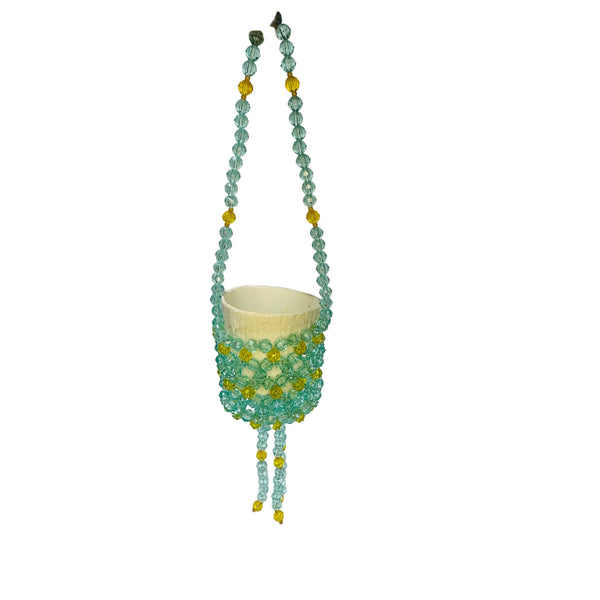
macrame plant hanger vintage Vintage 1980s Handmade Beaded Plant Hanger Aqua & Yellow Faceted Beads

Sale price$25.27 Regular price$28.08
Save 10%

Pay in installments of $7.02 with ShopPay, AfterPay and Klarna

Shipping Estimate
USA
  • USA
  • CAN

Ships within 48 hours · Estimated delivery Aug 2 - Aug 7

Promo Codes Available:

For Your Every Summer RSVP, with Code: SUMMER15

Description

macrame plant hanger vintage Vintage 1980s Handmade Beaded Plant Hanger Aqua & Yellow Faceted BeadsA charming handmade plant hanger from the 1980s, made with faceted crystal look beads in aqua and warm yellow, strung in a netted macram pattern around a cream styrofoam cup. Exactly the kind of piece that made the 80s home feel bright and personalized before mass production took over plant accessories. The beads catch light beautifully when hung near a window, and the compact size makes it perfect for small plants, succulents, or a trailing pothos.

A charming handmade plant hanger from the 1980s, made with faceted crystal-look beads in aqua and warm yellow, strung in a netted macramé pattern around a cream styrofoam cup. Exactly the kind of piece that made the 80s home feel bright and personalized — before mass production took over plant accessories.

The beads catch light beautifully when hung near a window, and the compact size makes it perfect for small plants, succulents, or a trailing pothos. Still holding its original form after 40+ years.

Details

  • Item: Hanging plant holder / macramé beaded hanger
  • Era: 1980s handmade
  • Material: Faceted acrylic beads (aqua, yellow, clear); beaded string/cord; styrofoam cup base
  • Colors: Aqua / teal green beads, amber yellow faceted beads, cream styrofoam cup
  • Construction: Hand-strung netted pattern; two hanging cord strands with bead detail and trailing tassel ends
  • Cup Size: 3 inches round (holds small to medium pot, 2–4 inches)
  • Total Length: 13 inches top to bottom
  • Maker/Signature: Unmarked; handmade origin
  • Special Feature: Original styrofoam cup left intact to maintain form and display authenticity

Condition Grade: Great

Positives

  • All beads present and secure; no breaks or missing strings
  • Beads bright and facets clear; no cloudiness or damage
  • Color fading minimal — aqua and yellow remain vibrant
  • Form intact after 40 years; styrofoam cup holds its shape
  • Ready to use or display immediately

Expected Wear

  • Minor dust or light patina on beads from age and storage (cleans easily)
  • String shows age but no fraying or weakness
  • Styrofoam cup has slight texture changes from decades of sitting, but is structurally sound

See all photos for detail — sold as pictured.

Condition Grade Key

  • Near Fine: Almost perfect. Very minor signs of age only.
  • Very Good: Shows light use. Sound and attractive with minor flaws.
  • Good: Complete and intact. Noticeable wear consistent with age and use.
  • Fair: Shows significant wear. Readable or usable but clearly used.

Collector's Notes

The 1980s marked a brief renaissance for handmade home accessories — a moment between the minimalism of the '70s and the mass-production boom of the '90s.

Small makers and crafters hand-strung plant hangers with beads, fringe, and cord to sell at craft fairs, tourist shops, and through mail order. Most of these didn't survive: beads went missing, strings frayed, styrofoam crumbled.

A quiet statement that someone made this by hand, for real.

Shipping + Trust (Reading Vintage standards)

∙Photo-verified condition (no surprises)
∙Packed with our protective packaging standard
∙Ships in 1 business day
∙Free Shipping on $35+ (U.S. only)

Disclaimer

All items are vintage and may show signs of age, wear, or use consistent with their history. Photos show the exact condition of each piece—please review them carefully, as they are part of the description. 

While I do my best to capture colors accurately, your monitor or device screen may display colors slightly differently from the actual item.

Please Note:
These pieces come from estate collections and have been surface cleaned. You may wish to perform additional cleaning depending on your preference.

Shipping Notes
  • Free Standard Shipping on $100+ Orders to the USA.
  • Except Preorder products are shipped in 48 hours.
  • Delivery to the USA:
  1. Standard Shipping : 3-10 business days
  • If time is of the essence, please consider selecting expedited delivery for faster service.
Exchange/Return Notes
  • We offer a 30-day return/exchange service after receiving.
  • Final sale items are not eligible for returns or exchanges.
  • To process your return/exchange, please contact us at [email protected]
  • Please click here for more details>>> Return & Exchange Policy
SKU: 90719587257

Discover Niche Categories That Outsell macrame plant hanger vintage

Top-Converting Item to Boost Your Average Order

4.1 ★★★★★
Based on 18 reviews
Sort
Highest Rating
Newest First
Oldest First
Product Reviews
T
TechMeister
Pawtucket, US
★★★★★ 5
Bible on x64 Assembler, but not for coding beginners.
Format: Paperback, Format: Paperback
The best way to review this book is in two parts, 1st a review of the book, 2nd to address the negative reviews about the readability of the code in the Kindle edition which is the one I have. I have several books on Assembly Language, starting with the long out of print 1986 “Peter Norton’s Assembly Language Book for the IBM PC.” Over the years I have acquired several books on Assembly Language. I find Randall Hyde’s book to be hands down the best reference and most in depth book on x86/x64 Assembly language. What I feel separates Hyde’s book from others is it goes into detail on each register and machine function. Which is then backed up with numerous illustrations to help explain the concepts, code, and quizzes to test your understanding. This is not a book for coding beginners on x86/x64 Assembly, IMO, as the author jumps right in with examples that I feel are too complex and too verbose for the novice. To help fill in the gaps alongside this book, I recommend using Mike McGrath’s, “Assembly x64 Programming in easy steps”, which guide the novice with colorful illustrations step by step, on the processor, number systems, linking, and building basic Assembly programs, in byte sized chunks, that are easy to understand for the novice. Also, a basic knowledge of C++ will be needed to use this book, as several example C++ programs make Assembly calls from within the program. Again, I recommend Mike McGrath’s “C++ Programming in easy steps.” For a basic review if you lack C++ knowledge. You’ll need the free IDE Visual Studio 2022 Community edition (not VS Code) with the C++ libraries, as that is where the MASM is located. As for the readability of the code in the Kindle version, there is a workaround which is better than reading the code from the book. A link is provided to download all the code listed in the book in a zip file. Most of the code is organized by listing number from the book. Once VS2022 is on your computer, double-click on the download file you’re interested in and the code will open properly formatted in VS2022 as shown in the attached images. You will be able to interact with the code, which is more productive than just reading from the book. This is an excellent book on x86/x64 Assembly language, looking forward to volume 2. After reading this book, the only way to get further in depth knowledge of the x86 processor IMO is from Intel's massive 4 volume reference.
WAS THIS REVIEW HELPFUL?YesReportShare
Reviewed in the United States on February 6, 2022
J
Verified Purchase
Jaime Velazquez
Bozeman, US
★★★★★ 4
Good reference manual for64 Bit Assembly Programming. Not an Introductory text.
Format: Paperback
I initially bought Assembly x64 in easy steps: Modern coding for MASM, SSE & AVX which is an excellent introduction to 64 Bit Assembly. This book however IS NOT an Introductory book - it is more a Reference to X64 Assembly. If you are new to Assembly Programming I suggest buying the introductory book and if you are serious about Assembly Programming then buy this book.
WAS THIS REVIEW HELPFUL?YesReportShare
Reviewed in the United States on March 14, 2024
J
Verified Purchase
Jamie Block
Battle Creek, US
★★★★★ 5
Parenting philosophy for all ages and stages
Format: Hardcover
Good Inside is the book I find myself referencing more than any other parenting book - well any book for that matter. I'm sure I annoy my friends! I annoy myself with my constant Dr. Becky this, and Dr. Becky that, but the truth is, I want more for my child. And in seeking out ways to understand him better, approach him better, be there for him better, Dr. Becky Kennedy allowed me to look at my own inner child and want better for her too. Good Inside helped me identify sources of my own pain, start healing, and empower me with tools to approach my child's struggles with more compassion, understanding, and confidence. This book sits perfectly between the scientific approach of Whole Brain Child and the spiritual views of The Enlightened Parent. You're gonna get a dose of warm fuzziness with a whole lot of practical and psychological gold! And as I hinted at before, this is for kids of all ages. You're not just getting a book aimed at how to survive the 2yo stage. You're getting a perspective that embeds itself into every relationship you have. Yes; it has been enormously useful with my toddler, but it has also helped my marriage. So, let me annoy you too. Becky Becky Becky!
WAS THIS REVIEW HELPFUL?YesReportShare
Reviewed in the United States on December 20, 2023
M
Verified Purchase
Mama N
Massapequa, US
★★★★★ 5
The most important book a parent will ever read
Format: Hardcover
I have so much I want to say about this book and how it changed my perspective to parenting for the better. There are so many books about what to expect when you first find out you’re pregnant and how to go about the next newborn/infant stage. There’s not enough talk about needing to read parenting books beyond the first 12 months. To be honest, I found this book the most motivating, inspiring and HELPFUL Of them all. This book is definitely geared towards the toddler and beyond years, and I really wish I had read this earlier. Please do yourself a favor and read this book prior to toddler years. Even if you think you know how to go about helping foster your on childs independent, appropriate, and emotional development, as well as sibling/ friendship hardship in the correct manner, I challenged you to read this book to make sure what you’re doing (or plan to do) is truly right. This book helped me develop the tools (actions and word choices) that I needed to improve my reactions towards undesirable words or actions by my toddler. This in turn has reduced her outbursts (Both physical and verbal) and has given her anymore independent and an emotionally stable/strong relationship with herself and everyone else. This is especially for those strong willed and emotionally intelligent/ sensitive children. To be honest, I even learned a lot about how to navigate adult relationships better. I learned a little bit (maybe more than I want to admit) about myself too. 10/10.
WAS THIS REVIEW HELPFUL?YesReportShare
Reviewed in the United States on June 11, 2025
L
Verified Purchase
Louis Liu
Alexandria, US
★★★★★ 5
After all, chidren are good inside.
Format: Kindle
Parenting is about how parents treat their kids. One important aspect of what counts for good parenting is how we face the kids’ negative behaviors. When we were children, our parents did not respect our emotional needs. They only scolded us when we were naughty. After we become parents, we treat our kids the way our parents treated us. Dr Becky proposes in this book, contrary to what our parents thought, children are all good inside and thus we should treat children’s bad behaviors as if their misbehaviors are signs that they don’t know how to express their needs. With this assumption, there are three implications for parenting. First, as children are good inside, what they do outside should not be our focus. Whether it is emotional tantrums, not listening, aggressive tantrums, sibling rivalry, rudeness and defiance, whining, lying, food habits, parents should not pay too much attention to it. Instead, parents should see the cause that contributes to the resulting negative behavior. Take whining as an example. Whining, according to a Cambridge dictionary, means ‘to make a long, high, sad sound’. As parents we are easily annoyed by whining and we quickly think that kids are disrespectful. In Dr Becky’s view, whining=strong desire+powerlessness. Children whine because they feel helpless and ‘indicate they feel alone and unseen in their desires’ (p.188), rather than because they are arrogant. What does this imply? Do we have to give in, knowing that they are desperate for connection and feeling powerful? The answer is no. Dr Becky said ‘while our job as parents is to make decisions that we feel are right for our kids even in the face of protest, we can still practice understanding and connecting’. While saying no, which they probably know they do need, at the same time we can give them the sympathy they also need. Thinking that kids are bad inside often leads to power struggles or arguments when we request them to request in an appropriate tone again. Kids are good inside, and thus we should focus our attention on how to respond to their helplessness rather than their whines. Secondly, not only should we not focus on their outside behavior, we should also be aware that what is on the surface often contrasts with what the kid feels inside. One of the most-feared emotions we are afraid to see children have is anger, also known as tantrums. When children are angry, they display undesirably violent behaviors such as hitting others. Dr Becky points out that they hit not because they are angry, but because they are scared. When we adults are afraid, we may also kill people if we are irrational. Children have not yet developed their prefrontal cortex which is responsible for logic and language, and so the most severe reaction they can possibly express is through tantrums. We may wonder why children are afraid: they are “terrified of the sensations, urges, and feelings coursing inside their body” (p.158) such as frustration and anxiety. These feelings which adults are used to feel scary to kids. Naming the right emotion is the first step to solving the problem and helping kids to cope with it. Only after we identify correctly the emotion the children are experiencing can we as parents exert the right method to deal with the out-of-control behavior. Clearly we know reprimanding our kids is not correct because “they are good inside”. To stop the kid's aggressive tantrums effectively, parents should assert their authority. Parents should show the confidence that they are in charge of the situation. Then, the next critical step is to maintain the kid's safety. Regardless of how the kid feels, the parent should stop the dangerous behavior the kid is engaging in, which Dr Becky calls containment. She says it best: “kids don’t feel good when they are out of control”. That we assert our authority and contain even though kids are not happy on the surface is an act of love, maturity, and responsibility. If we don't, not only will it cause injury, it will make children think we evade responsibility, thus making them feel more overwhelmed. To conclude, as parents we need to know our roles and our kids’ roles. Our job is to keep our children safe, both physically and psychologically. We need to remember that a gap exists between kids’ abilities to feel and their abilities to regulate their feelings, and the gap manifests as deregulated behavior. While it is children’s job to explore and express their feelings, it is our job to help them regulate them by setting physical boundaries, validating their emotions, and being empathetic to their feelings. We are our kids’ role models. We are demonstrating to our kids the emotion regulation skills. As our kids are allowed to shout and protest because they are doing their jobs, we are also allowed to upset them when we set boundaries. We just need to remember that to do our job well, we must learn to connect with and understand them more because after all, children are good inside.
WAS THIS REVIEW HELPFUL?YesReportShare
Reviewed in the United States on February 4, 2025

recommand products