SKU: 9447296914
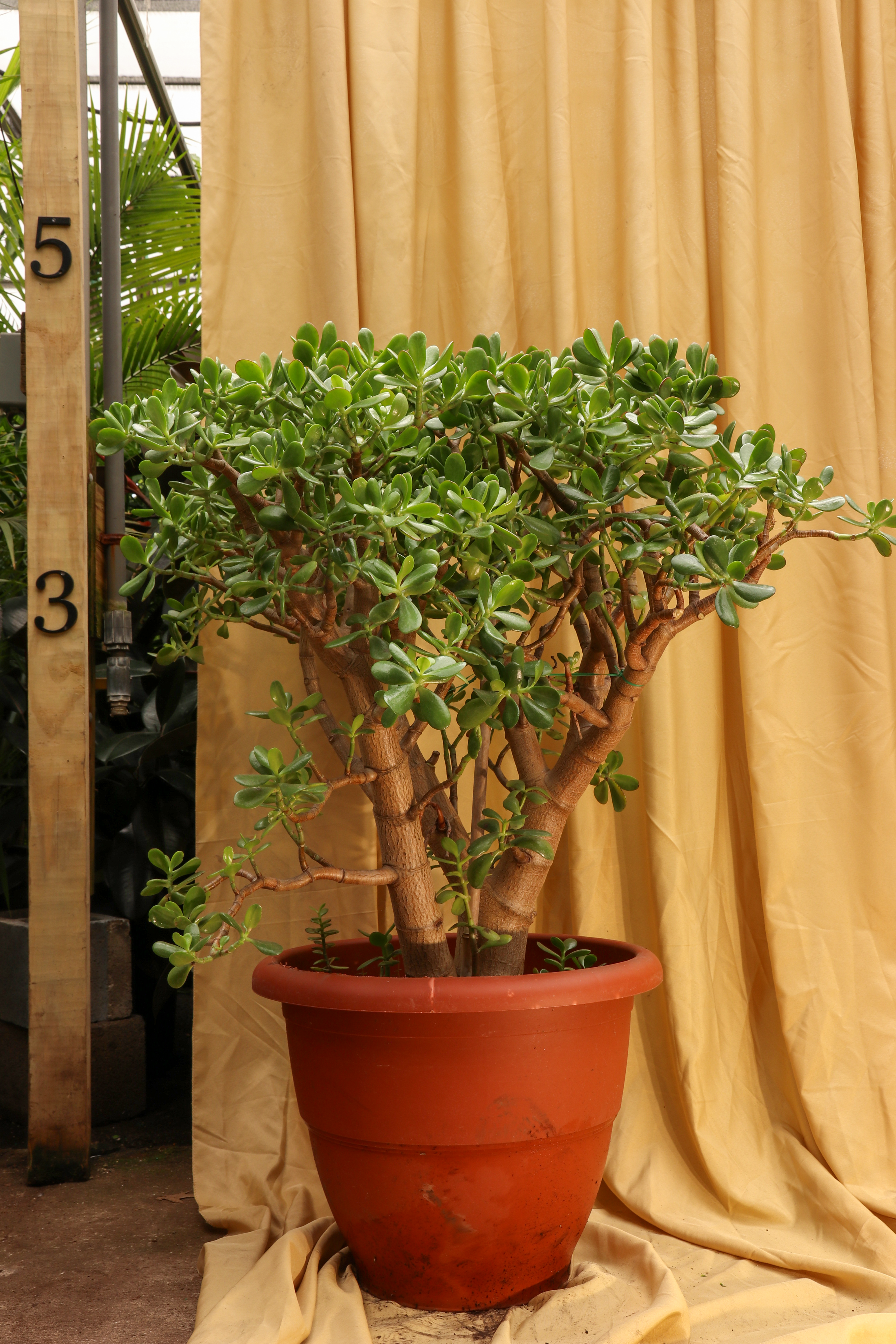
world's largest jade plant

world's largest jade plant Huge Jade Bonsai – GRANDE PLANTS

Sale price$25.36 Regular price$28.18
Save 10%

Pay in installments of $7.04 with ShopPay, AfterPay and Klarna

Shipping Estimate
USA
  • USA
  • CAN

Ships within 48 hours · Estimated delivery Aug 6 - Aug 11

Promo Codes Available:

For Your Every Summer RSVP, with Code: SUMMER15

Description

world's largest jade plant Huge Jade Bonsai – GRANDE PLANTSDescription The Huge Jade Bonsai brings ancient wisdom into your home with a gentle presence that's surprisingly forgiving. This beautiful specimen looks like it's been growing for centuries, with its thick, woody trunk telling stories of patience and resilience. Native to South Africa, this Jade plant Bonsai has adapted beautifully to indoor life while maintaining that timeless tree like character we all adore. Growing up to 3 6 feet tall when given

Description

The Huge Jade Bonsai brings ancient wisdom into your home with a gentle presence that's surprisingly forgiving. This beautiful specimen looks like it's been growing for centuries, with its thick, woody trunk telling stories of patience and resilience.

Native to South Africa, this Jade plant Bonsai has adapted beautifully to indoor life while maintaining that timeless tree-like character we all adore. Growing up to 3-6 feet tall when given proper space, your Huge Jade Bonsai will become a treasured companion that brings calm and stability to any room. We love how these plants reward consistent care with steady growth and that wonderful sense of nurturing something truly special.


Care 

Which Bonsai Tree is best for indoors?

The Jade Bonsai Tree ranks among the very best choices for indoor living. Your plant will adapt wonderfully to indoor humidity levels and forgive occasional care lapses better than most Bonsai species.


How big do Jade Bonsai get?

Your Huge Jade Bonsai is already a mature specimen that stands proudly above typical Jade Bonsai varieties, hitting up to 6 feet. While standard Jade Bonsai reach 6-8 inches tall, this specimen has been carefully cultivated to reach the sky.


How do you care for a Huge Jade Bonsai?

Caring for your Huge Jade Bonsai means providing bright indirect light for 6+ hours daily, well-draining succulent soil, and watering only when completely dry. These gentle requirements make Jade Tree care wonderfully straightforward and stress-free for busy plant parents.

Monthly fertilizing during the growing season keeps your plant healthy and content. We always tell our customers that Jade tree care is refreshingly simple—no complicated schedules or fussy requirements that might overwhelm you when life gets hectic.


What temperatures do Huge Jade Bonsai like?

Your Huge Jade Bonsai thrives in comfortable temperatures between 60-75°F (16-24°C), which matches most indoor home environments perfectly. During winter months, it can handle brief drops to 45-55°F, but anything below 40°F will stress your plant unnecessarily.


How fast does Huge Jade Bonsai grow?

This beautiful Bonsai grows slowly and steadily, adding about 1-2 inches per year when kept indoors with proper care. The gradual growth allows you to enjoy watching your plant develop and mature over time, creating that wonderful sense of partnership.


Can Huge Jade Bonsai live indoors?

Your Huge Jade Bonsai is perfectly suited for indoor living, adapting beautifully to typical home conditions with remarkable resilience. These plants handle indoor humidity and artificial lighting better than many houseplants, making them ideal long-term indoor companions.


Do Jade plants need special soil?

Your Jade plant Bonsai needs well-draining succulent or cactus mix to prevent root problems and keep those roots healthy. Think of it like choosing the right foundation for your home—proper drainage is essential for your plant's long-term wellbeing.


How often do you water a Huge Jade Bonsai?

Water your Bonsai only when the soil feels completely dry throughout, typically every 1-2 weeks during the growing season. In winter, you might only water once every three weeks as your plant naturally slows down and requires less frequent attention.


Do Huge Jade Bonsai like to be fertilized?

Your Bonsai appreciates gentle monthly feeding during spring through autumn using balanced fertilizer diluted to half strength for best healthy results. We recommend thinking of fertilizing like providing small, regular nutritious meals rather than overwhelming your plant with too much.


Pet-friendly?

Your Huge Jade Bonsai is mildly toxic to pets if eaten, so you'll want to position it where curious paws can't reach. We always recommend keeping it safely away from pet areas to avoid unnecessary worry or potential vet visits.


Are Jade Bonsai trees toxic to cats?

Jade Bonsai trees are toxic to cats and can cause vomiting and lethargy if eaten by curious feline friends. We suggest placing your plant somewhere high where cats can admire its beauty safely without investigating those leaves.


Are Huge Jade Bonsai poisonous for dogs?

Your Bonsai is mildly toxic to dogs, potentially causing vomiting and lethargy if they sample those glossy leaves. Keep your plant positioned safely away from curious canine companions who might think those thick leaves look quite interesting.


Factoids

How do you shape a Huge Jade Bonsai?

Shape your Huge Jade Bonsai through regular, gentle pruning to encourage branching and maintain that beautiful tree-like appearance. Wiring is possible but requires careful handling since branches are soft and can scar easily—treat your plant with gentle patience.


Do Jade plants make good Bonsai?

Jade plants make wonderful Bonsai because of their naturally thick trunks, woody appearance, and remarkable tolerance for careful pruning. Your Jade plant Bonsai responds beautifully to shaping while maintaining that ancient tree aesthetic that makes these plants so special.


What is the biggest Bonsai ever?

The largest Bonsai ever recorded is a 600-year-old Red Pine in Japan, measuring over 16 feet tall and 30 feet wide. While your Huge Jade Bonsai won't reach those proportions, it will still create a meaningful statement piece!


Buy a Huge Jade Bonsai

Welcome this gentle giant into your home and enjoy years of peaceful companionship with a living work of art. Your Huge Jade Bonsai combines the wisdom of ancient trees with the comfort of modern indoor living, creating that special connection between you and nature.

Our live video shopping calls let you meet your future Bonsai companion before delivery, ensuring that perfect match that starts every meaningful plant relationship. We're here to support you through every step of your Jade tree care journey, helping you nurture this beautiful specimen for years to come!

Shipping Notes
  • Free Standard Shipping on $100+ Orders to the USA.
  • Except Preorder products are shipped in 48 hours.
  • Delivery to the USA:
  1. Standard Shipping : 3-10 business days
  • If time is of the essence, please consider selecting expedited delivery for faster service.
Exchange/Return Notes
  • We offer a 30-day return/exchange service after receiving.
  • Final sale items are not eligible for returns or exchanges.
  • To process your return/exchange, please contact us at [email protected]
  • Please click here for more details>>> Return & Exchange Policy
SKU: 9447296914

Discover Niche Categories That Outsell world's largest jade plant

Top-Converting Item to Boost Your Average Order

4.1 ★★★★★
Based on 13 reviews
Sort
Highest Rating
Newest First
Oldest First
Product Reviews
A
Verified Purchase
An American
Waukegan, US
★★★★★ 5
Good Guide to Writing in General
Format: Paperback
What Gardener says about fiction can equally apply to writing any good prose. He was a master teacher and this book definitely shows his skills in conveying the underlying knowledge to others.
WAS THIS REVIEW HELPFUL?YesReportShare
Reviewed in the United States on December 30, 2024
L
Verified Purchase
Larry Dieli
Whiting, US
★★★★★ 5
First Aid for Writers Seeking to Tell Stories
Format: Paperback
This is such a wonderful tool for anyone who has a yearning to write fiction. Gardner's voice is challenging, nurturing and extremely informative for those who have a passion to jump on the path for mastering the art of story telling. He can be curt and dismissive for those who get 'lazy,' even taking to task some very skilled and famous writer's more feeble attempts (Hello, Mr. Faulkner). Gardener is a strong advocate of W.W. Watt's masterpiece for beginning writer's "An American Rhetoric," a book that is out of print , but can be found in many larger public libraries.
WAS THIS REVIEW HELPFUL?YesReportShare
Reviewed in the United States on March 31, 2016
M
Verified Purchase
Molly
Los Angeles, US
★★★★★ 5
” shows what it is like to be young and irresponsible
Format: Paperback
This book offers relatable poems about youth all the way up to adulthood. No matter the readers’ age, they can find something relatable in this book. One of the first poems, “River Gods,” shows what it is like to be young and irresponsible. This poem describes an instance where two young guys are walking on top of a railroad trestle, which is above the Tennessee River. “Since no one wants to cheat a foolish death alone, / I convinced my friend to leave his satchel on the bank / and we stepped out a hundred feet over the night” (“River Gods,” 13-15). This stanza shows that the two guys knew that what they were doing was dangerous and potentially deadly. This poem in comparison with other poems in this book really demonstrates recklessness in youth. While in that poem readers see the recklessness associated with youth, “Piano Key,” a later poem in the book, provides an insight into a more serious adulthood. In this poem, the narrator is dealing with the memories associated with his grandmother’s piano. I plunk my way left to right, up from the deep-forest Bass notes toward the bright high registers, Just past middle C, a dead spot I remember as a child, A crucial note that will not sing. (“Piano Key,” 13-16) The narrator does not provide much insight into his emotions, besides the fact the narrator is remembering something from when he was a child, but there is a sense of longing created because his grandmother is likely dead, which is why he is reminiscing about the piano. Going from “River Gods” to “Piano Key” provides different narrators. The first narrator does not care about his future; he only cares about what he is doing right at that moment. The narrator in “Piano Key” is thinking about the future and the past. If these narrators are the same, readers can definitely see how the narrator has changed and grown up. In “Digging the Pond,” there is a notable shift where the narrator, a young teenager, notices that him and his dad are different. He can name every species of tree, wild root, the compounds of the soil in every field, and knows that I stood off to the side too often to learn what he was born knowing. (“Digging the Pond,” 21-24) In this part of the poem, the narrator is realizing that he does not know something that his dad knows really well. When a child notices that they are different than their parent, it is usually a significant moment in that child’s life. The narrator in this poem seems to be realizing that he is growing up and changing; he knows he is no longer doing everything his parents are doing or enjoying it. Tennessee Landscape with Blighted Pine is a great book for poems about growing up and changing. This book grows with readers as the readers grow. I highly recommend this book.
WAS THIS REVIEW HELPFUL?YesReportShare
Reviewed in the United States on November 30, 2017
L
Verified Purchase
L. Moyse
Whiting, US
★★★★★ 5
A fine performance
Format: Paperback
You see an old pocket knife on the cover, maybe a Case; it may have even belonged to Jesse Graves, but he has certainly used it in sculpting his poetry. "Tennessee Landscape" is pure plain speech, and all the more evocative for it. Graves uses language not to shock, not incite and not to transgress; he uses it to bring home simple and time worn truths that never go away. In the poem that is the book's title, Graves recounts his family history and ends telling us "The dead move through us at their will, their voices chime/just beyond our hearing...alone in the field, and never alone." He pays homage to a farming tool"(Elegy for a Hay Rake), not with a tone of jaundiced cynicism, speaking to it instead in a voice filled with thanks and appreciation, as if the hay rake, too,knew how worthwhile its job had been. The second part of the volume expands Graves' geography from East Tennessee to New Orleans, North Carolina, points beyond, and the cast of subjects becomes a little broader as well, but the language remains firm and precise. "The Night Cafe: North Rendon, New Orleans": diction so perfect I feel I was there that night too. "My Sister at Sea": likely my favorite here. It feels personal, a short glimpse into a private heart; the glimpse is snatched away in a hurry but not before Graves tells us "...wishing I could bring/ you to this shore...Make your illness a small boat we could burn/Sailing out in ashes on the current." Whether it is a landscape, a hay rake, a bar or a loved one, Jesse Graves is a poet of things that last, one who writes quiet confessions with confidence in a spare quiet and sure voice. Very highly recommend this book.
WAS THIS REVIEW HELPFUL?YesReportShare
Reviewed in the United States on February 24, 2013
T
Thomas A. Holmes
Birmingham, US
★★★★★ 5
Fine Contemporary Poetry--Just Happens to Be Appalachian
Format: Paperback
The poems in Jesse Graves' TENNESSEE LANDSCAPE WITH BLIGHTED PINE express an indebtedness to a way of life that we contemporary Appalachians have watched transform at an accelerated pace over the past few decades, as we see the beloved old ways of our culture adapt to the demands of a society marked with the pervasiveness of media, the incursion of corporate demands, and the poignant recognition that as much as family prepares us to face the world outside our community, the impact of that world can blur the impressions our homes have made on us. Graves' work approaches these themes from various directions, as a son looking to the legacy of his family, as a youth and young man balancing education--both formal and that gleaned from personal experience--and as a family man weighing what he shares and offers in embodying those values. In this consistently fine volume, it is difficult to select favorites, but there are "River Gods," where an inebriated student and his companion cross the high railway trestle over the Tennessee River in Knoxville, Tennessee, "Deep Corner," where the speaker contemplates how his life has turned out differently than his brother's, "Mother's Milk," where the speaker weighs how much his mother has contributed to his life (including, sweetly, "an ear for slightly off-pitch singing"), and "Digging the Pond," where the speaker and his father silently acknowledge that the son will not preserve all his father's values: . . . I stood off to the side too often to learn what he was born knowing. The doing and the undoing. I can find in his face what he reads about the future in the tea-colored water, his eyes and mine trying to avoid it. Graves' love for these gifts, those accepted and those only acknowledged, resonates throughout TENNESSEE LANDSCAPE WITH BLIGHTED PINE. Graves' appreciation for lyric poetry, his talent for finding the expressiveness of everyday language, and his offering scenes with great depth of meaning and feeling make this collection memorable, worthy of high recommendation.
WAS THIS REVIEW HELPFUL?YesReportShare
Reviewed in the United States on December 30, 2011

recommand products