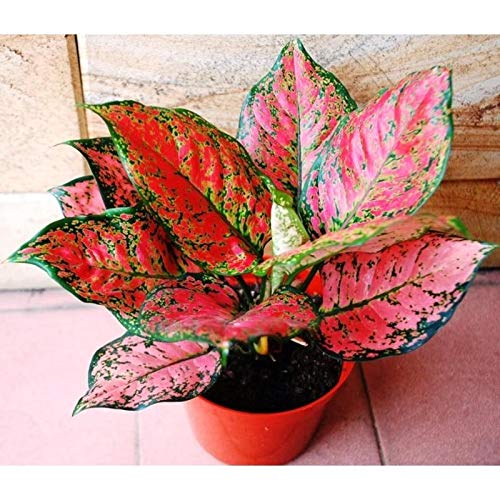
SKU: 97244091546
aglaonema plants oxygen

aglaonema plants oxygen Live Indoor Air Purifying Rotundum Hybrid 'Anjamani Red' Aglaonema Pla – GreenParadiseLive

Sale price$26.66 Regular price$29.62
Save 10%

Pay in installments of $7.41 with ShopPay, AfterPay and Klarna

Shipping Estimate
USA
  • USA
  • CAN

Ships within 48 hours · Estimated delivery Aug 19 - Aug 24

Promo Codes Available:

For Your Every Summer RSVP, with Code: SUMMER15

Description

aglaonema plants oxygen Live Indoor Air Purifying Rotundum Hybrid 'Anjamani Red' Aglaonema Pla – GreenParadiseLiveGreen Paradise Beautiful Aglonema Palnt About Aglaonema Plant The pink aglaonema offers a perpetual touch of pink all year round. Keep soil moist and provide bright indirect sunlight. Beautiful Leaves Oxygen Giving Plant. Easy Growing Can be Grown In Total Indoor As Well. indoor plants offer the home and office many virtues, and Aglaonemas have almost every one of them. This is a wonderful low light houseplant and is among the easiest to maintain.


Green Paradise Beautiful Aglonema Palnt  

                         About Aglaonema Plant


The pink aglaonema offers a perpetual touch of pink all year round. Keep soil moist and provide bright indirect sunlight. Beautiful Leaves Oxygen Giving Plant. Easy Growing Can be Grown In Total Indoor As Well.

indoor plants offer the home and office many virtues, and Aglaonemas have almost every one of them. This is a wonderful low-light houseplant and is among the easiest to maintain. They are one of the only plants which can survive long periods of time in poorly lighted and badly ventilated areas. They have large, glossy oval-shaped leaves on short stems, which arch outward elegantly and can reach 10 inches or more in length. Light: Low light. Too much light may cause its leaves to fade. Water: Keep potting mix evenly moist. 

Aglaonema, also known as Chinese Evergreen, is a popular genus of flowering plants in the family Araceae. It is native to tropical and subtropical regions of Asia, particularly Southeast Asia. Aglaonema plants are cultivated for their attractive foliage and are commonly used as indoor ornamental plants.

The plants are known for their sturdy nature, low maintenance requirements, and ability to tolerate various light conditions. They typically have broad, lance-shaped leaves that come in various shades of green, often with patterns of silver, cream, or red. The variegated foliage adds a decorative touch to indoor spaces.

Aglaonema plants are valued for their air-purifying qualities, as they can remove toxins from the air, making them a popular choice for improving indoor air quality. They are often found in homes, offices, and other indoor environments.

In terms of care, Aglaonema plants prefer indirect or filtered light, as direct sunlight can scorch their leaves. They thrive in average room temperatures and moderate humidity levels. They should be watered regularly, allowing the soil to dry out slightly between waterings to prevent overwatering, which can lead to root rot.

Overall, Aglaonema plants are beautiful, adaptable, and relatively easy to care for, making them a favored choice among plant enthusiasts and beginners alike.


                 How To Grow Aglaonema Plant


To successfully grow an Aglaonema plant, here are some general guidelines to follow:


Lighting:

Aglaonema plants thrive in bright, indirect light. They can tolerate low light conditions, but their growth may slow down. Avoid placing them in direct sunlight as it can scorch the leaves.


Temperature:

Aglaonema plants prefer average room temperatures ranging from 65°F to 75°F (18°C to 24°C). They are sensitive to cold drafts, so keep them away from windows or doors that may cause temperature fluctuations.


Humidity:

While Aglaonema can tolerate normal household humidity, they appreciate slightly higher humidity levels. If the air in your home is particularly dry, you can increase humidity by placing the plant on a pebble tray filled with water or by using a humidifier.


Watering:

Water your Aglaonema plant when the top inch (2.5 cm) of soil feels dry. Avoid overwatering, as it can lead to root rot. Ensure proper drainage and discard any excess water that collects in the saucer.


Soil:

Aglaonema plants prefer well-draining soil that retains some moisture. A good mix can be achieved by combining potting soil with perlite or peat moss to improve drainage.


Fertilization:

Feed your Aglaonema plant with a balanced liquid fertilizer during the growing season (spring and summer) every 4-6 weeks. Follow the instructions on the fertilizer package for proper dilution and application.


Pruning:

Regularly remove any yellowed or damaged leaves to maintain the plant's health and appearance. You can also trim the tips of the plant to control its height and promote bushier growth.


Repotting:

Aglaonema plants prefer slightly crowded root conditions, so repotting is usually only necessary when the plant has outgrown its current container. Repot during the spring using a slightly larger pot with fresh potting soil.


Pests and Diseases:

Aglaonema plants are generally resistant to pests, but occasionally they may be susceptible to mealybugs, spider mites, or scale insects. Monitor your plant regularly and take appropriate measures if you notice any infestation. Also, be mindful of overwatering to prevent root rot.

By following these guidelines and paying attention to the specific needs of your Aglaonema plant, you can create a favorable environment for its growth and enjoy its beautiful foliage for years to come.


Shipping Notes
  • Free Standard Shipping on $100+ Orders to the USA.
  • Except Preorder products are shipped in 48 hours.
  • Delivery to the USA:
  1. Standard Shipping : 3-10 business days
  • If time is of the essence, please consider selecting expedited delivery for faster service.
Exchange/Return Notes
  • We offer a 30-day return/exchange service after receiving.
  • Final sale items are not eligible for returns or exchanges.
  • To process your return/exchange, please contact us at [email protected]
  • Please click here for more details>>> Return & Exchange Policy
SKU: 97244091546

Discover Niche Categories That Outsell aglaonema plants oxygen

Top-Converting Item to Boost Your Average Order

4.1 ★★★★★
Based on 22 reviews
Sort
Highest Rating
Newest First
Oldest First
Product Reviews
P
Verified Purchase
PWL
Lexington, US
★★★★★ 5
Not only will this give you a great overview/introduction, but Fisher is a good writer as ...
Format: Paperback
I'm a fan of the Narrative Paradigm, and this is the seminal work on that. Not only will this give you a great overview/introduction, but Fisher is a good writer as well. Very clear, succinct, and engaging.
WAS THIS REVIEW HELPFUL?YesReportShare
Reviewed in the United States on December 1, 2016
H
Verified Purchase
Hugh of Skokie
Port Orchard, US
★★★★★ 5
The Dark Roots of Liberalism
Format: Hardcover
Italian philosopher/intellectual history Domenico Losurdo's study of the origins of liberalism is a tour de force of thorough scholarship and rigorous critique. Losurdo seems to have read all of the collected works of all of the significant thinkers in the liberal tradition, from Locke to de Tocqueville and beyond, and has created a coherent and compelling narrative of their themes and variations, as well as their rhetorical tropes and myriad contradictions. Classical liberalism, as here presented, is an attempt to translate the world, in all its richness and mystery, into property, and to transform property into the fullest expression of both nature and nature's God. It involves fetishizing "liberty" and disdaining equality, which is seen -- correctly -- as potentially compromising the God-given prerogatives of property holders. Losurdo's liberals divide the world into the "community of the free" -- always a minority -- and the servile majority. These masses do not deserve liberty or political participation because they perceive government as a way to address human suffering, and not simply as a bulwark protecting the divine rights of capital, i.e. the "private" realm. The classical liberal sees government as good to the extent that it has no social function at all -- because poverty and radical inequity are understood not as the outcome of human social and political arrangements, but as a reflection of immutable natural law and simple human frailty. Social Darwinist and eugenic motifs float through the Liberal symphony almost from the beginning, supplanting without really changing the earlier Protestant notion of predestination, but shifting the location of eternal reward or damnation to the marketplace and workplace. Thus liberalism sides against social emancipation, whether of slaves or peasants or factory laborers. The job of workers within a liberal commonwealth, as depicted by most of these thinkers, is to embrace their freedom to starve and cherish the institutions that oppress them in the sweet and holy name of Liberty. Slavery makes many of these thinkers uneasy, but it is not as profoundly disturbing to them as the prospect of central government tampering with the sacred rights of property holders by abolishing an institution that makes a mockery of any concept of human liberty. It is the radical thinkers of the French Revolution, and those influenced by them, who come out favorably here -- the ones who believe that the community must be seen as one body, and that freedom and dignity belong to all, without exception. Losurdo reminds us that it was not classical liberals who abolished slavery -- it was the Black Jacobins who brought the Rights of Man to the subjugated Africans of Haiti in history's only successful slave rebellion (at least since Moses). They were supported by the religiously inspired abolitionists, who saw slavery in moral rather than capitalist terms. Losurdo shows that liberalism took on the despotism of Church and Crown, only to create a harsher and colder absolutism of Money and Market, wrapped up in the rhetoric of Reason and tied with the ribbon of Freedom. And though classical liberalism has mutated over time and allowed the community of the free to expand somewhat, its fundamental biases remain in place, as witnessed in every ding-dong attack against "big government" or the "nanny state." Losurdo's "counter-history" of liberalism places these tediously reflexive political gambits in historical context, showing that they are rooted in a vision of the state as a kind of gated community, serving those within the threshold of privilege, suppressing those on the outside. At a time when political discourse centers on the percentages of the included and excluded, the worthy and the unworthy -- Occupy Wall Street's 1 percent and 99 percent, Mitt Romney's 47 percent (which was also his percentage of the vote) -- Losurdo's study is highly relevant and enlightening. It underscores the deep tensions between classical liberalism -- with its governance by and for the elite, and passive citizenship for the rest -- and the ideals of participatory and inclusive democracy, i.e., social democracy. It is an important book, and I recommend it to everyone with an interest in the history of political theory, and a desire to understand why our own political processes seem to take place in an abstract realm so cosmically distant from the reality of everyday life.
WAS THIS REVIEW HELPFUL?YesReportShare
Reviewed in the United States on November 24, 2012
M
Verified Purchase
Malvin
Lowell, US
★★★★★ 5
A brilliant reassessment of Western intellectual history
Format: Kindle
"Liberalism: A Counter History" by Domenico Losurdo offers a brilliant reassessment of Western intellectual history. Dr. Losurdo is a leading Italian intellectual who has taught at university for many decades. Dr. Losurdo's book will interest readers desiring bold, thoughtful and compelling perspectives on U.S. and European history; with insights that may be very useful to us today. More than anything else, Dr. Losurdo's work articulates a highly original and powerful critique of the ideology of capitalist property relations. Diving into the writings of John Locke, Adam Smith, Bernard de Mandeville and other influential Enlightenment thinkers, Dr. Losurdo explains that the principle goal of liberalism (used here in the European sense of the word) was to secure the rights of property holders over the poor; without the meddlesome interference of church and monarchy. Readers who are accustomed to viewing U.S. history through rose-colored glasses will find their views severely challenged here. Dr. Losurdo persuasively argues that Thomas Jefferson, Benjamin Franklin and other revolutionaries enthusiastically embraced liberal ideology in order to help institutionalize its brutal slave economy. Put another way, it seems that Independence was ultimately about the prerogatives of the elite class who comprised the "community of the free" to buy, sell and own slaves. Dr. Losurdo goes on to explain how Americans put philosophy into service to justify Anglo-Saxon racial superiority and the violent dispossession of native peoples' lands. Dr. Losurdo discusses how liberalism has influenced world history since the American Revolution. Through Dr. Losurdo's scholarship, we gain appreciation for the inherent tension that exists between liberalism's `emancipation' of the people who are privileged by virtue of their race and class; versus the `dis-emancipation' of the working class and poor who are comprised mostly of people of color. So, while liberals' greatest proponents have tended to use violence to lock in elite privilege (colonialism, the U.S. Civil War, the two World Wars), radicals have often struggled in the name of freedom for the people (the Haitian Revolution and the French Revolution). Importantly, Dr. Losurdo challenges us to rethink the idea that progress is a natural by-product of liberalism. It is probably more accurate to say that liberals would be content to have the people live in misery; and that freedoms have been gained by ordinary people through struggle and collective action. The importance of this insight cannot be overstated. By compelling us to think anew about the liberal legacy, we can more easily detect the liberal apologists who pander for the one percent; while empowering the 99 percent of us to speak truth to power. I highly recommend this outstanding book to everyone.
WAS THIS REVIEW HELPFUL?YesReportShare
Reviewed in the United States on April 28, 2014
A
Verified Purchase
A Reader
Carnegie, US
★★★★★ 4
Excellent critical history
Format: Kindle
A very thorough and important work, astute view and scope of a history of a philosophy and its most sweeping consequences in the modern era. However, this also tends to be postcolonialism in a nutshell and is, from that view, an argument that goes back to at least the 1950s in academia and further if you're looking for straight up anticolonial voices of the past. Also I don't like the way the author cites sources, often giving the reader no clue as to the specific primary source being referenced, instead referencing an entire volume or a generic secondary source. Lastly, the book falls a little short as an interrogation of the marketplace itself.
WAS THIS REVIEW HELPFUL?YesReportShare
Reviewed in the United States on September 7, 2018
F
Verified Purchase
Forrest K.
Birmingham, US
★★★★★ 5
Liberals run and cower, Losurdo is here to destroy you
Format: Paperback
First the physical product review: The book came in a brand new condition with no wonky missprints or anything. Good quality paperback. Now the contents: This book is a complete vivisection of the liberal ideology. Losurdo takes you to the earliest foundations of the liberal ideology and lays bare in great detail its positions and internal contradictions. He studiously walks you through the evolution of the ideology within the context of the times to give the reader a full understanding of how the "great" liberal theorists of the time attempted to navigate the sociopolitical environment, and how their interpretations in turn affected (and continues to affect) the real politick. From the French Revolition to Nazi Germany Losurdo exposes the Liberal ideology for the exclusionary and exploitative sham that it is with Liberal theorists own words and liberal governments' historical actions. If you ever heard the expression "scratch a liberal and a fascist bleeds" this book will fully explain why. Truly a must read that I cannot recommend enough!
WAS THIS REVIEW HELPFUL?YesReportShare
Reviewed in the United States on June 10, 2021

recommand products