SKU: 1665944982
urban e-bike x.2/y.2

urban e-bike x.2/y.2 Euphree City Robin X+ Step Thru Electric Bike

Sale price$21.20 Regular price$23.56
Save 10%

Pay in installments of $5.89 with ShopPay, AfterPay and Klarna

Shipping Estimate
USA
  • USA
  • CAN

Ships within 48 hours · Estimated delivery Aug 7 - Aug 12

Promo Codes Available:

For Your Every Summer RSVP, with Code: SUMMER15

Description

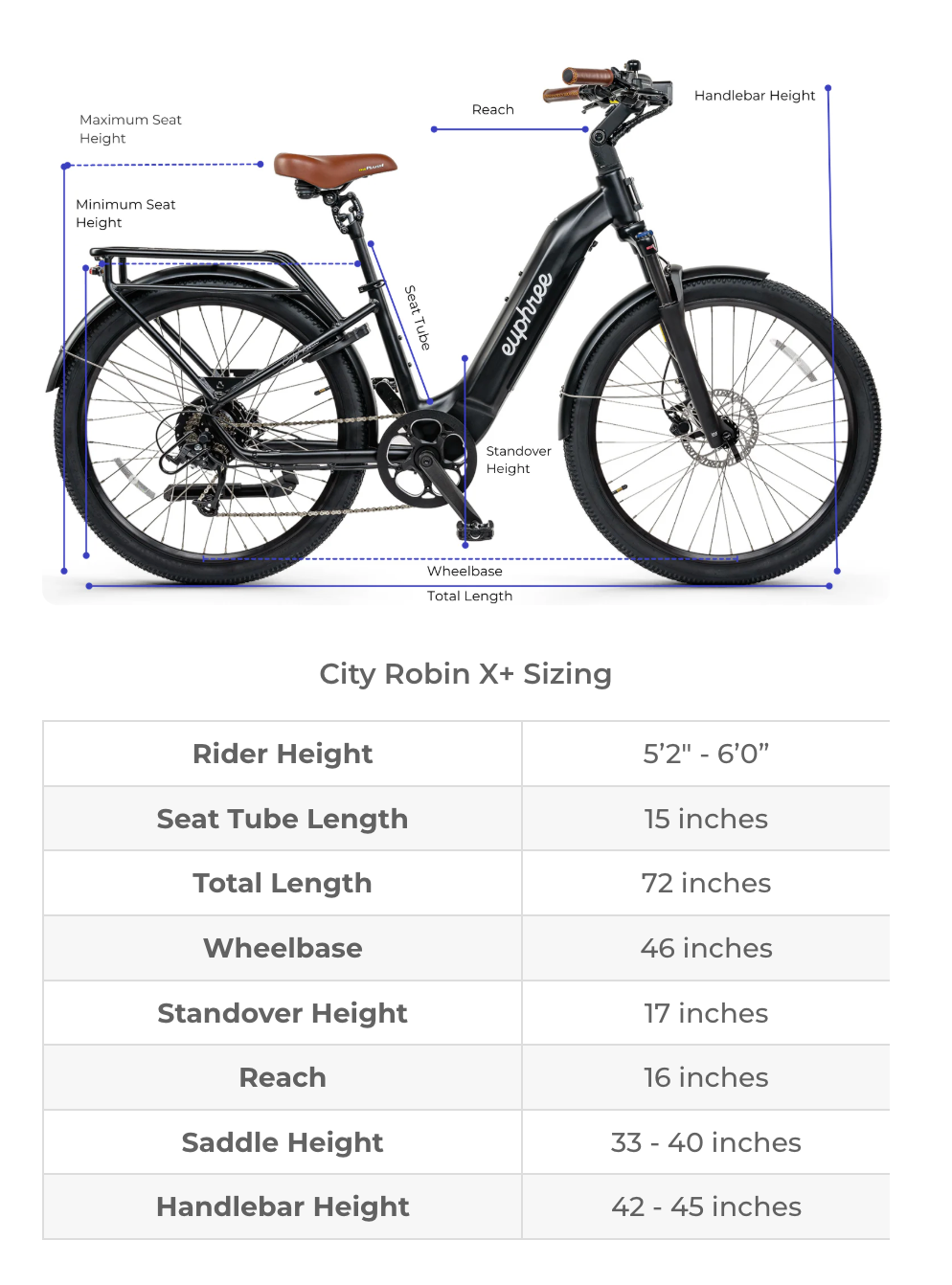
urban e-bike x.2/y.2 Euphree City Robin X+ Step Thru Electric BikeEuphree City Robin X+ Step Thru Electric Bike RANGE: Up to 60 Miles SPEED: 28 MPH SENSOR SYSTEM Torque Cadence FRAME: Aluminum 6061 Alloy, Step Thru MOTOR: 750W (1200 Peak) REAR RACK: Welded in frame BRAKES: Tektro E350 Hydraulic BRAKE LEVER: Adjustable W Motor Cut off BRAKE ROTOR: 180mm F R DERAILLEUR: Shimano Altus, 7 Speed FREEWHEEL: 7 Speed, 11 x 28T CHAIN: KMC Z7 Stainless Steel CRANKSET: Aluminum Alloy, 170mm CHAINRING: 50T, Double Sided PEDALS:

Euphree City Robin X+ Step Thru Electric Bike

RANGE: Up to 60 Miles

SPEED: 28 MPH

SENSOR SYSTEM Torque / Cadence

FRAME: Aluminum 6061 Alloy, Step Thru

MOTOR: 750W (1200 Peak)

REAR RACK: Welded in-frame

BRAKES: Tektro E350 Hydraulic

BRAKE LEVER:  Adjustable W/Motor Cut-off

BRAKE ROTOR: 180mm F/R

DERAILLEUR: Shimano Altus, 7-Speed

FREEWHEEL: 7-Speed, 11 x 28T

CHAIN: KMC Z7 Stainless Steel

CRANKSET: Aluminum Alloy, 170mm

CHAINRING: 50T, Double Sided

PEDALS: Aluminum with Rubber Grip

FRONT FORK: SR Suntour XCM 32 Boost, 100mm Travel, Preload and Lockout Adj

TIRES: Schwalbe Super Moto X 27.5 x 2.4"

RIM: Double Walled Aluminum

SPOKES: 13G F / 12G R

FRONT HUB: Thru Axle

BATTERY: 48V, 14Ah, 672Wh

CONTROLLER: Euphree custom 48V, 20 Amp in-frame

DISPLAY: Left Side, Color LCD

HEADLIGHT: 200 Lumens, Dual Beam LED

REAR LIGHT: Brake Light, Signal, 220 degree Visibility

CHARGER: 48V, 3 Amp, Fast Charger

THROTTLE: Thumb, Left side

USB PORT: Type C USB Charging

HANDLEBAR: Curved Aluminum Alloy, 700mm 

STEM: Adjustable Aluminum Alloy 90mm

PHONE MOUNT: SP Connect Compatible

SADDLE: Velo Wide Comfort

SEATPOST: SR Suntour NCX Suspension, 350mm

FENDERS: Aluminum, Full Coverage

KICKSTAND: Aluminum Alloy Adjust

WEIGHT: 64lbs

TOTAL WEIGHT CAPACITY: 350lbs

RIDER HEIGHT: 5'2" - 6'0"

FRONT RACK CAPACITY: 30lbs

REAR RACK CAPACITY: 100lbs

BATTERY CERTIFICATION: UL 2271

MOTOR CERTIFICATION: UL 2849

WARRANTY: 2 Year


Shipping Notes
  • Free Standard Shipping on $100+ Orders to the USA.
  • Except Preorder products are shipped in 48 hours.
  • Delivery to the USA:
  1. Standard Shipping : 3-10 business days
  • If time is of the essence, please consider selecting expedited delivery for faster service.
Exchange/Return Notes
  • We offer a 30-day return/exchange service after receiving.
  • Final sale items are not eligible for returns or exchanges.
  • To process your return/exchange, please contact us at [email protected]
  • Please click here for more details>>> Return & Exchange Policy
SKU: 1665944982

Discover Niche Categories That Outsell urban e-bike x.2/y.2

Top-Converting Item to Boost Your Average Order

4.5 ★★★★★
Based on 23 reviews
Sort
Highest Rating
Newest First
Oldest First
Product Reviews
U
UA
Fort Morgan, US
★★★★★ 5
A Good Reality Check on How AI Agents Actually Work in Enterprise Systems
Format: Paperback
Most AI books stop at prompts. This one goes deeper into how agent systems actually behave once you try to use them inside large workflows with memory, tools, permissions, automation, and multiple agents working together. That part felt very relevant for healthcare and enterprise environments. The book does a good job explaining why context engineering matters and how poor context handling creates hallucinations, inconsistent outputs, and degraded performance over time. Honestly, that is one of the biggest problems organizations underestimate right now. In healthcare workflows, context matters a lot: * prior interactions * business rules * auditability * escalation logic * safety constraints * tool permissions * workflow boundaries The sections on persistent memory, scoped context, subagents, and structured workflows connected strongly to that reality. I work in enterprise analytics, and while reading this book I kept thinking about use cases like: * pharmacy workflow automation * prior authorization support systems * coding assistants for healthcare engineering teams * AI copilots for operational analytics * agent-based escalation systems * claims and workflow orchestration The MCP chapters were also useful because they explain integration challenges clearly instead of treating tooling as magic. What made this book stand out for me was the balance between implementation and architecture. The author explains: * why long contexts fail * how context poisoning happens * why isolation matters * when parallel agents help * when they actually create more complexity That level of honesty is missing in many AI books right now. Another thing: the examples are not overly academic — The Next.js project setup, GitHub automation, Claude desktop workflows, memory systems, hooks, and subagents make the learning process feel practical and hands-on. One limitation: this book assumes technical background. Someone completely new to coding agents, LLMs, Git, or development workflows may struggle in the first few chapters. But for engineers, AI teams, enterprise architects, and technical leaders trying to understand where agentic coding is actually going, this book is worth reading. Especially for organizations trying to operationalize AI safely instead of just experimenting with chatbots.
WAS THIS REVIEW HELPFUL?YesReportShare
Reviewed in the United States on May 20, 2026
C
Christopher West
Lowell, US
★★★★★ 5
Great book! Practical and for developers that already use AI!
Format: Paperback
I purchased "Agentic Coding" by Claude Code due to my desire for an alternative to generic "Prompt Template" type resources related to AI-based development. This book accomplishes just that. As opposed to merely viewing Claude Code as a "magic box", the author has explained how to utilize it in conjunction with other actual development processes. The authors' emphasis on "context engineering" (i.e., structuring data/information; managing knowledge in a project; guiding an AI agent to produce consistent results vs. producing random/unknown results) represents the strongest component of the book. It should be noted that the book appears to be intended primarily for experienced developers with prior experience in software development and/or familiarity with AI-based development tools. Should you be familiar with Git, the command-line interface, and/or modern development processes, you may find this resource very helpful. Conversely, I did appreciate the fact that there were no novice-oriented descriptions provided throughout the book. The aspect of the book that I found most valuable, however, is the extremely pragmatic nature of the material contained within. The examples illustrated through developing/maintaining CLAUDE.md files; utilizing Claude Code in combination with GitHub Workflows; employing MCP Servers; and creating multi-agent or sub-agent workflows all seemed to reflect a clear focus on "real world usage" rather than theoretical constructs. In addition, each chapter builds upon previous chapters in such a manner as to provide a logical progression through which the reader can easily understand and ultimately implement the concepts learned. I also appreciated that the author included guidance on responsible utilization of the tool(s), as well as maintaining control over what changes are made by the agent. While numerous books regarding AI focus solely on what AI tools can accomplish, this book addresses both how to utilize these tools effectively in a real codebase, as well as responsibility and safety considerations. In summary, this is not a book for individuals completely inexperienced in either programming or generative AI. However, if you are currently experimenting with tools such as Claude, Cursor, GitHub Actions, or MCP, this is likely one of the more useful and practical books available on the subject. Recommended for software engineers seeking to transition from simply "prompting an AI" into establishing a repeatable/professional workflow process surrounding agentic coding.
WAS THIS REVIEW HELPFUL?YesReportShare
Reviewed in the United States on April 11, 2026
P
Paul Pollock
Houston, US
★★★★★ 4
⭐⭐⭐⭐ (so far)
Format: Paperback
I'm maybe a third of the way through this and already rethinking how I talk to coding agents. The reframe from "prompt engineering" to "context engineering" sounds like semantics until Marco walks you through why context poisoning, context clash, the Goldilocks zone for system prompts. That chapter alone reorganized something in my head. I keep going back to the line about garbage in, garbage out being the real reason agentic systems underperform. The hands-on stuff lands well too. Building the HookHub project from scratch, wiring up Playwright MCP, watching Claude generate a CLAUDE.md file and then not automatically loading a memory file you just created — that moment where you expect magic and get silence instead? That's the kind of honest teaching I appreciate. It made the "why" behind memory hierarchies click.
WAS THIS REVIEW HELPFUL?YesReportShare
Reviewed in the United States on May 12, 2026
J
Jonathan Reeves
Lexington, US
★★★★★ 5
Essential Reading for Developers Serious About Agentic AI Workflows with Claude Code
Format: Paperback
Agentic Coding with Claude Code is easily one of the most practical and forward-thinking AI development books I’ve read. Instead of treating Claude Code like a simple chatbot, this book shows how to turn it into a true agentic development platform capable of handling real-world engineering workflows. What I appreciated most was how actionable the content is. The explanations around slash commands, hooks, persistent memory files, and MCP servers are incredibly clear and immediately useful. The author does an excellent job balancing foundational concepts with hands-on implementation, making advanced topics like multi-agent orchestration and hierarchical delegation approachable for experienced developers. The chapters on MCP and context engineering were especially valuable. Most AI books stay at the surface level, but this one dives deep into structured context sharing, workflow automation, and scalable AI-assisted development practices that actually matter in production environments. I also liked that the book focuses heavily on maintainability and control. It doesn’t just show flashy demos—it teaches how to safely integrate AI agents into existing terminal and IDE workflows while enforcing coding standards and keeping projects organized. The examples using Claude Code with Next.js projects were practical and helped connect the concepts to real software engineering scenarios. The sections on subagents, planning workflows, and reusable automation patterns opened my eyes to entirely new ways of approaching AI pair programming and development productivity. If you are a developer, AI engineer, or technical lead looking to move beyond basic prompt engineering and build reliable, scalable AI-assisted workflows, this book is absolutely worth reading. Highly recommended for anyone serious about modern agentic coding and AI-powered software development.
WAS THIS REVIEW HELPFUL?YesReportShare
Reviewed in the United States on May 9, 2026
K
Kirk D. Borne
Houston, US
★★★★★ 5
Agentic Coding - all the right pieces in the right places
Format: Paperback
Before obtaining a copy of this book, I had not yet become familiar with Claude Code and didn't realize how robust AI Pair Programming is now. However, I did know and have rigorously promoted the absolute importance of Context (via Context Engineering) in any AI-prompted tasks, including coding. This book brings all of that together in an incredibly useful book (dare I say... a comprehensive toolkit and handbook) for AI-prompted coding in these multiple modalities: IDE, command-line, and pair programming. It covers memory management, agents, subagents, multiple-agent systems, context-sharing, orchestration, enforcement of coding standards, code maintenance, and more - for executing AI-assisted development with confidence. I highly recommend this book. Disclosure: the publisher provided me with a free review copy of the book.
WAS THIS REVIEW HELPFUL?YesReportShare
Reviewed in the United States on May 19, 2026

recommand products