SKU: 30253246405
bee plant seeds

bee plant seeds Flawn Seed Kits Bee Lawn Seed Mix

Sale price$25.40 Regular price$28.22
Save 10%

Pay in installments of $7.05 with ShopPay, AfterPay and Klarna

Shipping Estimate
USA
  • USA
  • CAN

Ships within 48 hours · Estimated delivery Sep 3 - Sep 8

Promo Codes Available:

For Your Every Summer RSVP, with Code: SUMMER15

Description

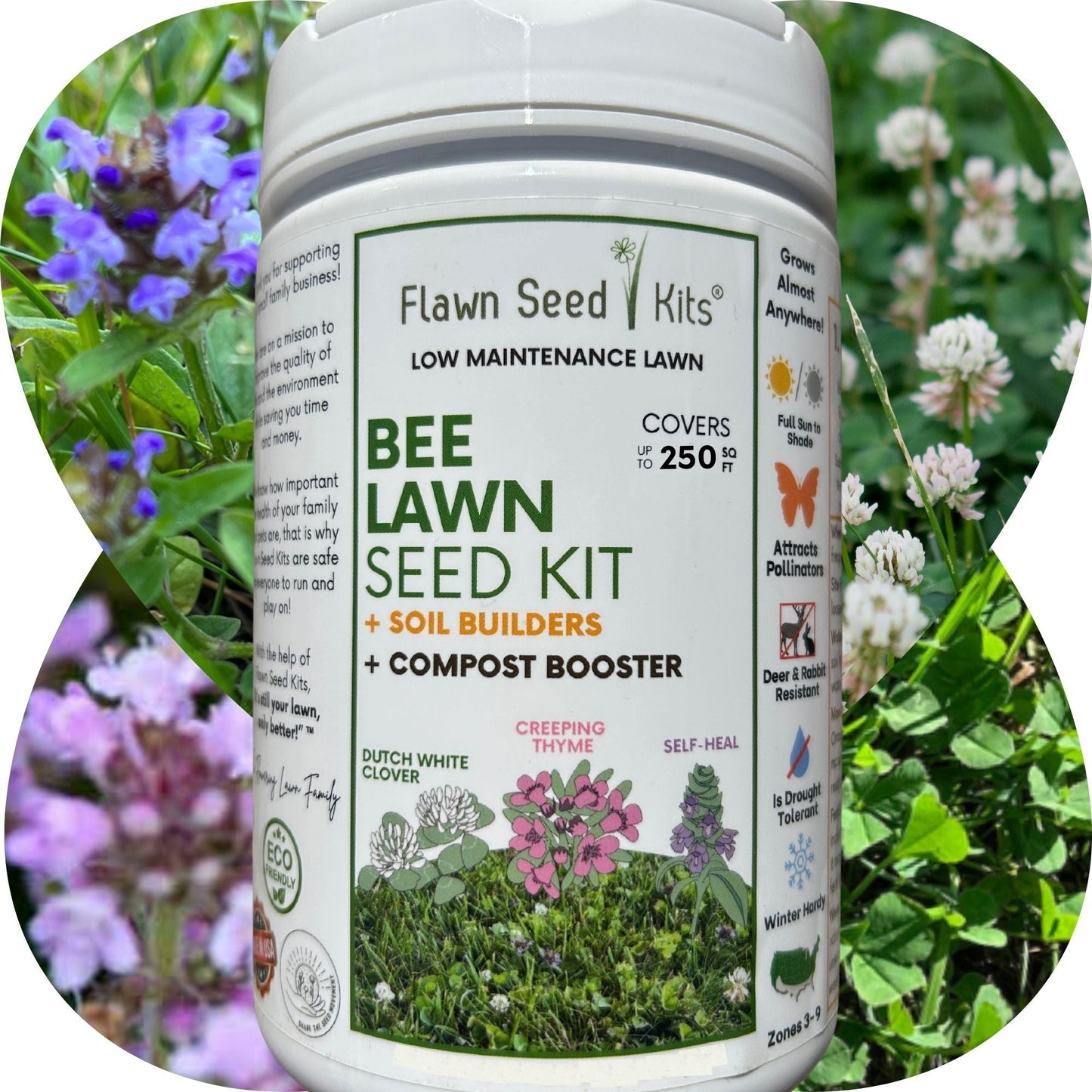
bee plant seeds Flawn Seed Kits Bee Lawn Seed MixNon GMO Flowering Lawn Bee Mix Seeds (Organic Coated Dutch White Clover, Self Heal, and Creeping Thyme) + Soil Builders + Compost Booster in an Easy to Spread Shaker. Dutch White Clover Trifolium repens: Produces white round blooms from late spring into fall 2. 5 4" unless allowed to grow taller if not mowed. Vital nectar source for pollinators including the monarch butterfly. Grows better in shade than grass and tolerates foot traffic and pets better

Non-GMO Flowering Lawn Bee Mix Seeds (Organic Coated Dutch White Clover, Self-Heal, and Creeping Thyme) + Soil Builders + Compost Booster in an Easy to Spread Shaker.

Dutch White Clover Trifolium repens:
  • Produces white round blooms from late spring into fall 2.5-4" unless allowed to grow taller if not mowed.
  • Vital nectar source for pollinators including the monarch butterfly.
  • Grows better in shade than grass and tolerates foot traffic and pets better than grass making it a great option for families with kids and pets.
  • Has above ground roots (runners/stolons) that will choke out weeds like dandelions over time as it fills in. Apply at higher rates for quicker effect.
  • Fixes atmospheric nitrogen into the ground, reducing the need for fertilizer once established.

Self-Heal Prunella vulgaris:

  • Produces many light purple blooms in early to mid-summer about 2-6" tall.
  • Beneficial nectar source for a variety of pollinators.
  • Grows well in part shade to full sun in sand, clay, or loam soils.

Creeping Thyme Thymus serpyllum:

  • Produces small pink blooms in mid to late summer about 2-4" tall.
  • Beneficial nectar source for a variety of pollinators.
  • Grows well in full sun to part shade in sand or loam soils.

Here at Flowering Lawn, we are on a mission to improve the quality of life and the environment, starting with lawns! By making the easy switch to Flawn Seed, you will experience many benefits like reduced mowing, fertilizing & watering - saving you time and money. Flowering lawns support beneficial pollinating insects. Flowering lawns also capture and store more carbon making your property greener. Our Flowering Lawn Kit seeds are easy to establish and can be seeded during any season! If you seed your lawn in late fall or winter, wait until the ground is frozen or sprinkle over fresh snow. If seeding in spring, wait until the ground thaws and soil temperatures are around 55 degrees. Avoid seeding before hot and dry periods to keep soil from completely drying out during germination. Our Flawn Seed Flowering Lawn Kit seeds is designed to be over-seeded into existing grass lawn areas to create about half grass and half flowers. If you are starting with bare soil, add 2-4 lbs of grass seed per 1,000 sqft. If you desire to have only clover and no grass, increase your seeding rates. Caring for a Flowering Lawn - Continue to mow your lawn regularly for the first season to keep the grass from overtaking the seedlings. Regular mowing at 2-4” is necessary to maintain smaller leaves. This will result in fewer flower blooms. Without regular mowing, the clovers will produce larger leaves and produce more flower blooms. Watering through hot and dry periods may also be necessary. Packaging is recyclable.

How to seed your Flawn:

Seed in spring, late summer to early fall. Spread over existing grass after mowing to .5" and raking to loosen soil (full instructions on package). Water lightly but frequently after seeding so soil and seedlings don't dry out. Continue to mow for one year at 2-3" until flowers are fully established.

Maintaining a Flawn:

- Mow at 2-3" for the first year. Once all varieties are established, it is up to you how you keep your Flawn. Mowing higher and less often will promote more flowers and have a more wild look. Mowing shorter and more often will have a more traditional lawn look with little to no flowers.

- Do not use pesticide weed or insect killers. Hand weed if necessary or desired.

- White clover fixes atmospheric nitrogen into the ground, so fertilizer needs are minimal, if at all, once established. Applying an organic starter fertilizer is recommended, especially if seeding grass seed in addition to the Flawn Seed Kit.

- If you are seeding a new lawn or renovating a bare soil area, we recommend using a blend of fine fescue seed at 2-4 lbs/1,000 sq. ft.

Not seeing the information you're looking for? Please email us


Shipping Notes
  • Free Standard Shipping on $100+ Orders to the USA.
  • Except Preorder products are shipped in 48 hours.
  • Delivery to the USA:
  1. Standard Shipping : 3-10 business days
  • If time is of the essence, please consider selecting expedited delivery for faster service.
Exchange/Return Notes
  • We offer a 30-day return/exchange service after receiving.
  • Final sale items are not eligible for returns or exchanges.
  • To process your return/exchange, please contact us at [email protected]
  • Please click here for more details>>> Return & Exchange Policy
SKU: 30253246405

Discover Niche Categories That Outsell bee plant seeds

Top-Converting Item to Boost Your Average Order

4.2 ★★★★★
Based on 5 reviews
Sort
Highest Rating
Newest First
Oldest First
Product Reviews
D
Verified Purchase
Diana D
Battle Creek, US
★★★★★ 5
Very well written and easy to read.
Format: Paperback
Few people are as qualified as Philip Meyer to write a book on storytelling for lawyers. With a background as a trial lawyer, he has plenty of practical, real-life experience in the courtroom. His approach is not that of an academic giving purely theoretical advice, but that of a seasoned lawyer who knows the ins and outs of the legal profession. His experience as a professor (of both law and writing) has honed his ability to effectively communicate his ideas to a broad audience. Not only is this book helpful for the practicing lawyer, it is also useful and not too complex for the legal neophyte or casual reader. This book breaks storytelling (narrative) down to its core components and analyzes them one by one. In the process of analyzing each part of a story, Philip Meyer skillfully explores each component with a non-legal example (e.g. movies, books, etc.) before applying it to a legal example (e.g. courtroom proceedings, appellate briefs, closing arguments, etc.) By first analyzing each part of a story (i.e. plot, setting, etc.) from a well-known story that resonates with the reader, he sets a strong foundation before transitioning to a legal story, thus making it easy for the reader to identify and better understand each part of the legal story. I highly recommend this book to anyone remotely interested in storytelling and persuasion as they relate to the legal profession.
WAS THIS REVIEW HELPFUL?YesReportShare
Reviewed in the United States on November 22, 2016
J
Verified Purchase
JR
Port Orchard, US
★★★★★ 4
Must Read for Novice Litigators
Format: Paperback
This book is a great starting point for developing the skill of storytelling for lawyers as was intended by the author. The author gives you the basics for developing the plot, characters, style, setting, and narrative for your trial with excellent examples. The author is a law professor and the book seems geared for the law student or novice lawyers getting into litigation. I only gave the book 4 out of 5 stars because of a couple of minor problems. However, the chapter on narrative needs further exposition and appears to be written in rushed manner. In addition, the physical binding of the book is of poor quality requiring me to glue the cover back on. Finally, the author missed the point that the lawyer's job is to look at his case as a giant puzzle to be solved and then explained as a story.It is not enough to understand your case but equally imperative that you communicate your case which is best done through the storytelling technique. This is a must read for lawyers getting up to speed on litigation. For further exposition on legal storytelling for lawyers after reading Meyer's book on Storytelling for Lawyers, I recommend the following: ABA webinar available with an internet search for "Storytelling for Lawyers"
WAS THIS REVIEW HELPFUL?YesReportShare
Reviewed in the United States on July 25, 2018
T
Verified Purchase
Tahoeman
Waukegan, US
★★★★★ 5
Much needed guide to narration in law practice
Format: Paperback
Meyer’s “Storytelling for Lawyers” is an important contribution to the literature on narration in law practice. We know that successful courtroom rhetoric can best be viewed through the prism of storytelling. But the literature does not contain a practical and detailed analysis of the elements of narration as used in law practice—that is, plotting, characterization, point of view, style, and settings in place and time. Meyer’s book fills this gap. It is blessedly free of jargon and full of practical examples of good legal storytelling. But the importance of this book goes well beyond providing practical assistance to litigators. It serves as a much-needed introduction to the principles of narration for teachers and students of literature, creative writing, and popular culture, who have lacked a readable introductory guide to the elements of successful storytelling.
WAS THIS REVIEW HELPFUL?YesReportShare
Reviewed in the United States on February 10, 2014
D
Verified Purchase
David R. Papke
Waukegan, US
★★★★★ 5
Recommended for All Lawyers
Format: Paperback
Meyer proves his initial point that much of what lawyers do is storytelling, and he achieves his goal of providing a primer on narrative theory for lawyer-storytellers. The book is sophisticated but written in an engaging way using non-technical language. Examples from legal and literary works abound, and they range from courtroom arguments and appellate briefs on the one hand to an essay by Joan Didion and Vonnegut's "Slaughterhouse Five" on the other. Meyer's favorite stories are found in Hollywood movies, and although he seems unaware of the accomplishment,Meyer provides fresh interpretations of such movies as "HIgh Noon" and"Jaws." I strongly recommend "Storytelling for Lawyers" for all law students, lawyers, and judges.
WAS THIS REVIEW HELPFUL?YesReportShare
Reviewed in the United States on May 7, 2014
D
Verified Purchase
DoubtfulReader
Belleville, US
★★★★★ 3
Notes on Legal Style by a Law Professor and Experienced Lawyer.
Format: Kindle
BOOK REVIEW: MEYER, Philip N., Storytelling for Lawyers ISBN: 978-0-19-5396638 Read June, 13th-27th, 2017. This book discusses storytelling tools by presenting a series of examples of good storytelling, both in legal settings and in literary works and movies. If theoretical explanations are sometimes a bit dry, the frequent quoting of practical examples conveys fluidity and speed to the book. After an introduction presenting lawyers as storytellers, it deals with the roles played in storytelling by Plots (chapters 2 and 3); Character (4 and 5); Voice, Perspective, Details and Images, and Rhytm and Speed (which relate to Scene and Summary) (chapter 6); Place or Story Environment (chapter 7) and Narrative Time. Focusing maybe too narrowly on legal storytelling before American juries, plot is almost equated with melodrama. Films like Jaws and High Noon are extensively discussed, as Gerry Spence’s Closing Argument on Behalf of Karen Silkwood. The chapters on character offer interesting insights on character classification (“round” characters, with psychological depth, prone to suffer transformation as the story evolves, vs. “flat” ones), while discussing the tools for telling how a character is, as opposed to simply showing the psychological nature of each character’s character through dialogue or the actions the character performs. Examples include Tobias Wolff’s This Boy’s Life and Jeremiah Donovan’s Closing Arguments on Behalf of Louis Failla, in a 13-week trial the Author could scrupulously attend in person. Discussions on Voice, Perspective, Details and Images, Scene and Summary, criticize the basic assumptions of the neutrality of lawyers’ voices, exemplifies how to manage details to suggest ideas and emotions, draw on the distinction between showing and telling, and offers interesting insights into the narrative theory’s concept of stretch (the slowing of the narrative rhythm in relation to the narrated story’s). Environment depiction storytelling tools deals with Joan Didion’s The White Album and the Judicial Opinion in a Rape Case, quoting also from W. G. Sebald’s The Emigrants and the Petition Briefs in Reck v. Ragen and Miranda v. Arizona. Further examples are Kathryn Harrison’s While They Slept and the Petitioner’s Brief in Eddings v. Oklahoma. Finally, the chapter on Narrative Time draws on Kurt Vonnegut’s Slaughterhouse Five and explores time, rhythm or speed, discussing more deeply stretch and the relation of time of the narrative itself with the time of the facts dealt with in the narrative. Chronology is discussed and criticized; Analepsis or Flashback is didactically explained and exemplified, both in general storytelling theory and in its legal use; the same holds for Prolepsis (Flash-forward) and Ellipsis (the intentional omission of a part of the narrative, often with the purpose of emphasizing the omitted event. Pacing and Rhythm are discussed in more lenght, with the caveat - repeated somewhat throughout the book - that legal stories are often left unfinished by the lawyer, in order to allow the jurors or judges fill the end with their decision. The Author remarks his purpose was to suggest possible tools and ways of dealing with problems which arise in legal storytelling, and he delivers what he promises.
WAS THIS REVIEW HELPFUL?YesReportShare
Reviewed in the United States on June 27, 2017

recommand products